If you work with SEO data programmatically, Semrush's API pricing is hard to ignore. At enterprise scale, costs climb fast. The good news is that the market for SEMrush API alternatives has matured considerably. Five tools stand out: SE Ranking, Majestic, Ahrefs, Serpstat, and DataForSEO. Each one is a credible alternative to SEMrush API for different workflow types — from backlink audits to real-time SERP monitoring.
This article gives you a structured, side-by-side breakdown so you can match the right API to your actual data needs. No filler.
TL;DR: What Is the Best Semrush API Alternative?
SE Ranking API is the best SEMrush API alternative for most SEO teams. It covers AI visibility, keyword research, backlink analysis, rank tracking, site audits, and competitor intelligence through a single REST API. Pricing sits in the mid-market range, documentation is well-maintained, and data spans 188+ countries. For teams that need full-stack SEO data without Semrush pricing, SE Ranking hits the right balance of breadth, accuracy, and cost.
Comparison Table: Semrush API Alternatives at a Glance
| Tool | Data Types | Keyword DB | Backlink Data | SERP Data | Pricing Model | Best For |
| SE Ranking API | Keywords, backlinks, rank tracking, site audit | 5.4B+ keywords | Yes | Yes | Subscription + API units | Full-stack SEO teams |
| Majestic API | Backlinks, Trust Flow, Citation Flow | None | Yes (deepest) | No | Subscription tiers | Link-focused workflows |
| Ahrefs API | Keywords, backlinks, content, SERP | 20B+ keywords | Yes | Yes | Pay-per-row / Enterprise | Data-heavy agencies |
| Serpstat API | Keywords, backlinks, site audit, SERP, clustering | 7B+ keywords | Yes | Yes | Subscription tiers | Mid-size agencies |
| DataForSEO API | SERP, keywords, backlinks, on-page | Large (SERP-first) | Yes | Yes (live) | Pay-as-you-go | Developers, SaaS builders |
SE Ranking API
SE Ranking is consistently ranked among the best SEMrush API alternatives because it offers the most complete set of endpoints at a price point that mid-size agencies and in-house teams can actually work with.
What Are the Key Features of SE Ranking API?
- AI visibility tracking across Gemini, ChatGPT, Perplexity, Google AI Mode, and Google AI Overviews
- Keyword research endpoint covering 5.4B+ keywords across 188 regions with search volume, CPC, keyword difficulty, and trend data
- Backlink checker returning referring domains, anchor text, link type, and first/last seen dates
- Rank tracking API with configurable update frequency (daily or weekly) and SERP feature tracking
- Website audit API delivering technical SEO issues in structured JSON — crawl errors, page speed signals, duplicate content flags, and more
- Competitor analysis endpoints covering estimated organic traffic, traffic cost, and top keywords per domain
- Keyword gap and backlink gap analysis for comparing multiple domains simultaneously
- White-label ready JSON output suited for agency reporting pipelines
What Are the Pros and Cons of SE Ranking API?
Pros:
- Broad endpoint coverage reduces the need for multiple third-party data sources
- Mid-range pricing compared to Ahrefs or Semrush at comparable data volumes
- REST API with clean, consistent documentation and active changelog
- Strong local and international data coverage, including non-English markets
- Regular endpoint additions based on user feedback
- AI visibility tracking across Gemini, ChatGPT, Perplexity, Google AI Mode, and Google AI Overviews
Cons:
- Backlink index is smaller than Ahrefs or Majestic for deep link audits
- Rate limits on lower plans can restrict high-frequency batch queries
What Is the Pricing of SE Ranking API?
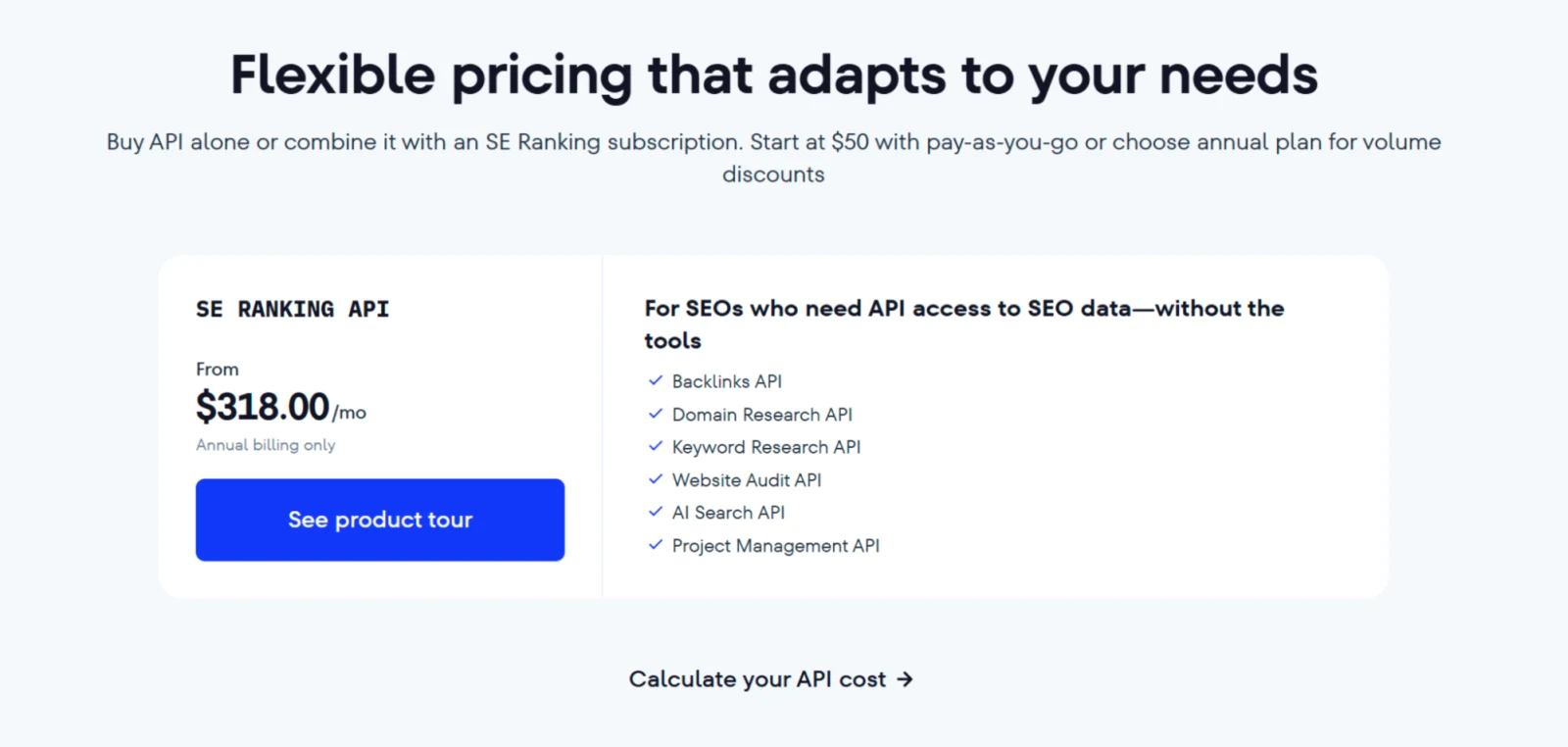
SE Ranking provides two distinct APIs: the Data API, which uses a pay‑as‑you‑go credit system for raw data retrieval, and the Project API, which uses your subscription limits for project management functionality.
- Core Plan: 25,000 credits/month; subscription starts at $103.20/mo billed annually.
- Growth Plan: Includes 100,000 Data API credits/month; subscription starts at $223.20/mo billed annually.
- Standalone Availability: You can purchase access without buying the normal SaaS dashboard. The annual billing plan starts at $318.00 per month.
- Yearly Credit Volume: The baseline $318 package provides 24 million credits for the entire year. You pay $3,816.00 upfront.
- Endpoint Specific Costs: SERP records cost 10 credits each. A single domain overview query deducts 100 credits instantly. Backlink queries charge exactly 1 credit for every single row returned in the payload.
- Machine Learning Premium: Any request interacting with the LLM prompt endpoints costs a massive 2,000 credits per single call.
- Free Trial Access: New developer accounts receive 100,000 free credits for 14 days.
Check SE Ranking's current pricing page for up-to-date unit allocations — they adjust these periodically.
Best Use Cases
- Automated SEO dashboards pulling rank, backlink, and audit data into one reporting layer
- White-label client reports in agency platforms
- Scheduled site audits via API triggering technical SEO alerts
- Competitor traffic and keyword monitoring at multi-client scale
Majestic API
Majestic is a focused SEMrush API competitor for teams whose workflows are primarily backlink-driven. It does one thing exceptionally well: link data.
What Are the Key Features of Majestic API?
- Trust Flow and Citation Flow — two widely accepted link quality metrics used across the SEO industry
- Fresh Index (updated frequently) and Historic Index (one of the largest crawled link datasets available)
- Backlink profile endpoint covering anchor text distribution, link types, and referring IP data
- Bulk URL checker for processing large domain or page lists in a single request
- Clique Hunter for identifying sites linking to multiple competitors simultaneously — useful for link prospecting
- Neighbourhood Checker for IP-level and hosting environment analysis
What Are the Pros and Cons of Majestic API?
Pros:
- Deepest backlink dataset in this comparison, especially in the Historic Index
- Trust Flow and Citation Flow are still the most-cited link quality signals among link builders
- Predictable subscription pricing with no per-row billing surprises
- API reliability and uptime are strong across the index
- Bulk operations work well for high-volume link prospecting jobs
Cons:
- No keyword research, rank tracking, or SERP data at all
- Not a full-stack SEO API — supplementary tools are required for keyword and content workflows
- UI is dated, which affects the developer experience in the dashboard
- Smaller data coverage for non-backlink SEO tasks means it cannot replace alternatives to SEMrush API that cover the full stack
What Is the Pricing of Majestic API?
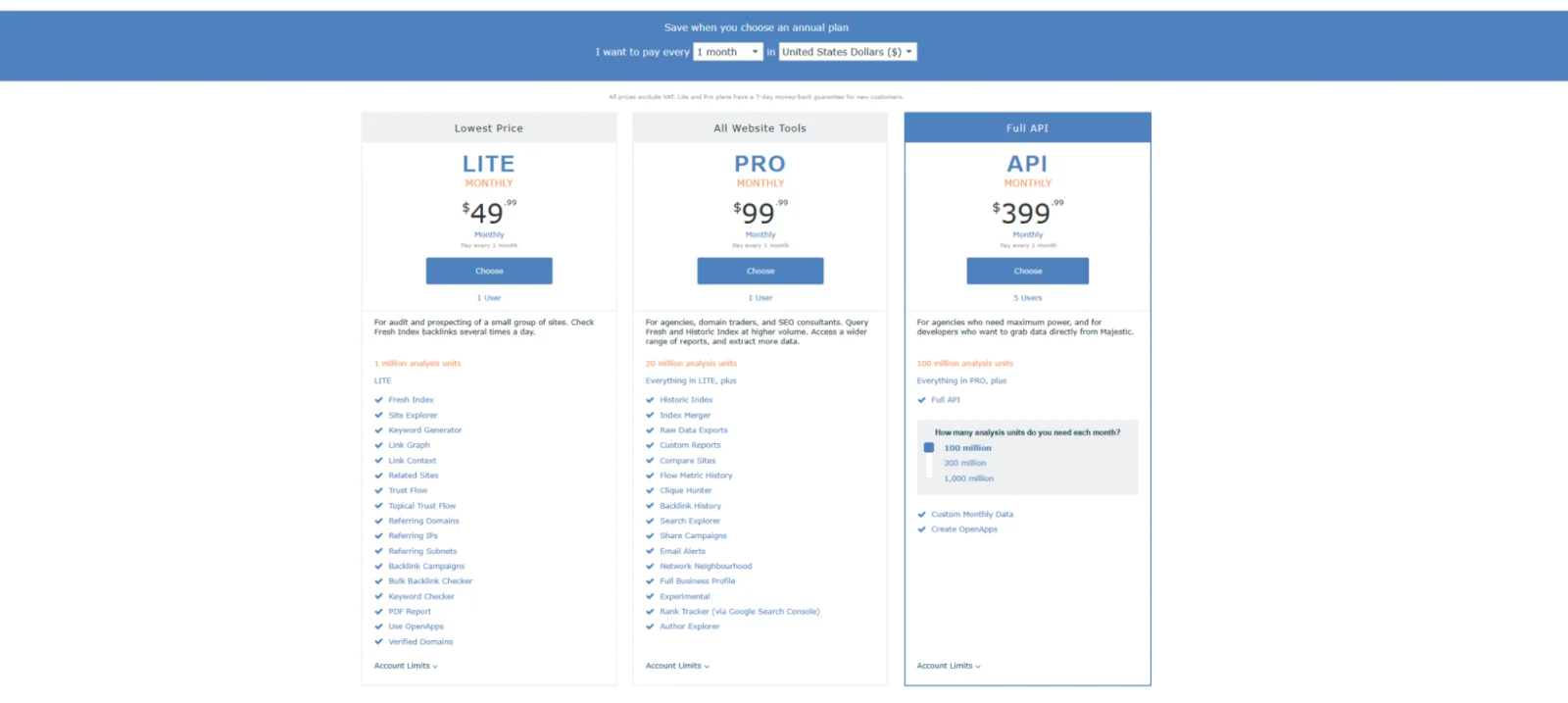
- Lite plan: $49.99/month — includes API access with 1 million analysis units
- Pro plan: $99.99/month — 20 million analysis units, bulk operations unlocked
- API Pro: $399.99/month — full API access with higher rate limits for production use
- Pay-as-you-go API units available for one-off or irregular projects
Majestic charges per API unit, and bulk operations consume more units. Map your expected query volume to unit costs before committing.
Best Use Cases
- Link prospecting tools that surface Trust Flow and Citation Flow at scale
- Disavow file generation pipelines using bulk backlink exports
- SaaS products selling backlink analysis as a core feature
- Domain acquisition due diligence requiring historical link profile data
Ahrefs API
Ahrefs runs one of the largest keyword and backlink indexes in SEO. It is the most data-rich of all SEMrush API competitors reviewed here, and pricing reflects that.
What Are the Key Features of Ahrefs API?
- Access to 20B+ keywords across 170+ countries — the largest keyword database among alternatives to SEMrush API in this list
- Backlink data with live index updates and historical snapshots going back years
- SERP overview endpoint with organic positions, estimated traffic, and top-ranking pages per keyword
- Content Explorer API for surfacing high-performing pages by topic or keyword
- Domain Rating and URL Rating proprietary metrics
- Batch analysis endpoint for processing large lists of domains or URLs efficiently
What Are the Pros and Cons of Ahrefs API?
Pros:
- Largest keyword and backlink index in this comparison by a significant margin
- Clickstream-based traffic estimates are among the most accurate available
- API v3 has a well-structured schema and consistent responses across endpoints
- Active developer community and thorough technical documentation
- Covers keyword research, link analysis, content, and SERP in one API
Cons:
- Enterprise-level pricing is out of reach for smaller teams
- Pay-per-row billing can compound quickly on high-volume queries — cost modeling is essential
- No free-tier API access; sandbox access is limited
- Some endpoints require higher-tier plan activation
What Is the Pricing of Ahrefs API?
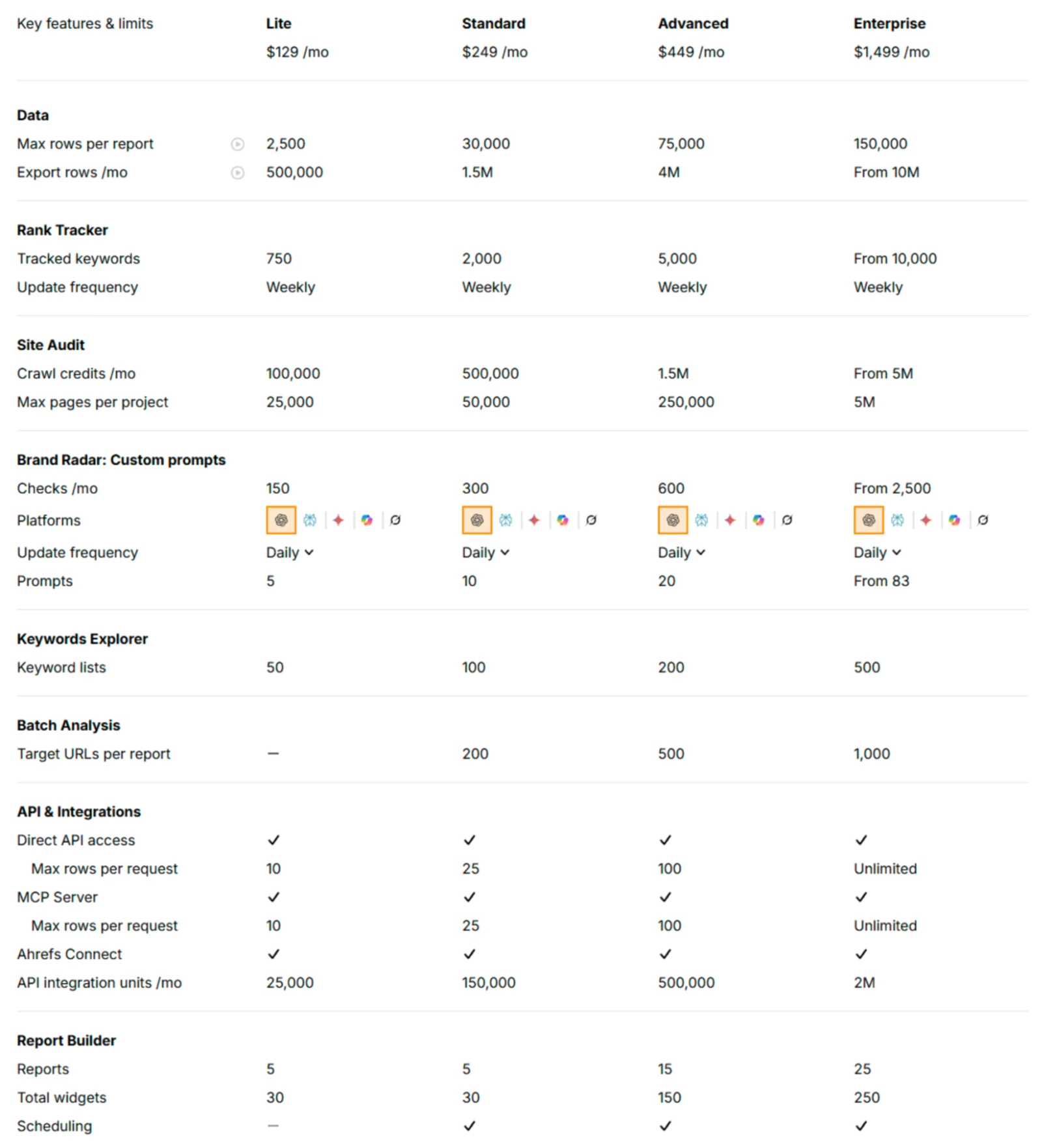
Ahrefs API v3 uses row-based billing. You pay per row of data returned, not a flat subscription fee. As of 2026:
- API access requires an Enterprise subscription
- Monthly costs start in the hundreds of dollars and scale with data volume
- Ahrefs uses a units/credits system for API consumption tracking
Row-based billing is efficient for moderate, predictable queries. For heavy or exploratory use, costs escalate fast — model this before building production pipelines.
Best Use Cases
- Large agencies and enterprise teams that need the deepest available keyword and link data
- SaaS SEO products requiring reliable, high-accuracy keyword difficulty scores
- Content gap analysis tools comparing multiple domains at scale
- Competitive intelligence platforms where data accuracy is a product requirement
Serpstat API
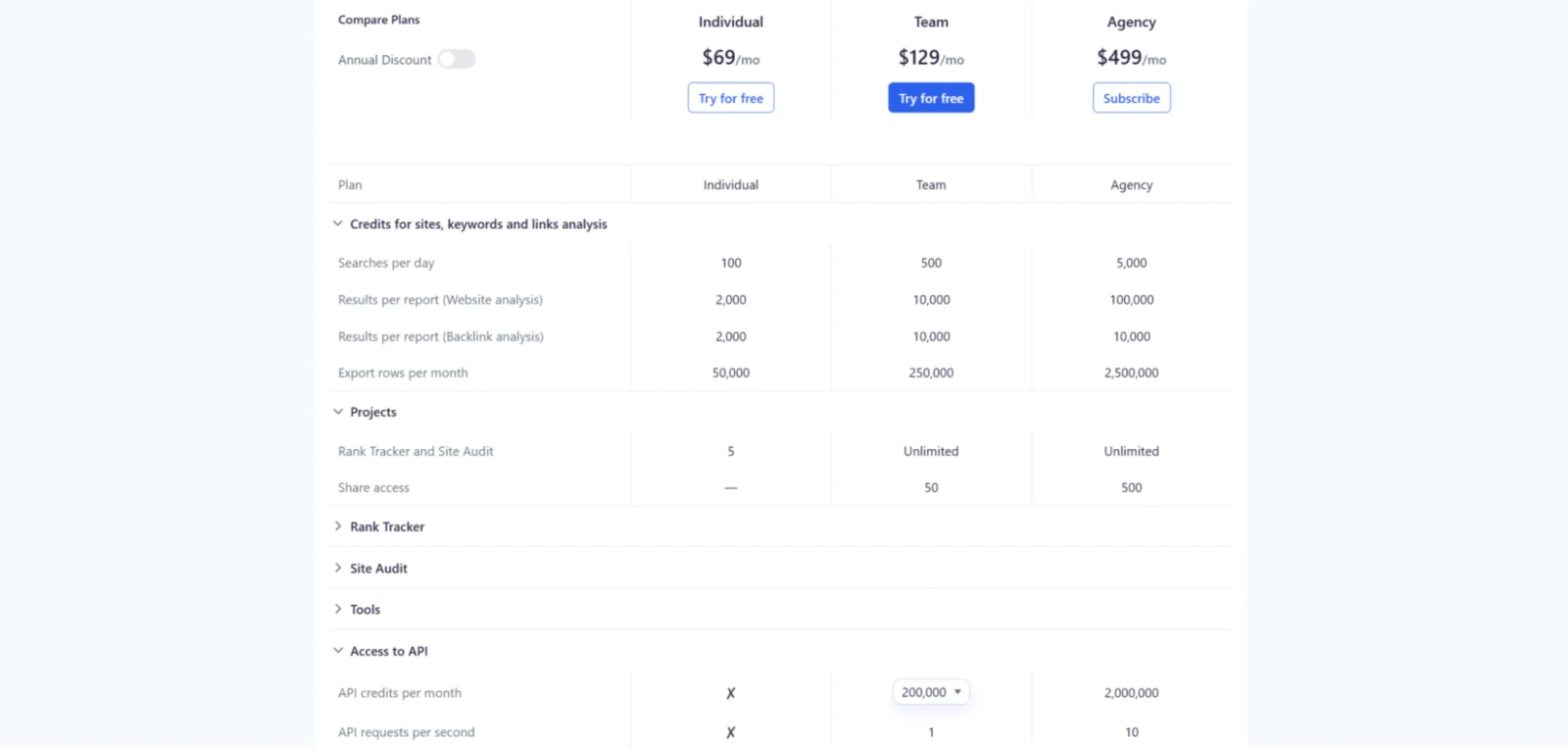
Serpstat occupies a solid mid-market position among SEMrush API alternatives, with one feature that stands out: native keyword clustering.
What Are the Key Features of Serpstat API?
- Keyword research data across 230+ regions with search volume, CPC, competition, and keyword difficulty
- Backlink analysis with domain rating, referring domains, and anchor text breakdown
- Site audit endpoint returning technical issues in structured format
- SERP analysis with top-10 results per keyword, traffic estimates, and CPC data
- Rank tracking API with position history across desktop and mobile
- Keyword clustering endpoint — a notable differentiator among SEMrush API competitors that generally lack this natively
What Are the Pros and Cons of Serpstat API?
Pros:
- Keyword clustering is built into the API, rare among the best SEMrush API competitors at this price tier
- Wide geographic coverage at a lower price than Ahrefs
- Single API covers keywords, backlinks, rank tracking, and site audits
- Clean REST API with JSON responses and straightforward authentication
- Reasonable rate limits for mid-volume agency use
Cons:
- Data freshness lags behind Ahrefs and Semrush in some markets
- Backlink index is smaller than Majestic or Ahrefs for dedicated link work
- Data coverage outside English-language markets can be inconsistent across endpoints
- Customer support response times on lower-tier plans have been reported as slow
What Is the Pricing of Serpstat API?
Serpstat offers tiered monthly subscriptions with API access included at each level:
- Individual — $69/mo: 5 projects, 100 searches per day, 10,000 keyword position checks, 30,000 pages to audit, 50,000 export rows, core features included (Keyword Research, Site Analysis, Rank Tracker, Site Audit, Backlink Analysis)
- Team — $129/mo: unlimited projects, 500 searches per day, 50,000 keyword position checks, 150,000 pages to audit, 250,000 export rows, extended features included (API, ChatGPT and Claude integration MCP, AI Overview Brand Opportunities Report, share access, AI tools, batch analysis, scheduled reports, billing by invoice)
- Agency — $499/mo: unlimited projects, 5,000 searches per day, 500,000 keyword position checks, 1,500,000 pages to audit per month, 2,500,000 export rows per month, all features included (white label reports, data engineer consultation, phone support)
API credits reset monthly and do not roll over on standard plans.
Best Use Cases
- Mid-size agencies needing keyword, backlink, and audit data from a single API
- Automated keyword clustering pipelines supporting content production at scale
- Regional SEO monitoring across European or CIS markets where Serpstat has strong data
- Rank tracking automation for clients spread across multiple countries
DataForSEO API
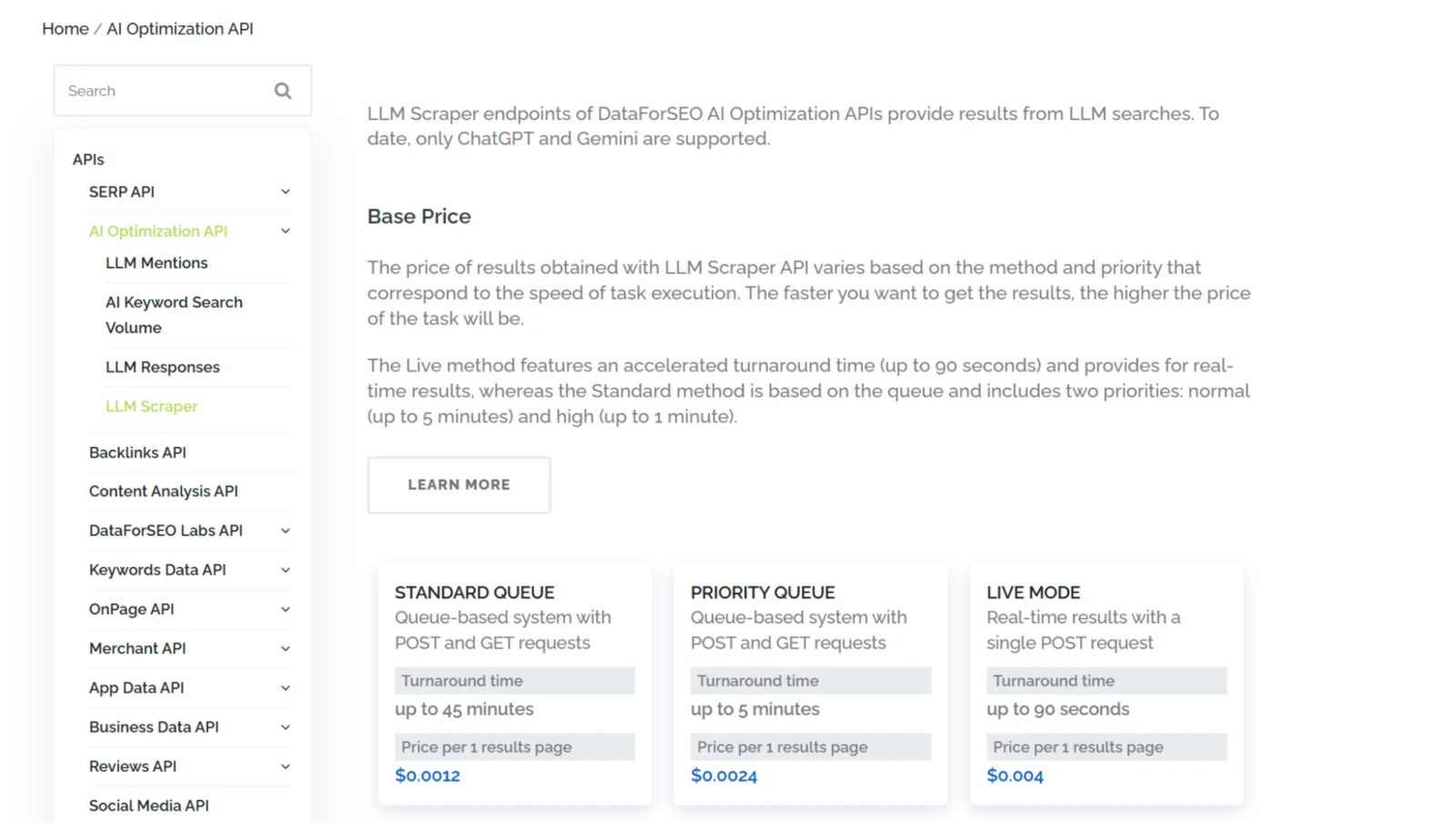
DataForSEO is not a traditional SEO platform with a retrofitted API. It is an API-first data company. That distinction matters when you are building production SEO products.
What Are the Key Features of DataForSEO API?
- Real-time SERP data across 100,000+ locations and 50+ search engines — the widest SERP coverage among best SEMrush API alternatives reviewed here
- Keywords Data API with search volume, CPC, competition metrics, and trend data
- Backlink API drawing from multiple index sources
- On-page analysis endpoint covering page-level technical signals
- Business data API pulling listings from Google Maps and similar sources
- Sandbox mode allowing full endpoint testing at zero cost before any production billing
What Are the Pros and Cons of DataForSEO API?
Pros:
- Pay-as-you-go pricing with no monthly minimum — pay only for what you use
- Best SERP data coverage by location and search engine in this comparison
- Sandbox environment makes development genuinely cost-free
- Built exclusively for developers — request/response structures are clean and predictable
- Async bulk requests handle large jobs efficiently without blocking
Cons:
- No proprietary metrics like Domain Rating or Trust Flow — raw data only
- Building a complete SEO product requires more engineering investment than plug-and-play tools
- Backlink data accuracy depends on the quality of underlying index sources
- No marketing or keyword tool UI — this is developer infrastructure, not an SEO platform
What Is the Pricing of DataForSEO API?
DataForSEO uses strict pay-as-you-go pricing with no subscription tiers. You deposit credits and spend them per API call. Indicative rates as of 2026:
- SERP API: from $0.0006 per task at volume
- Keywords Data API: from $0.0005 per record
- Backlinks API: variable by endpoint type
- On-Page API: priced per page crawled
This is the most economical model among alternatives to SEMrush API for developers running variable query volumes or early-stage product builds. No monthly commitment means no sunk cost during slow periods.
Best Use Cases
- SaaS developers building SEO tools from scratch who need raw, reliable data at scale
- Agencies running live SERP monitoring across thousands of geographic locations
- Rank tracking product builders needing real-time SERP snapshots
- Teams running large-scale A/B SEO experiments requiring live search result data
How to Choose an SEO API?
Picking among SEMrush API competitors is not a feature comparison exercise. It is a workflow-matching exercise. Here is a practical framework.
- List your required data types before looking at any tool. Backlink-heavy workflows — link audits, prospecting, disavow automation — belong on Majestic or Ahrefs. Keyword research and rank tracking belong on SE Ranking, Serpstat, or DataForSEO. If you need everything in one API, SE Ranking and Ahrefs are the shortest paths to a complete stack.
- Model costs against actual query volume. Flat subscriptions (SE Ranking, Serpstat, Majestic) suit teams with consistent, predictable monthly usage. Pay-per-use models (DataForSEO, Ahrefs) suit variable workloads or product builders in early stages. Run cost models for your expected P50 and P95 query volumes before committing to either model.
- Check data coverage in your target markets. Strong US and UK data does not guarantee quality in Eastern European, Southeast Asian, or Latin American markets. Serpstat has solid CIS region coverage. DataForSEO has 100,000+ SERP locations. Always test the specific regions you need before building production workflows on top of any best SEMrush API competitor.
- Evaluate documentation quality and sandbox access. Good API documentation cuts engineering time significantly. DataForSEO provides a sandbox. Ahrefs has a limited test environment. Poor documentation is a maintenance burden that compounds over time — factor this into your evaluation as seriously as price.
- Assess SLA and uptime requirements. For production SEO products, API downtime is a direct business impact. SE Ranking and Ahrefs both offer enterprise SLAs at higher tiers. DataForSEO maintains strong uptime but support depth varies by plan. Confirm SLA terms before signing any annual contract.
- Evaluate vendor stability and pricing history. Any best SEMrush API alternative you build on should have a stable pricing track record. DataForSEO and Ahrefs have both maintained consistent pricing structures. Serpstat has made mid-cycle pricing changes that affected API users in the past. This matters when your product is built on top of the API.
Conclusion
No single API wins across all use cases:
- SE Ranking is the most practical choice for teams needing full-stack SEO data at a predictable cost — and the reason we call it the best SEMrush API alternative for most workflows.
- DataForSEO is the developer's choice when query volumes fluctuate or when building a product from scratch.
- Ahrefs leads on raw data depth when accuracy is non-negotiable and budget is secondary.
- Majestic owns the backlink-only use case with no close competition.
- Serpstat fills the mid-market gap with keyword clustering as a differentiator.
The decision becomes straightforward once you define your data requirements. List the endpoints your product needs, map them against the tools above, and the right SEMrush API competitor will become obvious.
FAQ
1. What is the most affordable SEMrush API alternative for developers?
DataForSEO is the most cost-efficient choice. Its pay-as-you-go model eliminates monthly minimums — you pay only for the API calls you make. For developers in early-stage builds or teams with variable query volumes, this significantly reduces upfront cost compared to subscription-based SEMrush API alternatives.
2. Which SEMrush API competitor has the best backlink data?
Majestic and Ahrefs are the strongest for backlink data. Majestic has the deepest historic index and unique Trust Flow/Citation Flow metrics. Ahrefs has a larger live index with broader coverage across keyword and content endpoints as well. The choice between the two depends on whether your workflow needs historic depth or live breadth.
3. Do any alternatives to SEMrush API include keyword clustering?
Serpstat is the only API in this comparison that includes keyword clustering as a native endpoint. If clustering is part of your content production pipeline, that is a strong functional reason to choose Serpstat over other alternatives to SEMrush API that require building clustering logic yourself or relying on a separate tool.
4. Is SE Ranking a good alternative to SEMrush API for white-label agency reporting?
Yes. SE Ranking's API outputs are designed with agency use in mind. Data returns in clean JSON, making it straightforward to pipe into client-facing dashboards or white-label reporting portals. Combined with its full-stack endpoint coverage, it is one of the strongest alternative to SEMrush API options for agencies managing multiple clients.
5. How does DataForSEO compare to best SEMrush API competitors for SERP data?
DataForSEO leads among best SEMrush API competitors specifically for SERP coverage. It returns live SERP data from 100,000+ locations across 50+ search engines — a scope that no other tool in this list matches. For teams building location-specific rank tracking products or running large-scale SERP monitoring, DataForSEO is the strongest option. The best SEMrush API competitors for keyword depth (Ahrefs, SE Ranking) cannot match its SERP location breadth.