Your competitors are posting on social media. Some of them are posting well. And the ones doing it right are getting calls from homeowners who never even saw your truck drive by. Suppose that bothers you, good. It should. Because social media is not just for brands with marketing departments and content calendars pinned to the wall. It works for home service companies with five trucks and a shared office, too. You just need the right approach.
The problem is not that social media doesn't work for home service businesses. It does. The problem is that most service company owners treat it like an afterthought. A random post here, a shared meme there, then radio silence for three weeks. That is not a strategy. That is a waste of your time.
This post breaks down how to build a social media presence that actually produces results, even if your budget is closer to zero than it is to $1,000 a month.
Why Does Social Media Matter for Service Companies?
Social media matters for home service businesses because it is where your customers are making decisions before they ever pick up the phone. Research from Sprout Social shows that 73% of social media users say if a brand doesn't respond to them on social media, they'll buy from a competitor instead. That is phone calls and inquiries starting from a platform that costs nothing to join.
For a growing service company, social media does three things that traditional advertising cannot match. First, it builds trust before the first phone call. Homeowners want to see your work, your team, and your reviews before they commit. Second, it keeps your company visible between jobs. A customer who hired you for a spring AC tune-up sees your fall maintenance post six months later and calls again. Third, it creates word-of-mouth at scale. One share from a happy customer puts your name in front of their entire network.
And here is the part most business owners miss: Facebook ads average $27.66 per lead compared to Google Ads at $70.11 per lead, based on WordStream's 2025 benchmarks. That cost advantage makes social media advertising a strong complement to paid search for service companies watching their budget. If you are weighing where to put your ad dollars, we break down the comparison between Google Ads and social media advertising in another post. You do not need to outspend the franchises. You need to outpost them.
What Kind of Content Actually Works for Home Service Companies?
The content that performs best for service businesses is not polished, produced, or expensive. It is real. A before-and-after photo of a bathroom remodel. A 30-second video of your crew replacing a roof. A quick tip about how to reset a tripped breaker. That is the content homeowners engage with.
Before-and-After Photos
This is the easiest content you will ever create. You are already on the job. Take a photo before you start. Take another when you are done. Side-by-side comparisons stop the scroll because they tell a complete story in two images. A clogged drain turned clear. A patchy lawn turned green. A dated kitchen turned modern. No copywriting degree required.
Short-Form Video
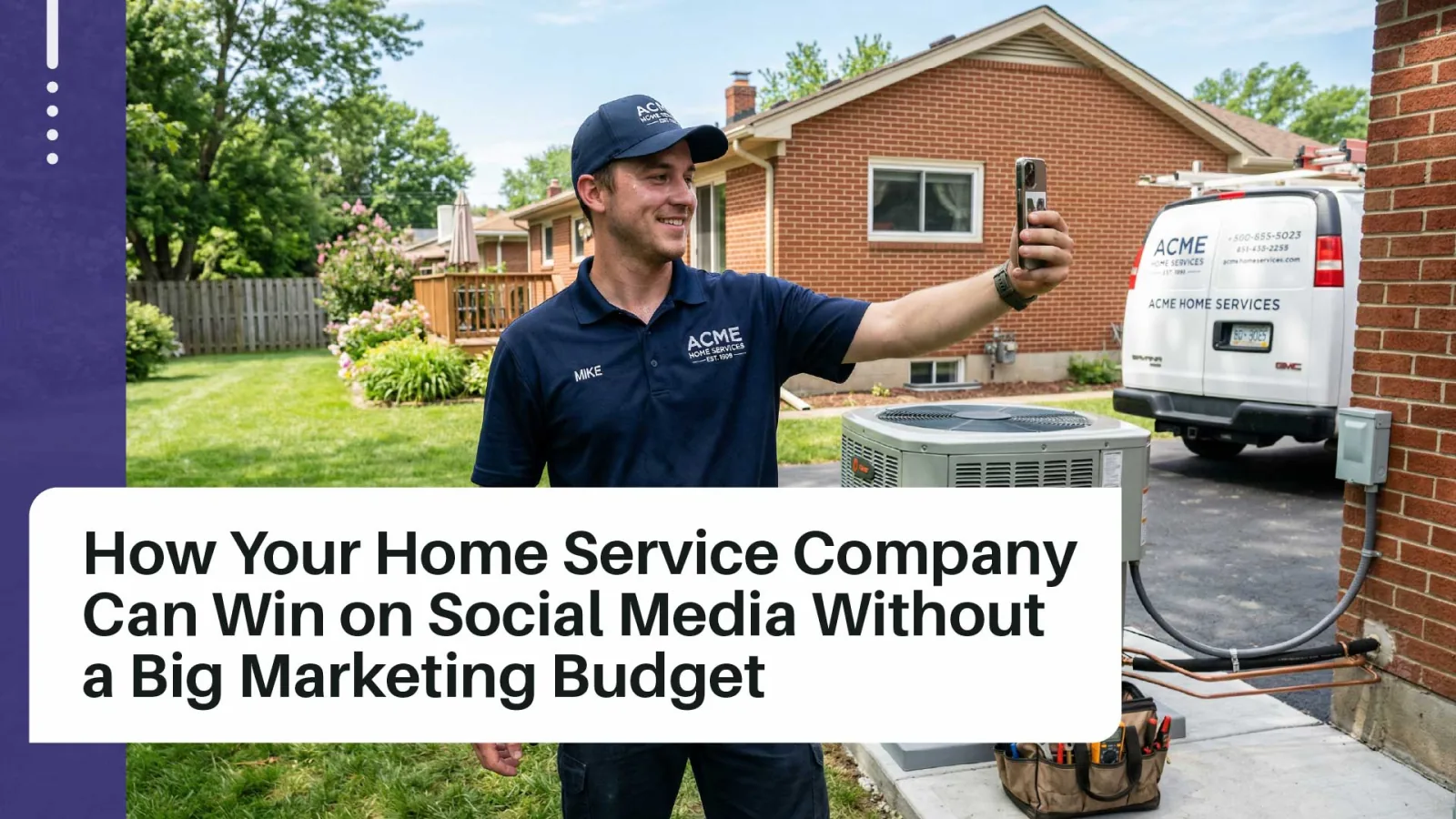
HubSpot's 2026 State of Marketing data shows that short-form video is the top ROI-driving content format among marketers, with 49% ranking it first, followed by long-form video (29%) and live-streaming (25%). You do not need a production crew. Prop your phone on the dashboard and talk about what you are working on today. Film a 15-second time-lapse of a water heater install. Show what a dirty air filter looks like versus a clean one. These videos work because they are specific, visual, and real.
The numbers back this up. Research from Wyzowl's Video Marketing Statistics shows 82% of marketers who use video report a positive ROI in 2026, down slightly from a record high of 93% the year before. For home service companies, the barrier is not equipment or editing. It is just starting.
Quick Tips and Seasonal Advice
Position yourself as the local expert by sharing practical tips homeowners can use right now. "Three signs your AC needs service before summer" or "What to check on your roof after a storm" gives people a reason to follow you. It also keeps your company top of mind when they actually need the service.
Team Spotlights and Behind-the-Scenes
People hire people, not logos. A quick post introducing your newest technician or showing your crew at a job site builds the kind of trust that a logo and phone number on a van cannot. This is especially effective for growing companies where the owner is not the one showing up to every job anymore.
Which Platforms Should Home Service Companies Focus On?
Not all of them. That is the most important answer here. Trying to maintain five platforms with no dedicated marketing person is a recipe for burnout and abandoned accounts.
For most home service companies, Facebook is still the primary platform. It is where homeowners in the 35-65 age range spend their time. Local Facebook groups are especially valuable. Posting helpful tips in community groups puts your name in front of potential customers without spending a dollar on ads. Facebook also remains the strongest platform for local reviews and recommendations. If you want a more detailed breakdown of how each platform fits into a social media strategy for service area businesses, we have a full guide on that.
Instagram has quickly become the second-most-used marketing platform behind Facebook. Sprout Social's 2026 statistics show that 78% of marketers are now active on Instagram, just behind Facebook at 83%. For service companies, Instagram Reels and Stories are perfect for before-and-after content and short video clips. The visual-first format is built for the kind of content trades businesses naturally create.
TikTok
TikTok is not just for teenagers anymore. In fact, the platform's engagement rate grew 49% year-over-year in 2025, making it the highest-engagement social platform available. Data compiled by Sprout Social from Socialinsider's benchmark analysis of 70 million posts shows TikTok reached a 3.70% engagement rate, more than seven times Instagram's rate. If you are already making short videos for Instagram, repurposing them to TikTok takes less than a minute.
The Two-Platform Rule
If your budget and time are tight, pick two platforms. Facebook plus Instagram gives you the broadest reach for the least effort. Both platforms share a backend through Meta Business Suite, so you can schedule and post to both from one place. Add TikTok only when you have a consistent rhythm on the first two.
How Can You Build a Social Media System That Costs Almost Nothing?
The highest cost in social media for home service companies is not money. It is time. The solution is building a system that reduces the time it takes to create and post content each week.
Batch Your Content
Set aside 30 minutes at the end of each workday to take photos and short videos on the job. At the end of the week, you have five days' worth of raw content. Spend one hour on the weekend (or assign it to your office manager), turning those into posts for the next week. This batch approach turns social media from a daily distraction into a weekly task.
Use Free Tools
You do not need to pay for social media software to get started. Several platforms offer free tiers that are more than enough for a small service company.
Buffer lets you connect up to three social accounts and schedule 10 posts per channel on the free plan. That covers a two-week posting schedule for two platforms.
Canva gives you access to thousands of templates for social media graphics, quote cards, and promotional images. No design skills needed. The drag-and-drop editor handles everything.
Google Business Profile is free and often overlooked as a social platform. Posting updates, photos, and offers to your GBP keeps your listing active and signals to Google that your business is engaged. This helps with local search visibility, too.
Set a Realistic Posting Schedule
Three posts per week are enough to stay visible without burning out. A simple rotation works well: Monday is a tip or educational post, Wednesday is a before-and-after or job-site photo, Friday is a team spotlight or customer review highlight. Consistency matters more than volume.
How Do You Measure Whether Social Media Is Working?
You do not need an analytics degree to track social media results. Focus on three numbers that actually tell you something useful.
Engagement Rate
This is the percentage of people who interact with your post (likes, comments, shares) compared to how many people saw it. For context, Sprout Social's 2026 social media statistics show that Instagram's average engagement rate sits around 0.48%, while Facebook averages 0.15%.
Profile Visits and Website Clicks
Every social platform shows you how many people visited your profile and clicked through to your website. This is the bridge between social media activity and actual leads. If profile visits go up but website clicks do not, your bio and call-to-action need work.
Phone Calls and Messages
For service companies, the ultimate metric is "did the phone ring?" Track how many inquiries come through social media direct messages, comments, or the link in your bio. Ask new callers how they found you. The data does not need to be perfect; it just needs to exist.
What Does a Budget Social Media Strategy Look Like in Practice?
Here is how this plays out for a growing HVAC company with eight employees and a service area covering two counties. The owner handles operations and has an office manager who spends about 30 minutes a day on administrative work that could include social media.
The Setup (Week 1)
The company claims or updates their Facebook page, Instagram business profile, and Google Business Profile. They download Buffer and Canva on the office manager's phone. Total cost so far: $0.
The Routine (Weeks 2 and Beyond)
Technicians snap a before-and-after photo on every job and text it to the office manager. On Friday afternoons, the office manager spends one hour using Canva to add the company logo to the best three or four images, writes short captions, and schedules them through Buffer for the following week. Once a month, the owner records a 60-second video answering a common customer question and posts it as a Reel.
The Results (After 90 Days)
Within three months, the company has 40-plus posts, a growing local following, and two or three new leads per month that specifically mention finding the company on social media. Total monthly cost: zero dollars and roughly four to five hours of staff time.
Compare that to running Facebook Ads at roughly $28 per lead, which is the average cost per lead on Facebook in 2025, according to WordStream's benchmarks.
That is not theoretical. That is how small service companies are building real visibility without writing a check.
Conclusion
Social media does not have to be expensive, complicated, or time-consuming. For home service companies, the best content is the work you are already doing every day. A photo, a video, a quick tip. Posted consistently, on the right platforms, using free tools. That is the whole strategy.
The companies winning on social media right now are not the ones with the biggest budgets. They are the ones showing up. If you need help building a social media system that fits your business and your budget, get in touch. I will help you figure out where to start.
Frequently Asked Questions