Every home service business has a story. The problem is, most of them never tell.
You are out there every day solving real problems for real people. A family's furnace dies at 2 a.m. in January, and your tech shows up, fixes it, and saves the night. A first-time homeowner finds a sewer line backup the week they move in, and your crew handles it professionally and at a fair price. These are not just jobs. They are stories. And they are the most powerful marketing tool you are not using.
This post is about storytelling for service businesses, not the kind that requires an ad agency or a creative writing degree. The kind that turns your actual work into content that builds trust, creates emotional connections, and wins you more customers.
Why Does Storytelling Work for Home Service Businesses?
Storytelling is not a soft marketing tactic. The data behind it is hard.
Research compiled by Marketing LTB shows that people are 22 times more likely to remember a fact when it is wrapped in a story compared to when it is presented as a standalone data point. That is not a small difference. It means a homeowner who reads about how your team solved a flooding emergency will remember your company's name far longer than someone who reads a bulleted list of your services.
The business impact is just as measurable. Marketing LTB's analysis of storytelling research found that storytelling improves conversion rates by approximately 30%. For a service company spending money on marketing, that is the difference between 10 calls a month and 13 calls from the same content.
Why does this matter specifically for home services? Because you are selling trust. A homeowner letting a stranger into their house to work on their plumbing or crawl around in their attic is making a trusting decision. Stories build that trust faster than any list of credentials or certifications ever could.
And it goes deeper than memory and clicks. Sprout Social's #BrandsGetReal research found that when customers feel connected to a brand, 57% increase their spending and 76% choose that brand over a competitor. You are not just telling stories to be interesting. You are telling them to become the obvious choice when a homeowner needs a plumber, HVAC tech, or roofer.
Think of it this way: two roofing companies bid on the same job. One sends a generic estimate PDF. The other sends a video walkthrough of a similar project they completed down the street, with the homeowner's permission, showing the before, the process, and the finished product. Which company gets the job?
What Stories Do Home Service Companies Already Have?
The good news is you do not need to invent stories. You have them. They are happening on every job site, in every dispatch call, and in every interaction your team has with customers. You just need a system to capture them.
Origin Stories
How did your company start? Most service companies have a founding story that homeowners connect with. Maybe you started with one truck, one toolbox, and a phone that rang only when your mom called. Maybe you left a corporate job to work with your hands. That story matters because it tells homeowners who you are and why you do this work.
Sprout Social's transparency research found that 86% of Americans say transparency from businesses is more important than ever before. Your origin story, told honestly, establishes that transparency from the first interaction.
Customer Transformation Stories
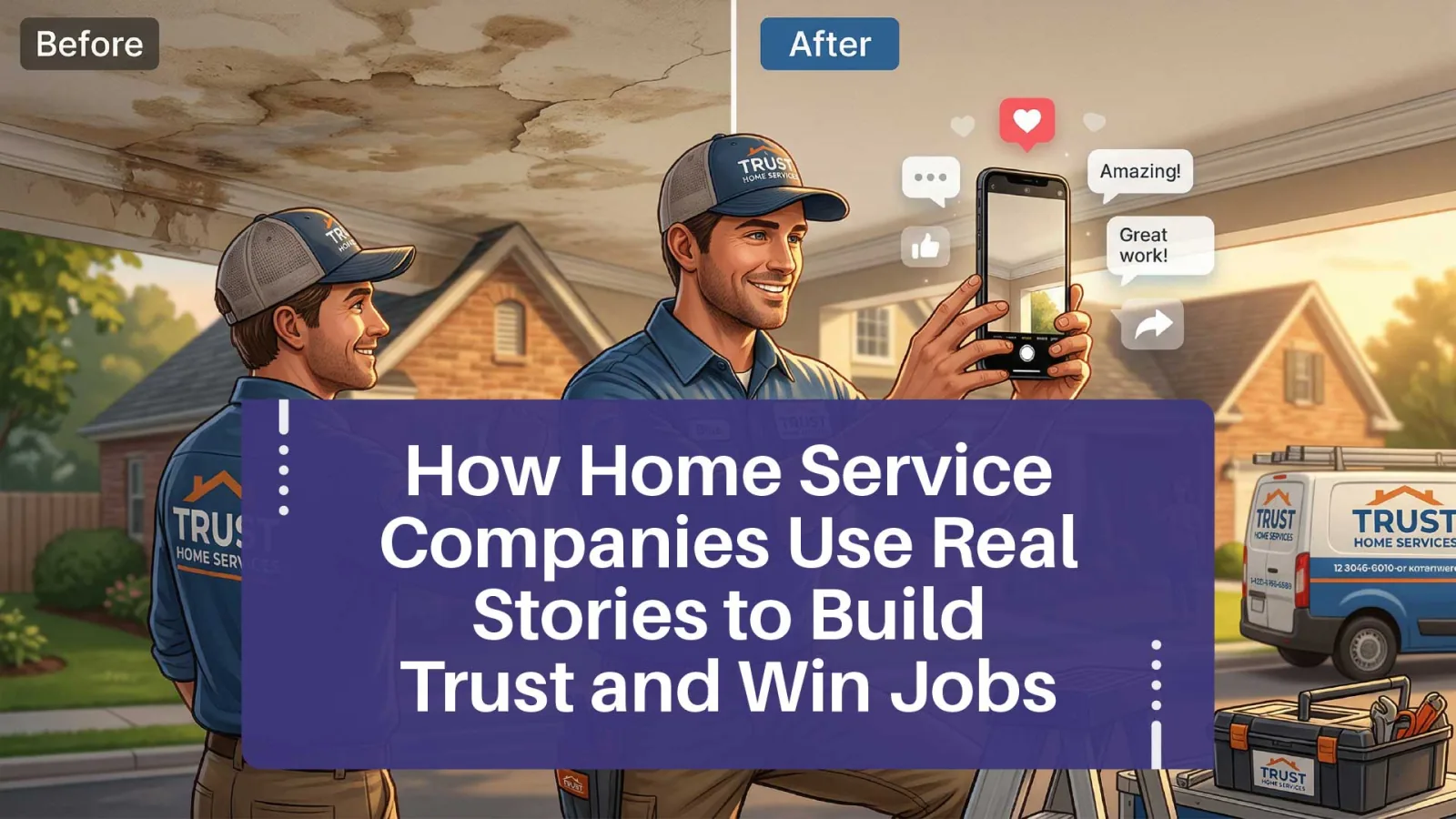
These are your before-and-after narratives. A bathroom that went from a 1970s time capsule to a modern renovation. A failing HVAC system was replaced with an energy-efficient upgrade that cut the homeowner's utility bill in half. A tree that fell on a roof and the full repair that followed.
The key is context. Do not just show photos. Tell the story: what was wrong, what the homeowner was dealing with, how your team solved it, and what the result was. According to research compiled by Marketing LTB, 55% of consumers are more likely to recall a brand story than a list of facts. Your project showcase, told as a narrative, sticks in memory far longer than a portfolio page.
Team Stories
Homeowners want to know who is walking into their house. Introduce your team. Share why your lead tech has been with you for 12 years. Mention the apprentice you just brought on and how they are learning the trade. Post a photo of your crew at the end of a long day with a caption about what they accomplished.
These stories humanize your company. A faceless "ABC Plumbing" is forgettable. A team of real people with names and faces and a clear work ethic is memorable, and it ties directly into building a strong brand identity. Research from Higo Creative found that 66% of people say their favorite brand stories are about ordinary people; stories they can relate to.
Community Involvement Stories
Sponsor a Little League team? Volunteer for Habitat for Humanity? Do free furnace inspections for veterans? Those are stories. They tell your community that you are not just taking from the local economy; you are putting back into it. And they differentiate you from the national chain that has no local roots.
How Do You Tell These Stories Effectively?
You do not need a professional writer or a videographer on staff. You need a system and a phone.
Start with one simple rule: document one job per week. Take a before photo, a during photo, and an after photo. Write two sentences about what the project was and what the homeowner said afterward. That is a story. Post it on your Facebook page, your Google Business Profile, and your website blog.
For more impactful storytelling, follow this three-step structure.
First, establish the problem. What was the homeowner dealing with? A flooded basement, a dead AC unit in July, a roof that leaked every time it rained. Describe it in language the reader can feel.
Second, show the solution. What did your team do? How long did it take? What was the approach? Keep it conversational; you are talking to a neighbor, not writing a technical manual.
Third, share the result. What changed for the homeowner? Did they save money on their energy bill? Did they finally stop worrying about water damage? A quote from the customer, even one sentence, adds credibility that no amount of self-promotion can match.
Research compiled by Higo Creative shows that 64% of respondents believe telling good stories helps brands connect with customers. Your three-step story creates that connection. It is not about being dramatic; it is about being real.
Where Should You Share Your Stories?
You already have the channels. The question is which ones to prioritize.
Your Website Blog is the foundation. Blog posts rank in Google, and a well-told project story with location-specific keywords ("roof replacement in Caldwell County") can pull in search traffic for years.
Facebook is where your local audience spends time. Post before-and-after photos with a short story caption. Share team photos. If you need a social media strategy for your service company, start here. Facebook's algorithm rewards content that gets comments and shares, and stories naturally generate both.
Google Business Profile is the most underused storytelling channel for service companies. Post project updates, team photos, and customer stories directly to your GBP. These posts appear in local search results and give homeowners a reason to choose you over the next listing.
Email is your most personal channel. A monthly email to your customer list featuring a recent project story, a seasonal tip, and a mention of a promotion keeps your name in their inbox. When they need service, you are the first call.
Video is the most powerful format, and you do not need production quality. A 60-second walkthrough of a completed job on your phone gets more engagement than a polished commercial. Post it everywhere.
What Storytelling Mistakes Do Service Companies Make?
The biggest mistake is waiting for the "perfect" story. There is no perfect story. The family whose sewer line backed up on Thanksgiving, and your team came out to fix it? That is a story. The routine water heater replacement, where the customer was thrilled with how clean your crew left the workspace? That is a story too.
The second mistake is being too promotional. A story that reads like a sales pitch ("We're the best! Call now!") is not a story. It is an ad. Let the work speak for itself, and let the customer's reaction be your call to action.
The third mistake is inconsistency. Posting one great story and then going silent for three months tells potential customers nothing about who you are today. A steady rhythm of one story per week builds a library of trust over time.
The fourth mistake is forgetting the customer's perspective. Your story should be about the homeowner's problem and how it was solved, not about how great your company is. The homeowner is the hero of the story. You are the guide who got them there.
The fifth mistake is only sharing perfect outcomes. Sometimes the job hits a snag. A repair takes longer than expected, or you find a bigger problem behind the wall. Sharing how your team handled the unexpected honestly and professionally tells a more compelling story than a flawless project ever could. Homeowners know things go wrong. They want to know you handle it well when they do.
How Does a Growing Service Company Start?
Here is what this looks like for a company like yours. Say you run an 8-person HVAC and plumbing operation covering three counties. You pick one tech each week and ask them to snap before-and-after photos on a job. You text those photos to your office manager, who writes a three-sentence caption and posts it on Facebook and your GBP. Once a month, you pick the best project and write it up as a 400-word blog post with location keywords.
After six months, you have 24 Facebook stories, 24 GBP posts, and 6 blog posts. Your website starts ranking for local search terms. Your Facebook followers recognize your team. Your email list has real content to share. And every story is an asset that keeps working.
Compare that to the competitor who posts nothing but "Call us for all your plumbing needs!" once a month. The homeowner choosing between the two companies is not even close to a fair fight. One company feels like a neighbor they know and trust. The other is just a name on a search result.
You have not hired an agency. You have not bought new software. You have used a phone, a Facebook account, and 30 minutes per week. That is storytelling for service companies.
If you want help building a storytelling system that fits your schedule and your market, get in touch, and I'll show you where to start.
Frequently Asked Questions
How Often Should a Home Service Company Post Stories?
Aim for one story per week across your main channels (Facebook, Google Business Profile, and your website). This keeps your presence consistent without overwhelming your team. If you can only manage one channel, start with Facebook; it has the broadest local reach for home service businesses and the lowest barrier to posting. Add your website blog, and GBP as your rhythm develops.
Do I Need Professional Photos or Videos for Storytelling?
No. Phone photos and short phone videos work well for service companies. Homeowners expect authenticity, not production quality. A real before-and-after photo taken on a phone carries more credibility than a stock photo. Just make sure photos are well-lit and show the actual work clearly. For video, horizontal format is best for YouTube and your website, while vertical works for social media.
Can Storytelling Replace Other Marketing for My Service Company?
Storytelling is not a replacement for SEO, paid ads, or a well-built website. It is a compliment that makes everything else more effective. A Google Ad that links to a landing page with real project stories converts better than one that links to a generic service page. An email with a customer story gets more clicks than one with a coupon alone. Think of storytelling as the ingredient that makes all your other marketing work harder.
How Do I Measure Whether Storytelling Is Working?
Track three things: engagement (likes, comments, shares on social posts), website traffic from story-related blog posts (use Google Analytics), and direct mentions from customers who say they found you through your content.
Research compiled by Higo Creative shows that 62% of B2B marketers find storytelling in content marketing effective, and you can validate that for your own business by watching whether story-driven content generates more calls than purely informational posts.