You started your home service company because you're good at what you do. Maybe you're the best HVAC tech in the county or the plumber everybody recommends at the hardware store. But somewhere between hiring your third employee and fielding your hundredth call, you realize something: people aren't just choosing you for your skills anymore. They're choosing between you and five other companies that all claim to be "reliable" and "professional."
That's where branding comes in. And no, I don't just mean your logo.
At Cube Creative Design, we work with home service companies every day, and the ones that stand out in their markets aren't always the biggest or the cheapest. They're the ones with a brand that feels like something. Something real, something consistent, something that makes a homeowner think, "Yeah, these are my people."
If you've been running your business for a few years and you're ready to stop being "just another service company," this post is for you. Let's talk about what branding actually means for a service business and how to build one that works as hard as you do.
What Does Brand Identity Actually Mean for a Service Company?
Brand identity for a home service company goes beyond visual design. It's the complete experience someone has with your business, from the moment they find you online to the follow-up email after the job is done. Think of it like this: your logo is the handshake, but your brand is the entire conversation.
Your brand includes how your techs show up (on time, in clean uniforms, or 20 minutes late in a stained T-shirt). It includes what your estimates look like (professional PDF or scribbled on the back of a receipt). It includes how your office staff answers the phone, how you respond to reviews, and what your website says about the kind of company you are.
The Touchpoints That Build (or Break) Your Brand
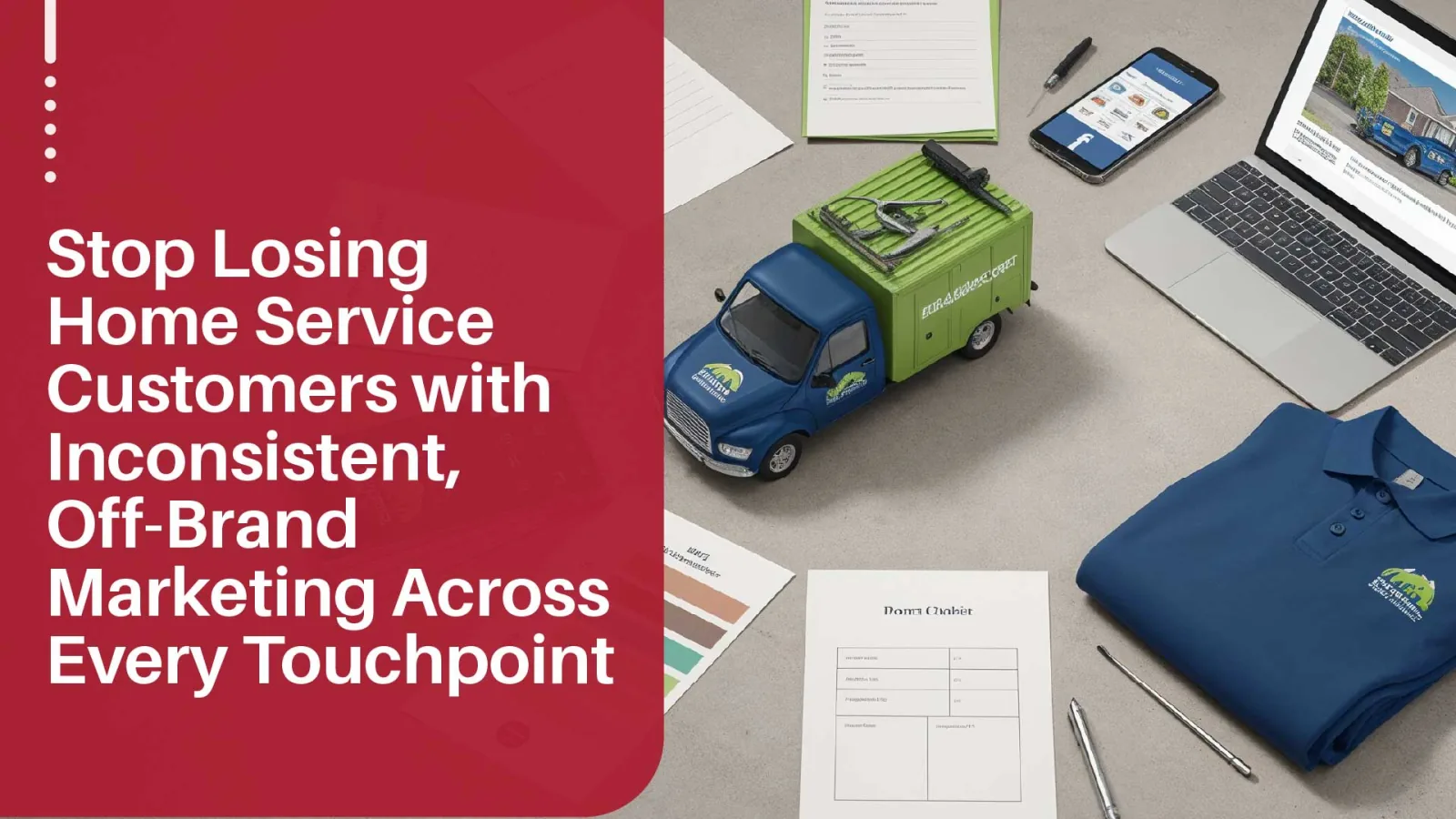
Here's a quick reality check. Every one of these is a brand touchpoint for your business:
- Your website and how it looks on a phone
- Your Google Business Profile photos and posts
- Your truck wraps and vehicle appearance
- Technician uniforms and appearance
- Estimate and invoice formatting
- How the phone gets answered
- Your review responses (both good and bad)
- Social media posts and tone
- Door hangers, yard signs, and print materials
- Follow-up communication after a job
If even two or three of those touchpoints send conflicting messages, you've got a brand consistency problem. And that matters more than you might think. Research from Marq (formerly Lucidpress) found that consistent brand presentation across all platforms can increase revenue by up to 33%. That's not a rounding error; that's a third of your top line.
How Do You Find Your Market Position?
Before you worry about colors and fonts, you need to answer a more fundamental question: why should someone hire you instead of the other company down the road? Your market position is the answer to that question, and it should be specific enough that a homeowner could repeat it back to a friend.
"They're the plumbing company that always shows up on time and explains everything before they start" is a position. "We provide quality service" is not. Every service company says that. It's the equivalent of a restaurant saying they serve food.
Three Questions to Define Your Position
Start with these:
- Who do you serve best? Maybe you specialize in older homes, new construction, or commercial properties. Maybe your sweet spot is a specific service area or customer type.
- What do you do differently? This could be your response time, your warranty, your communication style, your pricing transparency, or your technical specialization.
- What would a happy customer say about you? Not what you want them to say. What do they actually say in reviews? Read your five-star reviews and look for patterns. That's your real brand.
A growing HVAC company with eight employees serving a county-wide area might find that their reviews consistently mention "they explained everything" and "no surprise charges." That's gold. That's a brand position worth building around: the company that treats homeowners like adults and doesn't play pricing games.
Why Does Visual Consistency Matter Across Every Touchpoint?
Visual consistency is the fastest way to build recognition in your market. When someone sees your truck on the road, then visits your website, then gets an estimate from your tech, those three experiences should feel like they came from the same company. That sounds obvious, but you'd be surprised how many service companies have a professional website and then send estimates that look like they were typed in Notepad.
Research shows that it takes five to seven brand impressions before someone remembers your business. For a service area business where you're competing for local attention, every one of those impressions needs to tell the same story. Consistency is what turns a truck sighting into a phone call.
Where Visual Consistency Shows Up
Your visual brand should be consistent across these areas:
- Vehicles: Your trucks are rolling billboards. Use the same colors, logo placement, and design language across your fleet. A mismatched fleet looks like a franchise that lost its franchise agreement.
- Uniforms: Clean, branded uniforms aren't just for looks. They build trust the moment your tech steps out of the truck. Homeowners are letting a stranger into their house; looking professional matters.
- Digital presence: Your website, Google Business Profile, social media profiles, and email signatures should all use the same logo, colors, and fonts.
- Print materials: Estimates, invoices, door hangers, business cards, and yard signs should match your digital brand. When someone picks up your business card after seeing your truck, it should feel connected.
Think of it like a puzzle. Every touchpoint is a piece, and when they all fit together, the picture is clear. When they don't, it looks like a mess, and nobody trusts a mess with their plumbing.
How Does Your Brand Voice Shape Customer Perception?
Your visual brand gets attention, but your voice builds the relationship. Brand voice is how your company communicates at every level, from the first phone call to the post-job follow-up. And for service companies, this is where most businesses drop the ball.
Consider this scenario. A homeowner visits a roofing company's website, which is clean, professional, and reassuring. They call the number, and the phone rings six times before someone picks up and says, "Yeah?" That disconnect just killed whatever trust the website had built.
Building a Consistent Voice
Your brand voice should answer one question: "What does talking to our company feel like?" Are you friendly and approachable? Technical and thorough? No-nonsense and efficient? There's no wrong answer, but there is a wrong approach, and that's having no answer at all.
Here's where it gets practical:
- Phone scripts: You don't need a word-for-word script, but everyone who answers the phone should greet callers the same way and follow the same basic flow.
- Review responses: Responding to reviews (yes, all of them) in a consistent tone shows potential customers what kind of company you are. If you need a system for this, check out our guide on getting more Google reviews for home service companies. Edelman's Brand Trust research found that 81% of consumers say they need to trust a brand before they'll consider buying.
- Email communication: Whether it's appointment confirmations, estimates, or follow-ups, your emails should sound like they came from the same company.
- Social media: Your social media personality should match your real-world personality. If your techs are friendly and joke around with customers, your social media should feel that way too. Need a starting point? Our social media guide for service area businesses walks through the basics.
How Should Your Online Presence Reflect Your Brand?
Your online presence is often the first impression a homeowner gets, and it sets expectations for everything that follows. A Gallup survey found that 70% of U.S. adults express confidence in small businesses, making it the most trusted category Gallup tracks. That's a huge advantage for independent service companies, but only if your online presence backs it up.
Your website isn't just a place to list your services. It's where your brand either comes to life or falls flat.
Website as Brand Expression
Your website should answer three questions within five seconds of someone landing on it: What do you do? Where do you do it? How do I contact you? After that, it should reinforce your brand through real photos (not stock images), consistent messaging, and a design that matches the rest of your brand.
For a growing plumbing company with five trucks on the road, a website full of generic stock photos of models pretending to be plumbers sends a message, and it's not a good one. Real photos of your actual team, your actual trucks, and your actual work are worth more than any stock photo subscription.
Google Business Profile as Brand Touchpoint
Your Google Business Profile (GBP) is often the very first thing a potential customer sees. If your GBP has outdated photos, no recent posts, and a generic business description, you're already behind. Your GBP should feel like an extension of your website, with the same tone, the same visual quality, and the same attention to detail.
Post regularly. Respond to every review. Keep your hours, services, and service area updated. If you haven't touched your profile in a while, our Google Business Profile optimization tips are a good place to start. It's not glamorous work, but it's brand work, and it pays off.
How Do You Maintain Brand Consistency as You Add Employees?
This is where branding gets real for growing service companies. When it was just you and a helper, brand consistency happened naturally because you were the brand. But when you've got six or eight employees representing your company across town, consistency doesn't happen by accident anymore.
This is especially relevant in spring, when many service companies are hiring to ramp up for the busy season. Every new tech, every new office staffer is a new brand ambassador, whether they know it or not.
Create a Simple Brand Guide
You don't need a 50-page brand manual. You need a one-page cheat sheet that covers:
- Your company colors (with exact color codes)
- Your logo and where to use it
- How to answer the phone
- How to present an estimate
- What to wear on a job site
- How to follow up after a job
Keep it simple enough that a new hire can read it in 10 minutes and remember most of it. If your brand guide collects dust in a binder, it's not doing its job.
Onboarding as Brand Training
Every new hire should understand that they're not just a technician or an office staffer. They're the face of the company for every customer they interact with. A five-minute conversation during onboarding about "here's what our company is about and here's how we show that to customers" goes a long way.
Think about it this way: if your best tech provides a five-star experience and your newest hire provides a two-star experience, your brand is whatever the customer got, not whatever you intended. Consistency across crews and staff is what separates companies that grow from companies that just get bigger.
How Can You Measure Whether Your Brand Is Working?
Branding can feel squishy and hard to measure compared to something like pay-per-click advertising. But there are real indicators that tell you whether your brand is gaining traction.
Metrics That Reflect Brand Strength
- Review sentiment: Not just your star rating, but what people actually say. Are they mentioning your professionalism, your communication, your appearance? That's your brand showing up in the wild.
- Repeat and referral rates: Customers who come back or send their friends are responding to your brand, not just your service. Track this number and watch how it changes as you invest in brand consistency.
- Branded search volume: Are people searching for your company by name? Check Google Search Console to see how many people are finding you through branded searches. If that number is growing, your brand recognition is growing.
- Close rates: When you tighten up your brand, and your estimates look professional, your phone manner is polished, and your online presence is sharp, you should see your close rate improve. People buy from companies they trust, and trust comes from a cohesive brand experience.
A mid-size landscaping company that invested in matching uniforms, branded estimates, and consistent review responses saw their repeat customer rate increase noticeably within a year, and their referrals grew along with it. That's not a coincidence. That's brand consistency compounding over time.
Start Building Your Brand Before Busy Season
You don't have to overhaul everything at once. If your brand feels scattered right now, start with the highest-impact touchpoints and work from there. Get your trucks matching. Get your estimates professional. Make sure your website and Google Business Profile tell the same story. Bring your new spring hires into the fold with a quick brand overview.
The companies that win in competitive local markets aren't always the ones with the biggest budgets. They're the ones that feel like a real, consistent, trustworthy brand at every touchpoint. And that's something any growing service company can build.
If you're ready to turn your service company into a brand that stands out in your market, let's talk. I'd love to help you figure out where to start.
Frequently Asked Questions
How Much Does It Cost to Build a Brand for a Home Service Company?
Brand building doesn't have to be expensive. Start with the basics: a professional logo, consistent colors, and branded templates for estimates and invoices. Many service companies spend $2,000 to $5,000 on initial brand development (logo, colors, basic guidelines) and then invest incrementally in vehicle wraps, uniforms, and website updates. The biggest investment is consistency, which costs time more than money.
Can a Small Home Service Company Compete With Larger Brands?
Absolutely. Small, independent service companies have a built-in advantage: they're local, personal, and trusted. Gallup data shows that 70% of Americans express confidence in small businesses, more than any other institution. Your brand doesn't need to look like a national franchise. It needs to feel like a company that cares about your community and does great work consistently.
How Long Does It Take for Branding Efforts to Show Results?
Brand building is a compounding investment, not an overnight fix. Most service companies start seeing measurable improvements in recognition and referral rates within six to twelve months of consistent brand application. The keyword is consistent. Putting new wraps on your trucks but ignoring your website and review responses won't change much. The results come when every touchpoint tells the same story.
What Is the Most Important Branding Element for a Service Company?
If you had to pick one thing, it's consistency. A perfectly designed logo means nothing if your estimates look unprofessional and your techs show up in mismatched clothing. The most effective brand element is the one that shows up everywhere, the same way, every time. For most service companies, starting with visual consistency (vehicles, uniforms, digital presence) gives the fastest return.
Should I Hire a Marketing Agency for Branding or Do It Myself?
It depends on where you are. If you're a solo operator or a very small shop, you can handle the basics yourself: pick your colors, get a decent logo, and be consistent about using them. Once you're growing and adding employees, that's when working with an agency that understands service businesses pays off. An agency can build a cohesive brand system that scales with your team, so you're not reinventing the wheel every time you hire someone new or wrap a new truck.