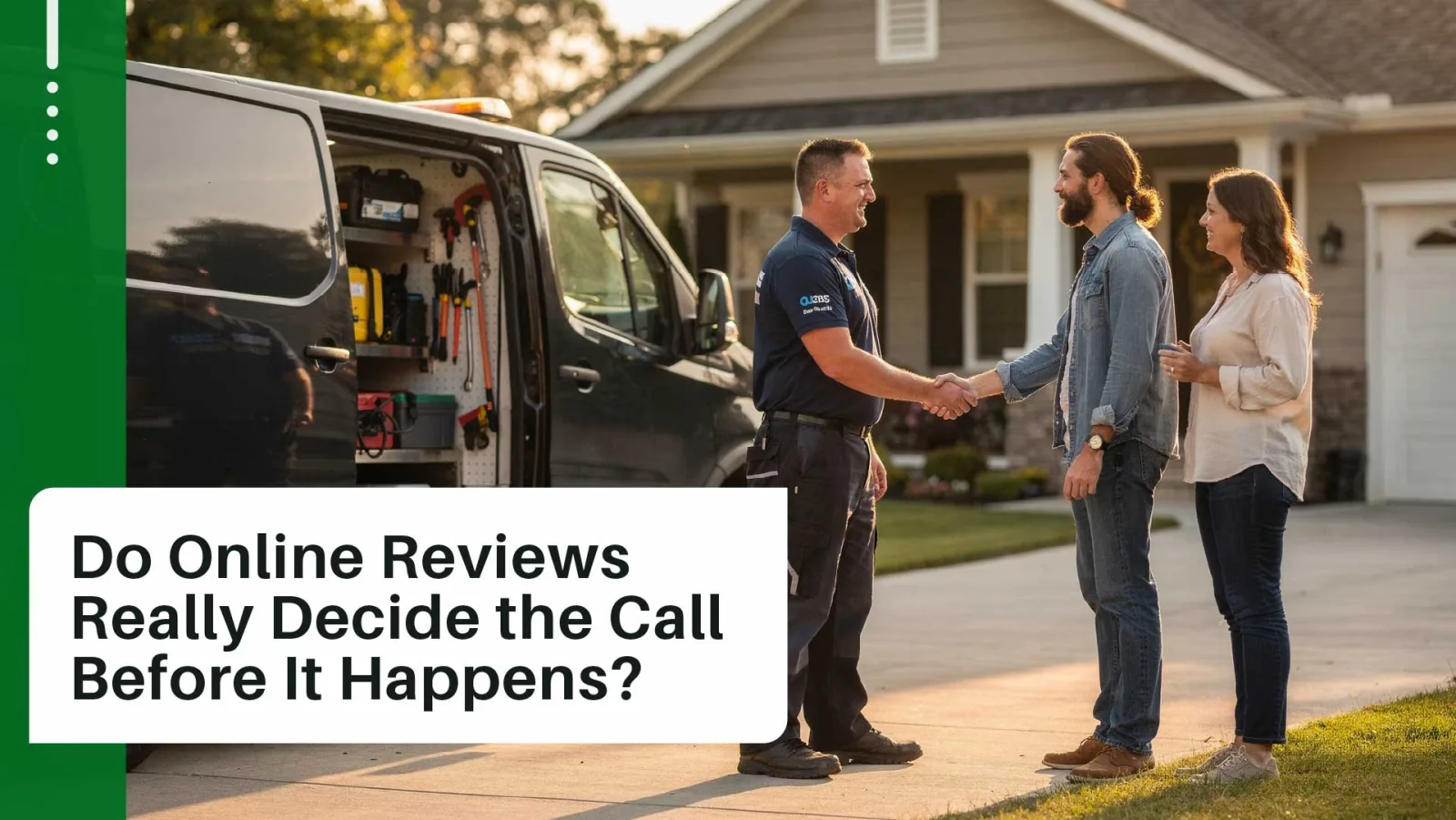
Every home service company sits on a lead engine it barely runs. Not the phone. Not the truck wraps. The reviews. Think of your online reviews like referrals from a trusted neighbor, except this neighbor talks to 500 people at once and never sleeps. Most owners treat review management for home service businesses as something the office manager handles on a slow afternoon. That is the mistake. A finished job is raw material for your next booked job, and whether it turns into a lead depends on whether anyone is running a process behind it. We work with home services businesses that generate this material every day and leave most of it on the table.
Do Online Reviews Really Decide the Call Before It Happens?
Yes. Most homeowners pick a home service company before they ever dial the phone, and reviews drive that choice. According to BrightLocal's Local Consumer Review Survey 2026, 97% of consumers read reviews for local businesses, and 41% now say they "always" read them when browsing, up from 29% a year earlier. The decision starts on a screen.
Volume matters more than most owners think. BrightLocal found that 47% of consumers won't use a business with fewer than 20 reviews, and only 9% will use one with five or fewer. That is a hard floor. If a homeowner pulls up three companies on their phone and yours shows eight reviews next to two competitors with 60, you are out of the running before the comparison even feels fair.
Picture a growing operation running multiple routes across a couple of counties. The trucks stay busy, the work is good, and the owner still wonders why the phone goes quiet between jobs. The reviews are the tell. Plenty of happy customers, no system to turn them into public proof, and a review count that makes a solid company look small. A steady process is how other home service companies win more customers through review management instead of losing ground to competitors with a bigger review count.
How Should Home Service Businesses Respond to Reviews?
Respond to every review, respond fast, and never paste in a template. In a survey conducted by BrightLocal, 80% of consumers said they are likely to use a business that responds to all of its reviews, while only 42% would use one that never replies. Replying only to the good ones (45%) or only to the bad ones (47%) barely beats staying silent.
Speed is now part of the standard. BrightLocal data shows that 89% of consumers expect a business owner to respond, 19% expect a same-day reply (up from just 6% a year earlier), and 81% expect one within a week. The clock starts when the review posts, not when you get around to it.
Here is the part that trips up busy owners: a lazy reply can cost you the job. "Generic or templated replies put off 50% of consumers, who may see them as a sign of subpar customer care." (Source: BrightLocal). "Thank you for your feedback!" pasted under 40 reviews reads as a form letter, and half your prospects notice.
Google agrees, for its own reasons. Its Business Profile Help page states, "When you reply to customer reviews, it shows that you value their feedback. Positive reviews and helpful replies can help your business stand out." (Source: Google Business Profile Help). Responding is both a trust signal to homeowners and a habit Google itself recommends.
Responding to a Good Review
A strong reply to a positive review does three things in two or three sentences. Thank the customer by name, mention the specific job or the technician who did the work, and add one line that invites the next visit. "Thanks, Karen, we're glad Dave got your AC running before the heat wave hit. Call us anytime for that fall furnace check." That reply proves a real person read a real review, and it quietly markets the next service to everyone else reading.
Responding to a Bad Review
A bad review is a de-escalation, not a debate. Lead with acknowledgment, take the detail offline, and never argue the facts in public. "I'm sorry the drain backed up again after our visit. That is not the standard we hold ourselves to. I'd like to make it right, so please call me directly at the office." Future customers are not grading the complaint. They are grading how the owner handled it. A calm, accountable reply often does more for building real trust with homeowners than a wall of five-star ratings.
Does Review Velocity Beat Review Volume?
Often, yes. A steady stream of recent reviews outperforms a big but stale total, both for homeowner trust and for local ranking. BrightLocal reports that 74% of consumers only weigh reviews written in the last three months, and 32% look only at the last two weeks, up sharply from 20% a year earlier. A five-star rating you earned three years ago does little for a homeowner deciding today.
Google's ranking system leans the same direction. Its guidance explains, "Prominence means how well-known a business is... This factor's also based on info like how many websites link to your business and how many reviews you have. More reviews and positive ratings can help your business's local ranking." (Source: Google Business Profile Help). Reviews feed the same prominence factor that decides who shows up in the map pack.
The experts who study local ranking put recency near the top. Whitespark's long-running Local Search Ranking Factors survey lists "Recency of reviews" and "sustained influx of reviews over time (rather than reviews coming in bursts)" among the leading review signals, and its analysts note that after the Business Profile itself, reviews are the second most important area of signals Google weighs for local results. A drip beats a flood.
This is also where AI search enters the picture, and it pays to be precise about it. BrightLocal found that consumer use of ChatGPT and similar tools for local recommendations jumped from 6% to 45% in a year, and 82% of consumers now read AI-generated review summaries when choosing a business. The reassuring part for owners: those AI answers pull from the same fresh, well-managed review signals that already drive normal local search. Do the fundamentals well, and you show up in both.
Building a Review Management System for Your Home Service Business
A review management system is just four decisions written down: when you ask, how you ask, how fast you respond, and who owns it. Most home service companies do all four inconsistently, which is why their results are inconsistent. Turning reviews into booked jobs is an operations problem, not a personality problem.
Ask at the moment the work is done. A technician who just fixed a homeowner's heat on a cold morning is standing in front of your best review, and that goodwill fades within hours. Waiting two weeks to send a "please review us" blast is how you end up with a trickle. The data backs the timing: BrightLocal found that 83% of people who were asked to leave a review went on to do it. Asking is not pushy. It is the single most reliable lever you have.
Make the ask effortless. A short text or email with a direct link to your Google review page beats a printed card every time, because it takes the customer two taps instead of five steps. Set a response standard your team can actually hit, such as every review answered within 48 hours, and assign one person to own it. Not "the office when there's time." One name. Getting the ask right matters, but so does optimizing your Google Business Profile itself, since every new review lands on a profile that either converts the next click or wastes it.
Consider that same multi-county operation running roughly 15 trucks. Before: no ask process, the newest review two months old, replies sporadic and templated. After: the CSR texts a review link the afternoon each job closes, answers every review within two business days in a real voice, and flags anything below four stars for the owner. Within a quarter, the company is posting fresh reviews most weeks and looks active to every homeowner comparing options. No inflated promises, just a steady signal where there used to be silence.
One structural advantage is worth naming. Embedding live, schema-marked review content on your service pages helps both shoppers and search engines trust your site, and it is straightforward on a Joomla build with full template control. On many WordPress sites, stacked review-widget plugins generate duplicate or conflicting schema that can quietly work against your local rankings instead of helping them.
The Bottom Line on Reviews and Booked Jobs
Reviews are not a scoreboard you glance at. They are a lead channel you run, with a cadence, a response standard, and an owner, exactly like every other part of your marketing. The homeowner comparing three companies on a Tuesday night is not picking the one with the most reviews from 2022. They are picking the one that looks active, responsive, and recent right now. That company can be yours with a system almost any office can operate.
If your reviews are strong but scattered and you want a process that turns finished jobs into booked ones, let's talk. We will map out where your review channel is leaking and how to fix it.
Frequently Asked Questions
How Many Google Reviews Does a Home Service Business Need?
Aim for a steady climb past 20 reviews, since 47% of consumers won't use a business with fewer than that, and only 9% will use one with five or fewer. More important than any target number is recency. A profile with 30 fresh reviews usually outperforms one with 100 that stopped two years ago.
How Fast Should I Respond to Online Reviews?
Within 48 hours is a safe standard, and faster is better. Consumer expectations have jumped, with 19% now expecting a same-day reply and 81% expecting a response within a week. Set a written response-time standard your team can hit consistently rather than replying in bursts whenever someone remembers.
Should I Respond to Negative Reviews or Ignore Them?
Always respond, and treat it as de-escalation rather than debate. Acknowledge the issue, avoid arguing the facts publicly, and move the conversation offline with a direct phone number. Future customers judge the business by how the owner handles a complaint, not by whether one exists.
Do Customer Reviews Actually Help My Google Ranking?
Yes. Google's own guidance states that more reviews and positive ratings can help your local ranking through the prominence factor, and that replying to reviews helps your business stand out. Reviews are one of the strongest local ranking signals a home service company controls, and building a process to earn them steadily is exactly the kind of work we handle for home services companies.
When Is the Best Time to Ask a Customer for a Review?
Right when the job is finished, while the customer is still happy and the work is fresh. A quick text or email with a direct review link at job completion converts far better than a delayed request. Asking works: 83% of people who were asked to leave a review did.