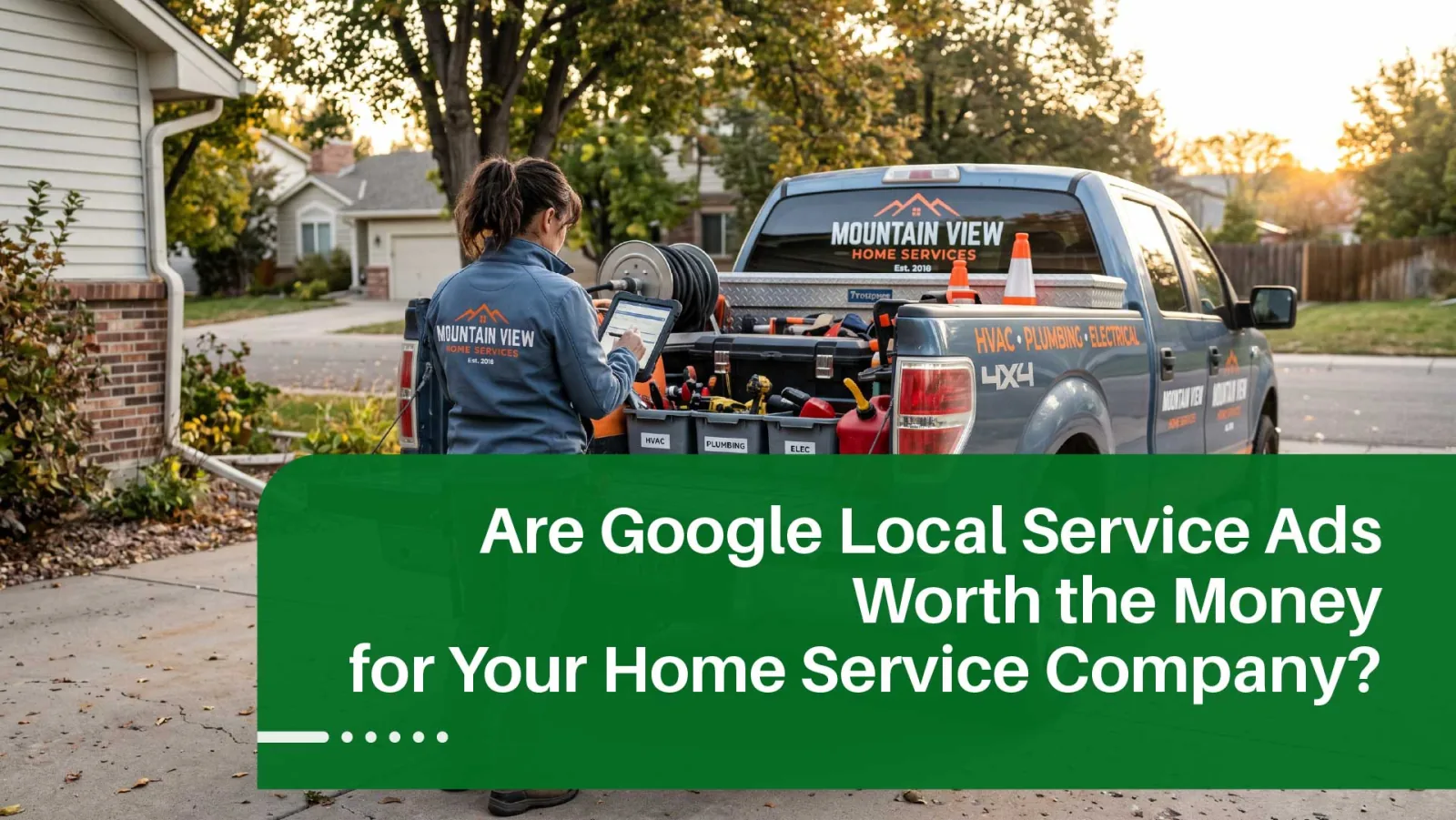
If you run paid search for a home service company, you have already met the pitch. "Just turn on Local Service Ads. It's free money at the top of the page." That sales pitch skips the part where you pay for leads you can't see the search term for, clear a background check, and hand Google control of the pricing. So the real question about Google Local Service Ads for home services is not whether they exist at the top of the page. It is whether they earn their spot in a budget you have to answer for.
This is the honest version. We market to home services companies for a living, and we would rather tell you when a channel fits than sell you one that doesn't. Here is exactly how the model works, what it actually costs by trade, what it takes to qualify, and when LSAs beat, lag, or work alongside standard Search Ads.
How Does Local Service Ads Billing Actually Work?
Local Service Ads charge you per valid lead, not per click. A "lead" is a phone call or message from a potential customer, and Google sets the price based on your trade, market, and competition. You control a weekly budget cap, not a per-keyword bid, and Google allocates leads inside that cap.
Google is direct about the billing model. On its Local Services Help pages, Google states, "You're charged for each valid lead you receive through your Local Services ad. Lead prices may vary depending on your location, the job type, the type of lead, or your bidding mode, but each lead received will count towards your budget."
The word "valid" is doing real work there. Not every call hits your bill.
Can You Dispute a Bad Local Service Ads Lead?
Yes. If a lead is spam, outside your service area, or for a job you don't do, you can dispute it, and a successful dispute gets credited back in the US and Canada. This is one of the honest advantages of the pay-per-lead model over pay-per-click, where a wasted click is just gone.
Per Google's Local Services Help, "If you believe the lead you received isn't valid, you can immediately dispute a lead. A successfully disputed lead will be credited back to you (US and Canada only)." Google also runs an automated screen before the charge ever lands. As its help center puts it, "Leads are first assessed when the potential customer makes initial contact, and leads determined to be invalid or low quality are not charged." (Source: Google: Local Services Help)
None of that makes the system perfect. You will still get the occasional wrong-number lead you have to flag. But the dispute path means you are not stuck paying for obvious junk, which is more than standard Search Ads can say.
What Happened to the Google Guaranteed Badge?
The Google Guaranteed badge is gone. As reported by Search Engine Roundtable, on Oct. 20, 2025, Local Services Ads consolidated Google Guaranteed, Google Screened, and License Verified into a single "Google Verified" badge. The consumer Money-Back Guarantee that rode along with the old badge was discontinued at the same time.
This matters for two reasons. First, if a competitor or a vendor is still selling you on the "Google Guaranteed money-back promise" as a current feature, they are working from old information, and that tells you something about how closely they follow the platform.
Second, the reimbursement window closed. According to Google's own badge documentation, "Google will be discontinuing the Money Back Guarantee associated with the Google Guarantee badge," and eligible consumers could submit reimbursement requests for services booked through Local Services Ads only before Dec. 7, 2025. (Source: Google: About Google Verified badge)
For existing advertisers, Google handled the switch automatically. If you were verified under the old system, you kept the badge with no action needed. The trust signal at the top of the results still exists. It just has a new name, and no cash-back promise behind it.
What Determines Local Service Ads Placement?
Three factors drive Local Service Ads placement: your bid, the predicted likelihood a given searcher turns into a lead, and your overall profile quality. Profile quality is the part you control day to day, and Google defines it to include your star rating, number of reviews, average response time, and photo quality.
Google spells this out plainly. Its ranking documentation notes, "Your rating, number of reviews, average response time, use of high-quality images, the verification checks you have completed, and any other information about your business that may influence user preferences factor into profile quality. Higher quality profiles, including those with images, may rank higher and may also pay lower costs per lead." (Source: Google: About ad rankings) The same profile optimization work that helps a Google Business Profile rank higher locally feeds directly into this LSA quality score.
Read that last line twice. Better profiles can rank higher and pay less per lead. Profile quality is not a vanity metric. It is a discount.
Why Does Response Time Matter So Much for LSAs?
Response time is a documented ranking lever, not a nice-to-have. Google says a consistently fast response to incoming leads can improve your ad's ranking and increase the leads you receive. For a home service shop, that turns your phone habits into an advertising input, which most owners never connect.
In Google's words, "It's highly recommended that you respond to leads as soon as they come in. Having a consistently fast response time could improve your ad's ranking on search and increase your ability to receive leads." (Source: Google: Manage leads and jobs)
Reviews carry the same weight, and consumer expectations keep rising. Findings from BrightLocal show that 31% of consumers in 2026 will only use a business with a 4.5-star rating or higher, up sharply from 17% the year before, and 74% only care about reviews written in the last three months. A wall of five-year-old reviews will not carry you. Recent, steady reviews will, which is exactly what a real reputation management routine for home service companies is built to keep up.
What Does Local Service Ads Cost per Lead by Trade?
Local Service Ads cost per lead for home services runs roughly $53 to $63 on average, depending on trade and season, with cheaper trades near $39 and pricier ones past $70. Treat any single "the answer is $X" number with suspicion. Cost moves with your trade, your market, and the time of year.
A February 2026 benchmark from SearchLight Digital, built on $6.72 million in observed LSA spend across 888 contractors and 126,650 leads, put the blended cost per lead at $53. By trade, that broke down to $39 for electrical, $51 for HVAC, $57 for plumbing, and $59 for drain and sewer work.
A later snapshot ran higher, which is exactly why you use a range. The Data-Driven Trades reported a May 2026 blended cost per unique lead of $63.29 across 1,011 home services businesses, with plumbing at $69.26 and electrical at $49.02. The jump from February to May tracks with cooling season demand climbing. Your number will move too.
How Does LSA Cost Compare to Google Search Ads?
LSAs usually win on cost per lead. In the same SearchLight dataset, standard Google Search Ads for home services averaged a $104 blended cost per lead, nearly double the $53 LSA figure. The gap widens on non-branded search, the terms you actually compete for, where cost per lead ran much higher.
The SearchLight breakdown put branded search at a $34 cost per lead, non-branded search at $149, and Performance Max at $72, for that $104 blended average. That non-branded $149 is the honest comparison point, because branded search is really just people already looking for you by name.
Search Ads are not overpriced, though. They do a different job. Data from LocaliQ shows home services search-ad click-through rates averaged 6.37% in its 2025 benchmark, up for 88% of advertisers at a 13.95% average year-over-year increase, with cost per lead ranging from about $45 for pools and spas to over $100 for roofing, gutters, and air conditioning. Search Ads still pull their weight for services and searches LSAs don't cover, and the fuller breakdown of how LSAs and PPC ads stack up for small businesses is worth a look if you are still weighing the two.
What Do You Need to Qualify for Local Service Ads?
LSAs have a real gate, and some readers haven't cleared it. To run Local Service Ads, you need a verified Google Business Profile, the applicable state and local licensing, general or professional liability insurance, and background checks on your business, your owner, and field workers who enter customer homes.
Google's screening documentation is specific. It states that "businesses seeking to advertise with Local Services Ads are required to complete appropriate background checks and have appropriate licenses and insurance, as applicable." (Source: Google: Business screening and verification requirements)
The background checks cover identity and criminal history, not credit, and they extend to the technicians who walk into a customer's house. If you have never run payroll-level background screening, budget a few days for verification before your first ad goes live. This is not a same-afternoon setup, and treating it like one is how owners end up frustrated in week one.
When Are Local Service Ads Worth It for Home Service Companies?
For most home service companies, LSAs are worth running alongside Search Ads, not instead of them. LSAs generally win on cost per lead and demand less ongoing management, since Google auto-matches searches with no keyword research. Search Ads give you the targeting control and service coverage LSAs can't. The smart budget runs both.
The lower management load is real. As Chris Cabaniss noted in Search Engine Land, with LSAs "you have limited control over ad copy and keywords, since Google automatically determines relevant terms." That is a feature and a limitation at once. Less work to run, less control over what you match.
Here is the honest split. LSAs tend to win when you want cheaper leads for your core services, you have strong reviews and fast response habits, and you cleared the verification gate. Search Ads earn their place when you need to promote a specific service, target a promotion, control your messaging, or reach searches your LSA category does not support in your market. Running only one leaves leads and control on the table.
A Realistic Look at Running Both
Consider a 19-technician operation covering multiple counties with a residential base and an expanding commercial division. This shop already runs Search Ads, tracks cost per lead, and the owner is tired of watching non-branded clicks climb toward $150 a lead.
Shifting core residential service calls, the emergency HVAC and plumbing work, to LSAs could pull that lead cost down toward the $50 to $60 range while the automated screening trims some of the junk. Search Ads then stay pointed at the higher-margin commercial work and the specific service promotions where message control matters. For a fuller picture of what that side of the budget runs, see the full cost breakdown of what Google Ads runs for home service businesses. The commercial division needs targeting and copy that a Google-matched LSA can't deliver.
The result is not a channel swap. It is a division of labor. Cheaper, lower-management leads for the bread-and-butter calls, and precise, controllable spend for the work that carries the margin. That is a budget you can defend using the marketing metrics that actually move a home service KPI meeting, which is the whole point.
The Honest Verdict on LSAs for Home Services
Google Local Service Ads are worth it for most home service companies, with two conditions. You have to clear the verification gate, and you have to keep your reviews and response time in shape, because both feed the auction. When those are in place, LSAs deliver leads at roughly half the cost of non-branded Search Ads, and the dispute system means you are not paying for obvious junk.
What LSAs are not is a magic top-of-page switch that replaces the rest of your marketing. They match searches you can't see, cap the control you have, and reward the shops that already run tight on reviews and response. The companies that get burned are the ones that expected free money and skipped the fundamentals.
If you want a straight read on whether LSAs fit your budget, or how to split spend between LSAs and Search Ads for your specific trades and markets, let's talk. No pitch, just an honest look at the numbers.
Frequently Asked Questions
Are Google Local Service Ads the Same as Google Ads?
No. Local Service Ads charge per valid lead and run above standard search results with a Google Verified badge, while Google Ads charge per click and give you keyword-level control. LSAs need less ongoing management because Google auto-matches searches, but Google Ads give you far more targeting and messaging control.
How Much Do Local Service Ads Cost for Home Service Companies?
Across recent home services benchmarks, LSA cost per lead averages roughly $53 to $63 depending on trade and season, with electrical near $39 and plumbing closer to $57 to $69. You set a weekly budget cap rather than a per-lead price. Actual cost varies by your market and competition, so treat national averages as a starting point, not a promise.
Is the Google Guaranteed Badge Still Available?
No. As of Oct. 20, 2025, Google retired the Google Guaranteed, Google Screened, and License Verified badges and combined them into a single Google Verified badge. Google also discontinued the consumer Money-Back Guarantee that came with the old badge. Existing verified advertisers kept the badge automatically with no action required.
Can I Dispute a Local Service Ads Lead I Don't Think Is Valid?
Yes. If a lead is spam, outside your service area, or for a service you don't offer, you can dispute it, and a successful dispute is credited back in the US and Canada. Google also runs an automated screen that filters out many invalid or low-quality leads before you are ever charged for them.
What Do I Need to Qualify for Local Service Ads?
You need a verified Google Business Profile, the applicable state and local licensing, general or professional liability insurance, and background checks on your business, owner, and any field workers who enter customer homes. The background checks cover identity and criminal history, not credit. Plan for a few days of verification before your first ad can run. If that setup is more than your team wants to take on, it is part of the groundwork we handle for companies like yours.