Let's be honest — if I asked you to name your school's most valuable marketing asset, what would you say? Your stunning new science center? That championship-winning sports program? Or perhaps your beautifully designed website that cost a small fortune?
Here's the thing: these are all valuable assets, but they're not your most valuable one.
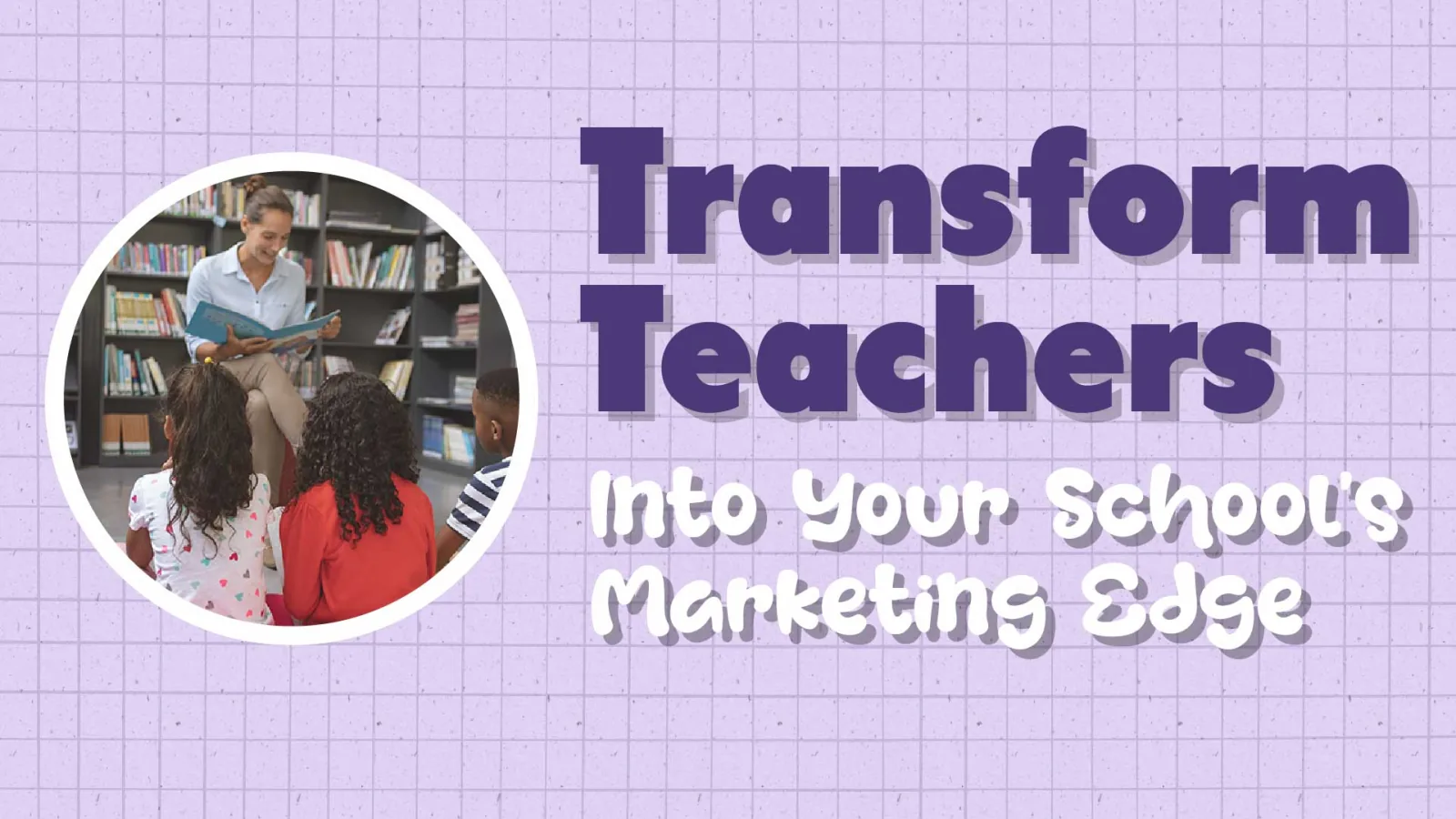
Your most powerful marketing asset is currently teaching algebra to 7th graders in room 204.
For all the sophisticated digital strategies and polished websites we create as marketers, the most persuasive selling point often remains underutilized on school websites: the exceptional educators who deliver your product every single day. It's like having a Ferrari but never showing potential buyers what's under the hood. Your website should be the showcase for your school's greatest asset — your teachers — not just a pretty digital brochure.
Here's the cold, hard truth: No parent has ever written a $25,000 tuition check because they fell in love with your mission statement. They're investing in the people who will be shaping their child's mind for the next several years. Yet most schools relegate faculty to an afterthought in their marketing strategy — a sterile directory with awkward headshots and dry credentials that could put an insomniac to sleep.
It's time to stop the madness. This post will show you how to build a comprehensive "Faculty Expertise Showcase" strategy that drives enrollment, enhances your school's reputation, and even improves teacher retention. Whether you're a marketing director trying to hit ambitious enrollment targets, a principal looking to elevate your school's profile, or a parent leader hoping to see your school thrive, this approach delivers results where they matter most.
Why Faculty Expertise Is Your Marketing Goldmine
The Research-Backed Connection Parents Actually Care About
Let's talk data for a moment. According to EdChoice, an overwhelming 97% of private school parents report being satisfied with their child's school, with 60% being "very satisfied." Compare that to public schools at 82% and 43% respectively. What drives this satisfaction gap? Teacher quality consistently tops the list.
A study from the National Center for Education Statistics found that over 70% of private school parents were "very satisfied" with their school's teachers and academic standards. Parents aren't paying for your mission statement — they're paying for Ms. Jenkins, whose passion for literature has transformed reluctant readers into budding poets.
But here's where it gets interesting (and where most schools drop the ball): while parents love your teachers, the teachers themselves often feel undervalued. The 2021 NAIS Teacher Satisfaction Survey revealed that fewer than 60% of independent school teachers feel they receive "meaningful feedback for growth." Many report dissatisfaction with recognition and compensation.
See the golden opportunity here? A robust faculty showcase serves a dual purpose: it markets your school's greatest asset to prospective families while simultaneously recognizing and validating your teachers' expertise. It's the marketing equivalent of having your cake and eating it, too.
How This Directly Addresses What Parents Are Really Looking For
Think about your most sophisticated prospective parents — the ones who do deep research before they ever fill out an inquiry form. These Parent Researchers aren't swayed by marketing slogans or mission statements. They want substance. They're looking for evidence of academic excellence, not just claims about it.
When your biology teacher writes an article on "How We're Teaching Advanced Genetics to 10th Graders," you're giving these research-oriented parents exactly what they crave: tangible proof of educational value. You're showing, not telling.
The SEO Advantage You're Completely Missing
Here's something your competitors probably don't know: Google's quality ranking algorithm, known as E-E-A-T (Experience, Expertise, Authoritativeness, and Trustworthiness), now explicitly prioritizes content created by authors with demonstrable, first-hand experience.
What does this mean in plain English? An article on "innovative math teaching" written by your veteran math department chair will outrank generic content written by a marketing intern every single time. Google is literally telling us to let our faculty experts create content.
When your physics teacher writes a definitive article on "Teaching Quantum Mechanics to High Schoolers" that ranks nationally, you're not just attracting traffic — you're building domain authority that elevates your entire website's ranking. Suddenly, you're showing up higher in searches for "best private school in [your city]" because Google sees you as an educational authority. It's the digital marketing equivalent of compound interest.
Creating a Faculty Showcase Strategy That Actually Works
Step 1: Reimagine Faculty Profiles (Because Nobody Cares About Where They Got Their Master's Degree)
Let's be brutally honest: your current faculty directory is probably putting prospective families to sleep faster than a glass of warm milk. Static headshots, dry credentials, and perhaps a generic paragraph about teaching philosophy — it's all so... forgettable.
Time for a complete overhaul. Each faculty profile should be a micro-story that captures the essence of the educator. Here's what works:
- Authentic Visuals: Ditch the formal headshots. Show teachers in their natural habitat — leading a dynamic classroom discussion, coaching on the field, or mentoring students. Short video clips (even just 10 seconds) add a powerful human dimension that standard photos can't match.
- Narrative Biographies: Nobody really cares where Ms. Johnson got her master's degree. They care about why she's spent 15 years teaching middle school science when she could probably make twice as much in the private sector. They want to know what makes her eyes light up when she talks about cellular biology. Tell that story.
- Proof of Expertise: Don't just say your teachers are experts — prove it. Link to their published articles, conference presentations, or innovative student projects they've led. This concrete evidence is what persuades Parent Researchers far more than vague claims about "faculty excellence."
- Interactive Elements: Consider adding a Q&A format that reveals personality and teaching approach. Questions like "What's the most innovative project you've done with your students?" or "What book has most influenced your teaching?" provide deeper insight than standard biographical information.
Pro tip: Create a simple online form for faculty to fill out over the summer. This streamlines data collection and ensures a consistent format across all profiles.
Step 2: Transform Classroom Knowledge Into Content Gold
Now that you've built compelling faculty profiles, it's time to systematically convert your teachers' knowledge into high-value content that attracts and engages prospective families.
Start by surveying your admissions team about the most frequently asked questions from prospective parents. These questions are content gold — they reveal exactly what your target audience wants to know. Then match these questions with faculty expertise to create a targeted content plan.
Effective formats include:
- In-Depth Articles: Faculty-authored blog posts on pedagogical approaches, curriculum deep-dives, or practical advice for parents. "How to Foster Mathematical Thinking at Home," written by your math department chair, provides genuine value while showcasing expertise.
- Webinars: Live or pre-recorded presentations where faculty experts share knowledge on topics like "Navigating the College Admissions Process" or "The Science Behind Our Reading Program." These are particularly effective for capturing contact information from high-intent prospects.
- Downloadable Guides: Compile faculty insights into comprehensive e-books or white papers on topics that matter to parents. "The Middle School Transition: A Comprehensive Guide for Parents" can become a powerful lead generation tool.
Every piece of content must feature a clear author byline with the faculty member's photo, title, and credentials, linking back to their full profile. This sends powerful E-E-A-T signals to Google while building a personal connection with prospective families.
Step 3: Make "Great Teaching" Tangible Through Student Success Stories
Abstract concepts like "academic excellence" must be made concrete through stories that connect teacher expertise directly to student outcomes.
Document innovative classroom activities with high-quality photos and videos. Create short "Classroom Snapshot" videos featuring a teacher explaining an innovative lesson, followed by clips of engaged students. These visual elements make the abstract concept of "good teaching" immediately tangible to parents.
The most persuasive content connects faculty expertise directly to student outcomes. Create "Alumni Spotlight" features where graduates explicitly discuss how specific teachers prepared them for success in college and careers. These testimonials provide irrefutable proof of your value proposition and directly address the Parent Researcher's need for evidence of return on investment.
Multi-Channel Promotion: Getting Eyes on Your Faculty Content
The Digital Campus: Website Optimization for Maximum Impact
Your school website is the natural home for your Faculty Expertise Showcase. Here's how to optimize it for maximum impact:
- Dynamic, Filterable Directories: Implement modern faculty directories with robust search and filter tools that allow users to sort by department, grade level, or areas of expertise. This functionality transforms a static list into an engaging, user-friendly resource.
- Dedicated "Faculty Spotlight" Sections: Create curated pages that feature rotating educators. In-depth interviews and Q&As provide excellent, shareable content for prospective families.
- Strategic Placement: Don't bury faculty content in a remote corner of your site. Weave it into high-traffic pages like your homepage, admissions sections, and academic program pages. A compelling faculty quote or video snippet on your homepage immediately communicates that your teachers are your priority.
Social Media: Platform-Specific Strategies That Actually Work
Each social platform requires a distinct approach to effectively showcase faculty expertise:
- LinkedIn: This is your professional authority platform. Share faculty-authored academic articles, announce conference presentations, and highlight professional development achievements. This content targets educational consultants, peer institutions, and professionally-minded parents.
- Instagram & Facebook: These platforms excel at authentic, visual storytelling. Use Instagram Stories and Reels for "day-in-the-life" features, "teacher takeovers," and short Q&A videos. With 82% of teachers active on Instagram, it's a key channel for both community building and faculty recruitment.
- Email Marketing: Faculty content should be a prominent feature in newsletters to current parents (driving retention and word-of-mouth referrals) and in automated nurture campaigns to prospective families (building trust and demonstrating academic depth).
Pro tip: Efficiency comes from repurposing content across platforms. A single faculty Q&A can become a series of quote graphics for Instagram, a short video clip for Reels, and a link to the full profile on LinkedIn.
Extending Influence: Professional and Academic Networks
To build true institutional prestige, your showcase must extend beyond your own channels:
- Academic Publications: Support faculty who publish their research or pedagogical insights in respected journals or industry publications. These third-party validations are powerful endorsements of your academic rigor.
- Speaking Engagements: Encourage teachers to present at education conferences and promote these sessions heavily across your digital channels before, during, and after the event.
- LinkedIn for Professional Referrals: Use LinkedIn's precise targeting capabilities to reach educational consultants, psychologists, and other professionals who refer students. By showcasing faculty with specific expertise—for example, in learning differences or gifted education—you can generate qualified, mission-aligned referrals.
Implementation Blueprint: Making This Actually Happen
Building Your Content Engine Without Overwhelming Faculty
The practical challenge is producing consistent, high-quality content with busy teachers. The solution is a streamlined editorial workflow:
- Ideation: Hold regular meetings with department heads and admissions staff to identify content opportunities based on curriculum highlights and common parent questions.
- Content Brief: For each approved idea, create a simple one-page brief outlining the topic, audience, key takeaways, and deadline.
- Flexible Creation Methods: Here's the key to faculty buy-in: don't always make them write from scratch. A 30-minute Zoom interview that your marketing team transcribes and edits into a polished blog post is often more efficient than asking a busy teacher to write an article.
- Streamlined Review: Keep the approval process simple—just the faculty member and marketing lead—to ensure accuracy and maintain momentum.
- Recognition: Create an internal system to celebrate faculty contributors, making them feel valued for their efforts.
The Content Calendar: Planning for Maximum Impact
A strategic content calendar ensures your faculty showcase aligns with key school milestones:
- Admissions Cycle Alignment: Schedule content that addresses common admissions questions just before your application season opens.
- Academic Cycle Integration: Plan content around curriculum highlights, student assessments, and major school events.
- Realistic Cadence: Based on your team's bandwidth, establish a sustainable posting schedule. Consistency trumps frequency every time.
Measuring What Actually Matters: KPIs for Success
To justify the investment and refine your strategy, track these key performance indicators:
- Website Engagement: Monitor traffic to faculty profiles and faculty-authored content. Pay special attention to Time on Page (high duration indicates deep engagement) and Conversion Rate (the percentage of visitors who read faculty content and then complete an inquiry form).
- SEO Performance: Track keyword rankings for faculty-related topics, backlinks earned by faculty content, and overall growth in organic search traffic.
- Admissions Metrics: In interviews or on inquiry forms, ask families what prompted them to reach out. Track how often "academic reputation" or "teacher quality" are cited.
- Internal Metrics: Monitor year-over-year faculty retention rates and satisfaction scores to measure the internal impact of your recognition efforts.
The Strategic Advantage: Why This Matters Now More Than Ever
In today's hyper-competitive educational landscape, the schools winning the enrollment game aren't just the ones with stunning campuses or flashy digital presence—they're the ones strategically integrating their most powerful differentiator into their marketing: their exceptional faculty.
Let's be clear: Your beautifully designed website and professional social media strategy are essential foundations. But what transforms these digital assets from good to extraordinary is showcasing the remarkable educators who bring your educational philosophy to life every day.
A Faculty Expertise Showcase strategy creates a powerful virtuous cycle that no competitor can easily replicate:
- External Impact: Prospective families see tangible evidence of academic excellence, increasing inquiries, and enrollment yield.
- Internal Transformation: Faculty feel valued and recognized, improving retention of your intellectual capital.
- Digital Authority: Your school website gains domain authority through expert-authored content, elevating search rankings.
- Brand Differentiation: While competitors all make similar claims about "excellent teachers," you're actually proving it.
The private schools that will dominate their markets in the next five years aren't leaving their faculty expertise hidden in classrooms—they're strategically amplifying it across every channel. They're turning their teachers into visible thought leaders, and in doing so, turning interested prospects into enrolled families.
Your next step? Transform your most valuable asset into your most powerful marketing advantage. Let's build a customized Faculty Expertise Showcase strategy that integrates seamlessly with your existing digital platforms and delivers measurable enrollment results.
Contact me to get started with a Faculty Showcase Strategy Session.
Frequently Asked Questions
How Do We Get Buy-In From Reluctant Faculty Members?
Start with your most enthusiastic teachers—every school has natural ambassadors who love sharing their passion. Their success will inspire others. Make participation as easy as possible by offering multiple contribution methods (interviews rather than writing assignments). Finally, create a recognition system that celebrates participants, perhaps including a small stipend or professional development credit.
What If We Have a Limited Marketing Budget?
Focus on quality over quantity. One exceptional faculty profile or article per month is better than weekly mediocre content. Leverage free platforms like LinkedIn and repurpose content across channels to maximize efficiency. The most resource-intensive part—capturing faculty expertise—can be accomplished with just a smartphone camera and basic editing tools.
How Do We Balance Showcasing Star Faculty Without Creating Jealousy?
Create a systematic rotation that gives everyone an opportunity to shine. Focus on different departments, grade levels, or teaching approaches each month. Emphasize that this initiative is about showcasing the breadth of expertise across your school, not just highlighting a few favorites.
How Can Small Schools Compete With Large Schools That Have More Resources?
Small schools often have an advantage: closer faculty-student relationships and more personal attention. Lean into these strengths. In a smaller community, teachers often wear multiple hats and bring diverse expertise—showcase this versatility. Quality always trumps quantity, and authentic stories from a small, tight-knit community can be incredibly compelling.
How Long Before We See Results From This Strategy?
Some benefits, like increased faculty morale, may be immediate. SEO improvements typically take 3-6 months to materialize significantly. Enrollment impact is generally visible within one admissions cycle, though the full cumulative effect builds over 2-3 years as your content library and domain authority grow.