Let me paint a picture. You're Maria, the marketing director at a 380-student faith-based school somewhere in North Carolina. Your budget is $50,000 to $75,000 a year. You're wearing five hats. The head of school expects enrollment to stay stable or increase, the development director needs alumni engagement, and your principal keeps asking why Instagram followers aren't translating to applications.
Here's the thing: you're not alone in this, and the problem isn't your effort. The problem is that schools like yours often set marketing goals the way my uncle Jerry sets New Year's resolutions. Big picture, zero plan, collapse by February.
Most school marketing goals suffer from one of two problems. Either they're too vague—"increase enrollment" or "build our brand"—or they're too ambitious without any bridge between here and there. Someone in a conference room says, "We need 50 more students next year," but nobody stops to ask: What does the marketing funnel need to generate to make that happen? How many inquiries? How many applications? And what's your realistic conversion rate?
This guide walks you through a practical, step-by-step process for setting marketing goals that live in the real world. Not fantasy land. Not theory. The kind of goals you can actually execute with your team, your budget, and your schedule.
Why Your Old Goals Probably Didn't Work
Before we build something new, let's talk about why the old approach failed. And I'm not saying this to be harsh; I'm saying this because if you don't understand the failure, you'll repeat it.
Most school marketing plans confuse two completely different things: enrollment goals and marketing goals. Your admissions director has an enrollment goal—"We need 45 new students next year." That's their number. But what's your marketing number? How many inquiries does your funnel need to generate so the admissions team can convert 45 of them into enrolled students?
That gap right there? That's where plans die.
You can't hit an enrollment goal. Only your admissions team can do that through tours, follow-ups, financial aid conversations, and family fit. But you absolutely can hit a marketing goal: generating a specific number of qualified inquiries within your budget.
The second reason old goals failed is that they weren't tied to your calendar or capacity. A one-person marketing team can't execute the same plan as a five-person department. Yet many schools write goals that assume infinite time and resources. When February rolls around, and you're drowning, you abandon the plan. Six months later, nobody remembers what the goal was.
The third reason is measurement paralysis. Some schools set goals but never look at them again. Others collect so much data they can't tell what matters. You need 2-3 key metrics, not 15. As research shows, schools that rely on accurate data backing every decision are better positioned to succeed, but that doesn't mean tracking everything. It means tracking the right things.
What's the Real Difference Between Enrollment Goals and Marketing Goals?
Let me use a construction analogy because Chad thinks in those terms. Your admissions team is the foreman. Your marketing team is the site manager bringing workers to the job site. The foreman's goal is, "We need 45 new students by August." Your goal is, "We need to deliver 180 qualified leads to the admissions team by June so they can convert them into 45 enrollees."
The admissions team controls what happens after the lead arrives. Are they responsive? Do they follow up? Can they articulate school culture? Do they close the family emotionally? That's their job. You don't control conversion rates. You control traffic and lead quality.
Here's a practical example. According to research on private school enrollment funnels, inquiry-to-application conversion rates typically run between 15-25%. Let's say your school converts at 20%. If the admissions team needs 45 new students and your yield rate (applicants to enrollees) is 40%, they need 112 applications. If your inquiry-to-application rate is 20%, you need to generate 560 inquiries.
That's your marketing goal: 560 inquiries by a certain date.
Is that realistic on a $50K–$75K budget? Let's find out.
The Backward-Planning Framework: Start With Enrollment, Work to Marketing
This is where Chad gets practical. Grab a spreadsheet and answer these questions in order.
Question 1: What is the enrollment growth target? This comes from your head of school or board. Let's say they want to stay flat at 380 students, but fill 25 seats that opened up from attrition (our retention strategies guide covers the other side of that equation). That's your starting number.
Question 2: What's your admission yield rate? Look at last year's data. How many admitted students actually enrolled? If 70 families got offers and 28 enrolled, your yield is 40%. This varies by school. Highly selective schools might hit 50–60%. Others run 30–35%. Be honest.
Question 3: What's your inquiry-to-application conversion rate? How many inquiry forms did you get last year? How many applications were submitted? Divide one by the other. Typical conversion rates range from 10-35% depending on your school type, but your actual number is what matters.
Now work backward.
If you need 25 new students and your yield is 40%, you need 62 admitted candidates. If your application-to-admission rate is 70% (typical for moderately selective schools), you need 88 applications. If your inquiry-to-application conversion is 20%, you need 440 inquiries.
440 inquiries are your marketing goal for the year.
Can you hit it on your budget? Maybe.
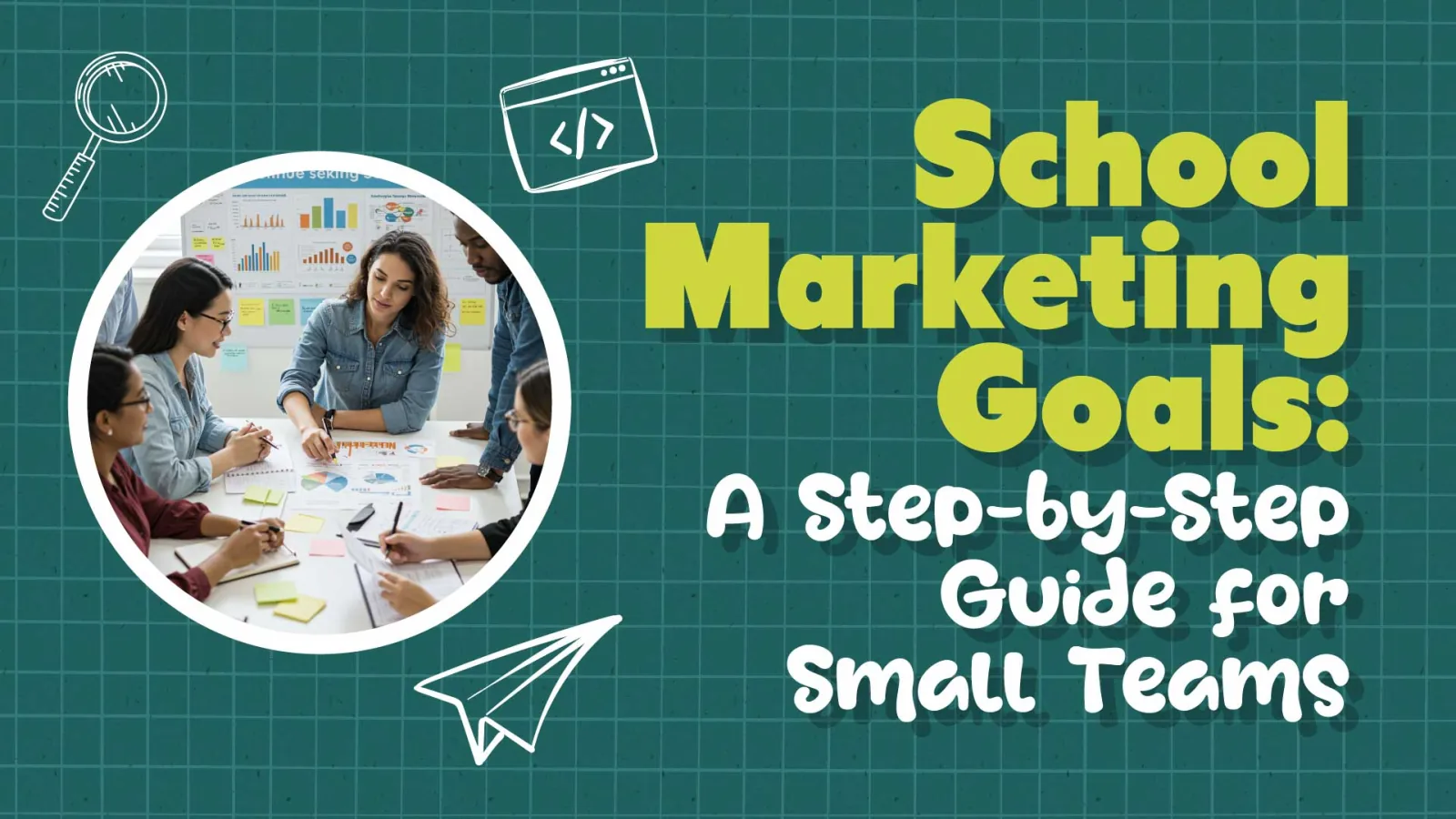
A one-person marketing team can win by planning annually, meeting quarterly, and routinely revisiting that plan. Goals like improving newsletter readership or strengthening communication with parents are good starting points for that planning process.
But you need to know whether 440 is asking for 12 inquiries a month (totally doable) or 60 inquiries a month (requires paid ads, events, and serious legwork).
Break it monthly and by channel. How many come from your website? How many from events? How many from social media? How many from referrals? This isn't guessing; it's looking at last year and deciding what to improve.
The SMART Framework Applied to School Marketing Goals
Okay, you've got your inquiry target. Now make it real with the SMART framework: Specific, Measurable, Achievable, Relevant, and Time-bound.
Let's say your backward calculation says you need 440 inquiries. A vague goal would be: "Generate more inquiries." A SMART goal would be: "Generate 440 qualified inquiries (name, email, grade level interest, contact consent) between January 1 and June 30, tracked weekly in Salesforce, with a quarterly review on March 31 and May 31."
See the difference? The second goal tells you exactly what you're aiming for, how you're measuring it, when you're checking in, and what counts as a qualified lead.
SMART goals—specific, measurable, achievable, relevant, and time-bound—keep your plan realistic and accountable according to enrollment management best practices. When you apply SMART to school marketing goals, you're not setting yourself up for disappointment; you're setting yourself up for course correction.
Here's a template you can steal:
Goal: Generate [X] qualified inquiries (defined as [your criteria]) in [timeframe] using [primary channels], tracked [frequency], with performance reviewed [check-in dates].
Example: Generate 440 qualified inquiries between January and June using website forms, community events, and email referral campaigns, tracked weekly, with reviews on March 31 and May 31.
Working With Your One-Person (Or Small Team) Reality
This is where I want to be straight with you. You're not a five-person marketing department. You don't have the bandwidth to run five channels at full capacity. You need to pick your battles.
When you're a one-person marketing team, planning annually, meeting quarterly, and routinely revisiting that plan is key. More importantly, set your goals for the year and then anchor them to one or two channels that will actually drive results.
Here's a practical breakdown of how a $50K–$75K budget typically splits (this is flexible based on your school):
- Website and SEO: $12K–$15K (hosting, maintenance, ongoing optimization)
- Paid advertising (Google Ads, Facebook/Instagram): $15K–$20K (your biggest lever for inquiry volume)
- Events and community marketing: $5K–$8K (tours, open houses, print materials)
- Email and automation: $2K–$3K (nurturing existing leads and alumni)
- Staffing: $12K–$18K (if you're contracting part-time help; your salary comes from the school budget)
According to education marketing benchmarks, 54% of schools surveyed have annual marketing budgets over $70,000, while 28% allocate more than $120,000. You're in a reasonable range, but that means you're competing against schools with larger teams and budgets. Your advantage is focus and speed.
Pick the two channels where you'll concentrate. For most small private schools, that's website/SEO for organic long-tail traffic (cheap, consistent, builds over time) and targeted paid ads (Facebook, Google) for seasonal inquiry volume. Everything else is supporting these two.
Now set your goals per channel. If paid ads deliver 60% of your inquiries and organic search will deliver 30%, with referrals filling the rest, your numbers look like this:
- Paid ads: 264 inquiries (60% of 440)
- Organic search: 132 inquiries (30% of 440)
- Referrals and other: 44 inquiries (10% of 440)
Suddenly, it's not "generate 440 inquiries." It's "generate 264 inquiries from paid ads that spend $15K, deliver 264 clicks to landing pages, and achieve a 10% form submission rate."
That's a goal you can manage as one person.
Aligning Your Goals With the School Calendar and Seasonality
Here's something a lot of marketing plans miss: your school's calendar and the enrollment calendar are different.
Summer break isn't your marketing break; it's often your enrollment decision crunch. Families are making school decisions in June, July, and August. Back-to-school marketing in August is too late if you're trying to fill seats for August. Your primary inquiry season is January through April, with a smaller spike in July for families moving or changing schools.
Set your inquiry goals monthly, not annually. January–April should deliver 70% of your annual inquiries (that's about 300 of your 440). May–June is follow-up and summer overflow. July–August is secondary for families finding new schools. September–December is lower volume, but not zero.
When you break it down seasonally, your quarterly reviews become useful. On March 31, you should have 150 inquiries (about one-third of your annual goal). If you're at 120, you know you need to adjust. If you're at 180, you're ahead. Seasonal planning tells you when to push and when to pace yourself.
Also, remember that responding to an inquiry within 5 minutes is 21 times more effective than waiting 30 minutes or longer. This is an operations goal, not a marketing goal, but it affects your marketing outcomes. Make sure your admissions team commits to response time.
What To Do When You Miss a Goal Mid-Year
Here's the thing nobody wants to say: you might not hit your goal. That's not failure. That's data.
Let's say it's April 15, you've hit 120 of your 150 inquiry targets, and you're 30 short. You have two options: accelerate or adjust.
Accelerate means doubling down. Increase your paid ad spend by $1,500–$2,000 in May. Extend your open house event to an extra session. Email every referral source and ask for one more recommendation. This makes sense if you're close and the shortfall is temporary.
Adjust means rethinking your assumption. Maybe your inquiry-to-application rate is lower than you thought. Maybe you're getting great inquiries, but they're not converting to applications because the application is too long or confusing. Maybe your school's actual capacity for tours is lower than the admissions team thought. You solve that by talking to admissions: "We've got 400 inquiries. Why are only 40 converting to applications instead of 80?"
When you miss mid-year, the worst thing you can do is bury it and hope the next half fixes it. The second-worst thing is pretending you never set a goal. The best thing is asking why and adjusting.
Sometimes the goal was wrong. Sometimes the execution was weak. Sometimes outside factors (the local economy, a competitor opening, new state regulations) changed the game. None of that means your goal was a mistake. It means your system is working. You're learning.
Making Goals Stick: Tracking Without Drowning in Data
You've set your SMART goals, broken them into monthly chunks, and aligned them with your calendar. Now the question is: how do you track them without spending three hours a week in spreadsheets?
You need three numbers—not 15, not 30. Three.
- Total inquiries month-to-date vs. target. This tells you if you're on pace. Are you at 44 inquiries in January (should be about 44 of your 440 annual goal) or only 20? That's your headline number.
- Inquiries by channel. Which of your channels is delivering? If paid ads are generating 250 inquiries but organic search is only at 80 instead of 110, you know where to focus next.
- Application conversion rate. How many of those inquiries are actually moving to applications? If it dropped from 20% to 12%, the admissions team needs to know. You can't fix it, but you can flag it.
That's it. Those three numbers should take you 30 minutes to compile at the end of each week. Anything more granular is nice-to-have, not must-have.
Use a simple spreadsheet or a basic dashboard in your CRM. If you're using Google Forms for inquiries, you can pull data directly into Sheets. If you're using a CRM, run a simple report. The tool doesn't matter. The consistency and simplicity do.
Conclusion
Setting marketing goals as a small team with a real budget is less about inspiration and more about math and honesty. You start with what you need (45 new students), you work backward through the funnel (440 inquiries), you break it into human-sized pieces (264 from paid ads, 132 from organic), and you track it without losing your mind (three metrics per week).
You're not going to hit every goal perfectly. Maria's probably going to be 20–30 inquiries short some years. The head of school might move the target mid-year because a family is moving or a facility question comes up. That's not a plan failure; that's real life.
What matters is that you're asking the right questions, you know what you're aiming for, and you're checking in quarterly so you can adjust. That's how one-person marketing teams win. Not by being superhuman. By being intentional.
If you're working through this and realize your goals are tied up in channels you don't have expertise in (like paid ads or SEO), that's exactly when to get help. A partner who knows the enrollment marketing game can build those plans with you, manage the execution, and free you up to do the relationship work that only you can do as Maria.
Ready to set marketing goals that actually work? Contact me and let's talk about what your funnel needs this year.
Frequently Asked Questions
What if I don't have last year's data to work backward from?
If this is your first year in the role or your school didn't track inquiries, make conservative estimates based on what you know. Ask admissions: "How many families did you meet this year?" Ask development: "How many parents got your newsletter?" Use those as starting points. Run a small test in one channel (a Facebook campaign for two weeks, a Google Ads test) and use the results to extrapolate. You're building a baseline, not a perfect model.
Should I set enrollment goals, too, or just marketing goals?
Set marketing goals. The enrollment goal (how many students you need) comes from your school leadership; that's input to your planning, not output. You communicate what marketing can deliver. Then admissions communicates their conversion rates. That conversation is where you figure out if the school's enrollment target is realistic. Marketing can't fill 50 seats if the admissions team only has bandwidth to nurture 100 leads. That's a planning conversation, not a marketing failure.
How do I present goals to my head of school if they're not about enrollment?
Frame it as the bridge. "We need 45 new students. Our admissions team converts 40% of applications to enrollees, so we need 112 applications. Our inquiry-to-application rate is 20%, so we need to generate 560 inquiries. Here's my plan to deliver those 560." Now the head of school sees that marketing is directly tied to their enrollment goal; you're just speaking a different language.
What if we only have a $30K budget, not $50K–$75K?
The framework stays the same; the numbers get tighter. Our budget planning guide covers allocation models in detail. You probably can't sustain paid ads year-round. You focus on organic search and events. Your inquiry target might be 250 instead of 440. The backward-planning process is identical; the execution is scrappier. One-person teams with lean budgets win by choosing two channels instead of five and going deep instead of wide.
Is a 70% application-to-admission rate realistic, or should I use a different number?
Use your actual data if you have it. If you're selective and have more applicants than seats, your rate might be 50–60%. If you're open-admission and work hard to convert applicants, it might be 80–90%. Your school's selectivity and admissions philosophy determine this. Don't use a benchmark number that doesn't match your model.