Your school probably has a strategic plan. It probably took months to produce, involved a consultant, and is currently sitting in a binder on a shelf in the development office. Nobody has opened it since the board approved it. That is not a strategy. That is a compliance document.
A real SWOT analysis is supposed to be the diagnostic that drives every enrollment and marketing decision you make for the next year. Most schools do not use it that way because most schools have never been shown how. They treat SWOT as a brainstorming exercise; it should be a stress test.
This guide is for the principal who is also the marketing director, the admissions counselor, and the person fixing the website at 10 PM. We work with private school leaders every week who tell us their last SWOT produced exactly zero decisions. Here is how to run one that does.
What Is a School SWOT Analysis, Really?
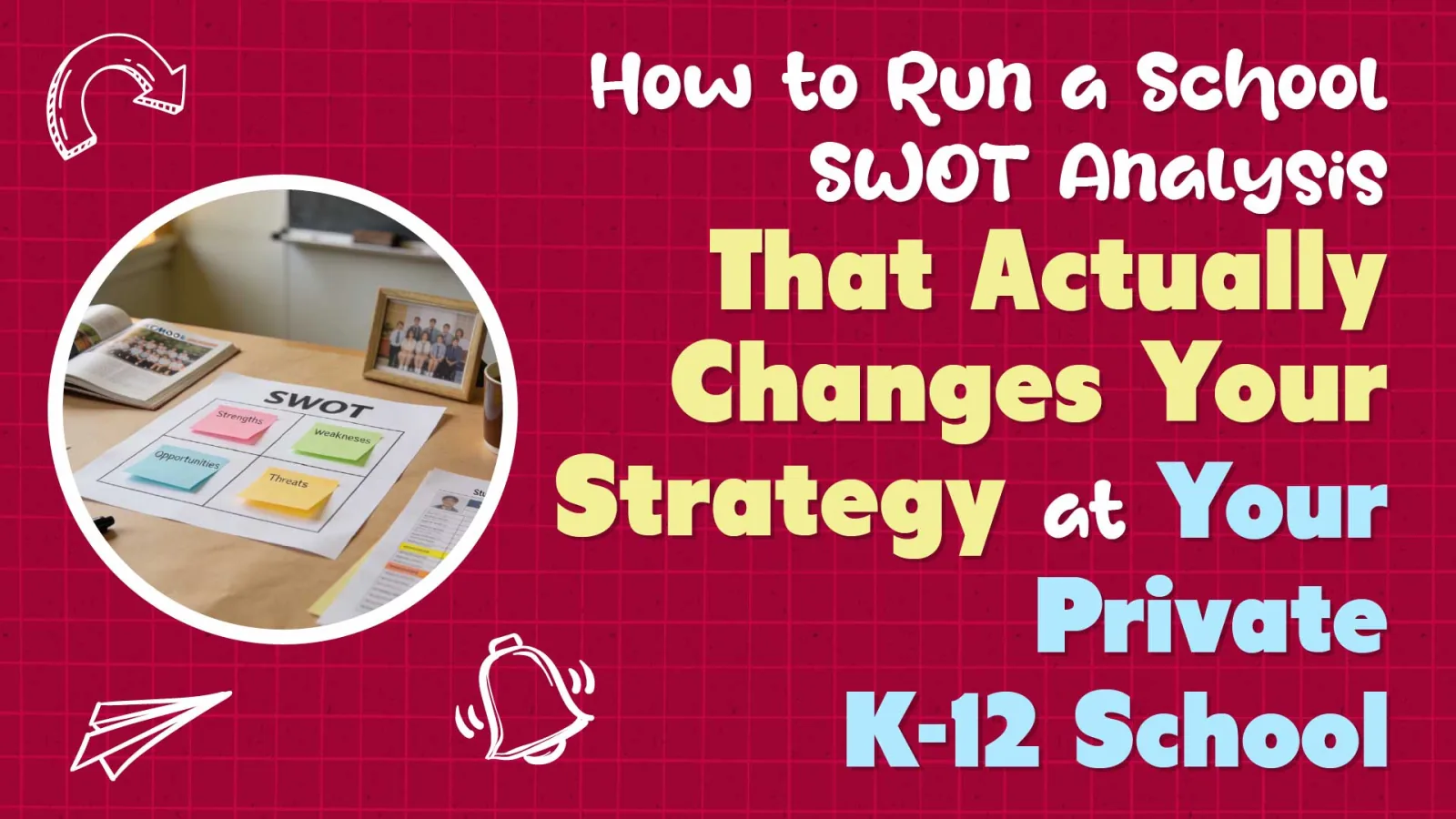
A school SWOT analysis is a structured assessment of internal strengths and weaknesses alongside external opportunities and threats. Done well, it functions as a data-driven environmental scan that drives enrollment and marketing decisions. Done poorly, it produces a binder of bullet points nobody reads.
The framework is decades old. It was originally a corporate planning tool. Schools have adopted it because it forces a useful conversation: who are we, what are we missing, what is the market doing around us, and what could end us in three years.
The mistake most schools make is treating SWOT as a brainstorming session. Five people sit around a conference table, generate a list of nice-sounding bullets, and call it done. That is a feelings exercise. Real SWOT requires data. You should walk into the room with three years of enrollment numbers, your inquiry-to-application conversion rate, your retention figures by grade, your parent survey results, and at least a glance at what your two closest competitors are doing.
Frameworks like the AdvancED school improvement model (now Cognia) sort internal factors into three domains: Leadership Capacity, Learning Capacity, and Resource Capacity. Borrow that structure when you assess your Strengths and Weaknesses. It keeps the conversation from drifting into trivia.
The point of SWOT is not the grid. The point is the three decisions you make after the grid is filled out. If you finish a SWOT session and nobody can name what you are going to do differently on Monday, you did it wrong.
Why Should Private Schools Run SWOT Differently Than Public Districts?
Private schools depend on tuition revenue, donor relationships, and brand differentiation in a way public districts do not. Your SWOT must account for enrollment pipeline health, advancement performance, and parent perception, because those are the levers that keep your school open.
Public district SWOT analyses are about taxpayer accountability, legislative compliance, and serving every student who walks in the door. Private school SWOT is about choice. Every family at your school chose you over a free option. Every family that did not enroll evaluated you and decided your tuition was not worth it. That is the central question your SWOT has to answer: why are families choosing us, and why are some choosing someone else?
This matters even more for schools where the principal is also the marketing director, the website manager, and the person writing the parent newsletter on Sunday night. If you are running marketing yourself, you are not the norm among larger independent schools with dedicated communications staff, but you are squarely in the majority among schools your size. Your SWOT has to accept that reality. The framework has to fit one person doing the work, not a five-person team.
Private school SWOT also has to weigh tuition sensitivity. A 4% tuition increase that a $35,000 prep school absorbs without notice might lose you twelve families at a $4,500 tuition point. Threats are not abstract; they show up in your retention numbers six months later.
You are not a school district trying to comply with a state assessment. You are a small business that happens to educate children. Plan accordingly.
What Counts as a School Strength in a SWOT Analysis?
A strength is any internal asset your school controls that prospective families would value if they knew about it. The catch: a strength only matters in a SWOT if it is reflected somewhere in your marketing. Hidden strengths do not enroll students.
Picture the fictional Greenfield Academy, a K-12 faith-based school with 240 students in a mid-sized city. The principal, Maria Gonzalez, sits with her admissions coordinator, two faculty members, a board representative, and one parent volunteer. They start listing strengths. The first round is generic: "small class sizes," "caring faculty," "strong community." Every private school in their state could write the same three things on a whiteboard.
Then someone asks a better question: what do we actually have that the school four miles away does not? The list changes. Faculty turnover at Greenfield is below 5% over the last five years; the new charter school down the road has lost three teachers since August. Greenfield's college matriculation rate puts graduates in schools that rival placement results from programs charging three times the tuition. Their alumni family loyalty is real and measurable; 38% of current students have a parent or sibling who also attended.
That last one is a marketing asset they have never used. Nobody on the website knows Greenfield has multigenerational families because nobody put it there.
This is the pattern. Real strengths are specific, comparative, and verifiable. "Faith-based" is not a strength; "a coherent faith identity that 82% of our parent survey says was the top reason they chose us" is. Strengths only count if you can name them, prove them, and translate them into a sentence a parent could repeat to a friend.
If your strengths sound like everyone else's, you do not have strengths. You have platitudes.
What Counts as a School Weakness?
A weakness is anything inside your operation that quietly costs you enrollment, retention, or trust. The most common ones are not what schools expect; they tend to be inconsistency, outdated technology, and unwritten processes that depend entirely on one person's memory.
Back at Greenfield, the weaknesses round is uncomfortable. Nobody wants to be the person who names them. The board representative wants to talk about facilities. The faculty members want to talk about the pay scale. The parent volunteer wants to talk about the lunch program.
Maria pushes for the harder list. The website was built eight years ago and is not mobile-friendly; 71% of their analytics traffic comes from phones. They have no CRM. Inquiries live in a spreadsheet on the principal's personal laptop. There is no formal follow-up process after campus visits, which means a family that toured in October might not hear back from Greenfield until December if Maria is busy. They have no paid search presence in a market where the new charter school three miles away is bidding on their school name.
There is also the cultural weakness Maria is unwilling to say in front of the board rep: the longtime teacher who treats every curriculum update as a personal attack, the alum on the board who thinks the logo should never change. The Park Ridge-Niles District 64 Strategic Plan listed "tradition blockers" and inconsistency in how programs were implemented across buildings as issues surfaced through their SWOT process. The same pattern shows up in independent schools.
Inconsistency is the silent killer. Inconsistent tour experience. Inconsistent communication after a campus visit. Inconsistent curriculum from one teacher to the next. Parents do not always articulate why they did not enroll; they just say the school "felt off." Inconsistency is what "felt off" usually means.
Weaknesses are not failures. They are the list of things you have permission to fix.
What Are the Best Opportunities for Private Schools Right Now?
The strongest external opportunities in private K-12 education today come from school choice legislation, demographic shifts, and competitor weakness. Schools that track these systematically pull ahead of schools that wait until the opportunity is obvious to everyone.
At Greenfield, the opportunities scan turns up three real ones. The first is school choice. The state passed an Education Savings Account program last year that gives qualifying families up to $7,500 per child for private school tuition. Greenfield has not built a single landing page targeting families who qualify. Nobody has contacted a financial advisor or a local employer who could refer ESA-eligible families. The voucher money is sitting on the table.
The second is a new residential development three miles east of campus. Two hundred sixty single-family homes priced for young professional families with school-age kids, occupancy starting in 18 months. Greenfield is the closest private school. Nobody has begun running ads targeting that ZIP code or showing up at neighborhood association meetings.
The third is competitor instability. A similarly priced K-8 school nine miles away just announced it is closing at the end of the academic year. Forty families will be looking for a new school in the next six months. Greenfield has not drafted a single targeted outreach campaign to those families. Maria found out about the closure from a parent at pickup.
Opportunities are the easiest quadrant to fill with aspirations. Resist that. An opportunity is something specific, external, and time-bound. "Use social media better" is not an opportunity; it is a wish. "Reach 40 displaced families from a closing competitor before they pick a new school" is an opportunity, and it expires in March.
If your opportunity quadrant cannot be tied to a calendar date, you are still brainstorming.
What Threats Should Private Schools Take Seriously?
Real threats are not theoretical. They are the new charter school opening three miles away, the economic squeeze on your middle-income families, the AI policy you have not written yet, and the perception that private school is only for the wealthy.
Greenfield's threat list includes the obvious: the new STEM-focused charter school opening in the fall, three miles from campus, and free. The list also includes the less obvious. Roughly 30% of Greenfield's enrollment comes from families earning under $80,000. Those families are the most vulnerable to economic pressure. A bad quarter could cost Greenfield 15 students before fall, which translates directly into a faculty position. Threats become operational problems faster than schools expect.
There is also the brand threat Maria has been hearing for a year. Several parents have mentioned, often apologetically, that their friends assume Greenfield is "one of those expensive schools" because it is private. At $4,200 a year and with 15% on financial aid, the perception is wrong. But the perception is the reality that Greenfield is marketing against. If they do not actively counter it, they lose families who never even inquire.
Then there is AI. A 2025 study published in the TEM Journal maps AI in K-12 onto a full SWOT grid, identifying new learning experiences beyond space and time limits and skills development as opportunities, and ethical concerns and over-reliance on AI as threats. Schools without an articulated AI position will be outflanked by schools that have one, both in student outcomes and in how families evaluate quality. Maria does not need an enterprise rollout plan. She needs a half-page faculty statement and a paragraph for the family handbook by the end of summer.
Threats are not the things that might happen. Threats are the things already happening that you have not addressed yet.
How Do You Actually Run a School SWOT Analysis?
Get the right people in a room, bring real data, work one quadrant at a time, and end with three decisions. The whole thing takes one afternoon if you do it right, and it is the most useful planning day on your calendar.
Step 1: Pick the Right People
Five to eight people, not fifteen. You need the head of school, the admissions lead, one veteran teacher, one newer teacher within their first three years, one board member who is not the chair, and one engaged parent. If you have a student leadership representative who is mature enough to sit in the room, add them. Do not stack the table with senior administration. The whole point is to surface things the senior team is too close to see.
Step 2: Bring Real Data
Walk in with the numbers. Three years of enrollment by grade, three years of retention by cohort, your inquiry-to-application and application-to-enrollment conversion rates, your last parent survey, Google Analytics for the past twelve months, social media engagement, and a competitor scan (websites, tuition, programs, recent announcements). If you do not have any of this, the SWOT does not happen yet. Spend two weeks gathering it; then run the SWOT.
Step 3: Work One Quadrant at a Time
Start with Strengths. Give everyone five minutes of silent writing, then go around the room. No discussion until everyone has named at least one. Force comparative language: compared to what? Then, Weaknesses, same process. Then Opportunities and Threats. The full grid should take 90 minutes. Rushing it means you skipped the second-order insights that only show up after the obvious ones.
Step 4: Make Three Decisions
This is where most SWOTs die. After the grid is filled, ask one question: What are the three things we are going to do differently in the next 90 days based on what we just named? Not ten. Three. Write them down. Assign an owner and a date. The Education Resource Strategies strategic planning guide found that effective plans focus on a few clearly defined priorities with measurable goals and deadlines, rather than sprawling lists that try to address everything at once.
If you cannot name three decisions, you do not have a SWOT. You have a list.
SWOT or SOAR: Which Framework Does Your School Need?
SWOT is for honest baseline assessment and risk-aware planning; SOAR is for visioning, momentum, and team motivation. The best approach for most schools is sequential: run SWOT first to face reality, then run SOAR to build the action plan that turns reality into a roadmap.
SOAR stands for Strengths, Opportunities, Aspirations, Results. It replaces Weaknesses and Threats with Aspirations and Results, which makes it a positive-only framework. Some schools have embraced it for that reason. After three years of pandemic-era doom-scrolling at staff meetings, faculty teams are tired of cataloging what is wrong.
The problem with SOAR by itself is that it skips the diagnostic. If your school has a real weakness, a serious threat, or a structural problem that needs to be fixed, SOAR will not surface it. You will end up with a deck of aspirational slides and the same broken inquiry-tracking process you had last year.
A conference paper published on CEUR-WS.org suggests that strategic planning based on prioritized SWOT factors can produce 35-40% improvements in learning experiences within STEAM-focused environments. Treat the specific number cautiously; the research is not peer-reviewed, and the context is narrower than a full school. The directional point still holds: SWOT-driven planning produces measurable outcomes because it forces you to confront the gaps. SOAR does not.
The pragmatic answer for most private schools is to run both. Use SWOT in February or March, when budget season is starting, and you need an honest read. Use SOAR in August, when faculty are coming back and need a vision to rally behind. SWOT names the problem. SOAR builds the team that will solve it.
Skip neither.
How Do You Keep a SWOT Analysis Useful Year-Round?
A SWOT analysis is only useful if it generates feedback loops. Schools that revisit their analysis quarterly with fresh enrollment data outperform schools that do it once and shelve it. The framework is not the document; the framework is the habit of checking your assumptions.
Think of SWOT as a four-phase cycle: engage and diagnose, interpret and prioritize, develop and implement, then review and reset. You do not need a formal framework to make this work. You need a calendar reminder. Schedule a 60-minute mid-year SWOT check-in in November or January. Pull out the three decisions you made; review what happened; update the grid where reality has changed.
The schools that get the most from SWOT do not treat it as an annual event. They treat it as a recurring quality check. The grid lives on the wall, not in the binder.
Conclusion: Turning SWOT Into Enrollment Action
A good school SWOT analysis does not produce a document. It produces decisions. And the decisions almost always point in the same direction for private schools: fix the website, build a real follow-up process for inquiries, develop messaging that counters the misperceptions families bring to the table, target the families and neighborhoods the data says are reachable, and stop relying on word-of-mouth alone in a market where competitors are buying ads against your school's name.
That is where we come in. At Cube Creative, we work with private school principals who have done the SWOT, identified the gaps, and need a partner who can translate those gaps into enrollment marketing that actually moves the numbers. We build school websites on Joomla because it is more stable, more secure, and easier to maintain than WordPress, which matters when one person is doing the marketing job. If any of this sounds like your school, let's talk. No consultant binder required.
Frequently Asked Questions
How Often Should a Private School Conduct a SWOT Analysis?
A full SWOT analysis should be conducted at least annually, ideally tied to the start of your strategic planning cycle in late winter. Schedule a 60-minute mid-year check-in in November or January to review the three decisions you made and update the grid where reality has shifted.
Who Should Be in the Room for a School SWOT Analysis?
Five to eight people work best. Include the head of school, the admissions lead, one veteran teacher, one newer teacher, one non-chair board member, and one engaged parent. Avoid stacking the table with senior administration; you want voices that can see what insiders miss.
What Is the Difference Between SWOT and SOAR for Schools?
SWOT covers Strengths, Weaknesses, Opportunities, and Threats. SOAR replaces Weaknesses and Threats with Aspirations and Results. SWOT is better for honest diagnostic work and risk-aware planning; SOAR is better for visioning and team motivation. Most schools benefit from running both at different points in the year.
How Do You Turn a SWOT Analysis Into Actual Decisions?
After completing the four quadrants, ask one question: What are the three things we are going to do differently in the next 90 days based on this? Assign each decision an owner and a deadline. If you cannot commit to three, you do not yet have a usable analysis. For most private schools, those decisions land on the same operational gaps: the website, inquiry follow-up, and paid search. That is the work Cube Creative does with private schools.
What Are the Most Common Mistakes in a School SWOT Analysis?
The top mistakes are running the analysis without data, allowing only senior administrators in the room, filling Strengths with platitudes that match every competitor, treating Opportunities as a wishlist, and failing to translate the finished grid into committed actions with owners and dates.