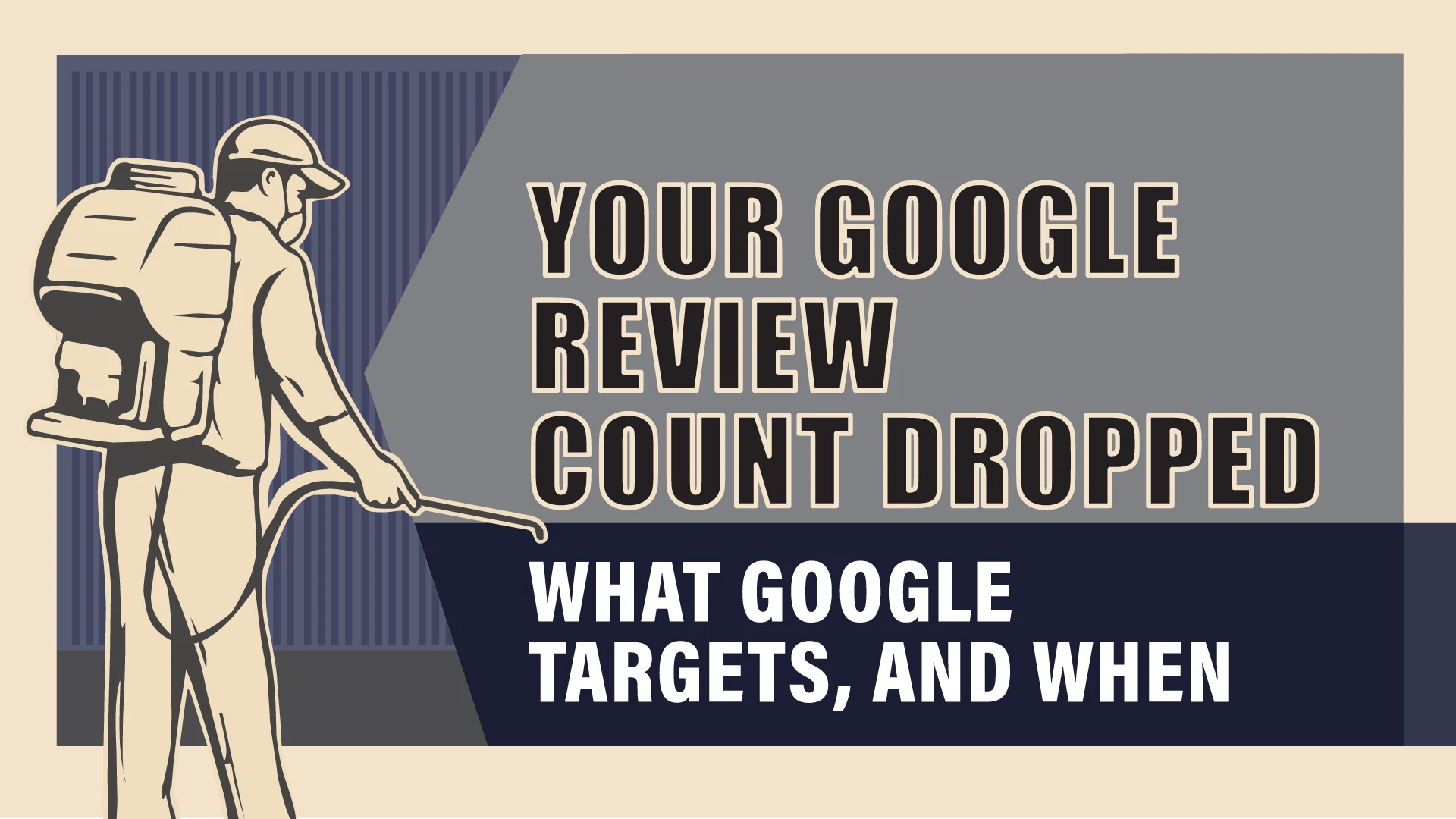
Your Google review count dropped, and nobody on your team touched it.
If you own a pest control company with a handful of trucks or a few offices, that drop now has a paper trail. A new study tracked the Google reviews deleted from pest control profiles and thousands of others, every morning for two weeks. Reviewflowz and its analysis partner Cartelis re-checked 4.9 million reviews on 9,048 Google profiles from Aug. 11 to 24, 2026. The biggest purge they saw hit pest control: four US chains lost 1,199 positive reviews in two weeks.
Owners at pest control companies tend to treat reviews like money in the bank. You ask, you collect, and the balance only goes up. This study shows Google keeps auditing the account after the deposit clears, and it audits home services harder than almost anyone.
One limit up front. The study covers two weeks in August, and it shows what Google deleted, not why. I read all 28 pages so you don't have to. Below is what it found, when reviews are most at risk, and six habits that help you keep the reviews you earn, all inside Google's own rules.
What Did the Google Review Deletion Study Track?
The Google review deletion study tracked every review on 9,048 Google Maps profiles once a day for two weeks. Reviewflowz counted a review as deleted when it showed up in one complete daily listing and was gone from the next. The panel covered seven industries, home services included, in the US and Europe.
The split was close to even. Based on findings from the Reviewflowz full report, the panel held 4,508 US profiles and 4,540 across 40 European countries, with the UK left out. Businesses were drawn by brand, so no chain was cherry-picked. Across 14 daily crawls, the team logged 4,876,933 reviews and 4,590 deletions.
Here's the catch. The study sees what disappeared, not the reason. A flag, a report, a legal request, and a customer deleting their own review all look the same from the outside. Reviewflowz stated that its results are "associations, not proven causes."
Why Should Pest Control Companies Pay Attention to Review Deletions?
Pest control sits in the most exposed corner of the Reviewflowz study. Four US pest control chains took the biggest hit of any brand. Even with them set aside, US home services lost a larger share of new positive reviews than any other industry tracked. The risk isn't limited to a few unlucky chains.
Start with the purge. Those four chains lost 1,199 positive reviews across 102 locations, which Reviewflowz put at 26% of every deletion in the panel. As reported by the study's full report, the removals came in purges on Aug. 12, 16, and 17, plus a steady removal of fresh reviews. The report doesn't name the chains or say why Google hit them, and I won't guess.
A purge that size would warp every average, so the researchers set those chains aside, along with two Spanish gyms. US home services still led the field. Here's the share of new positive reviews deleted within seven days in six US sectors, from the Reviewflowz sector data:
| US Sector | Deleted Within 7 Days |
|---|---|
| Home services | 4.1% |
| Healthcare | 3.4% |
| Wellness and fitness | 3.0% |
| Automotive | 1.1% |
| Food and beverage | 1.0% |
| Hotels | 0.4% |
That 4.1% covers every kind of home services business in the US panel, not pest control alone, and it leaves the four purged chains out. The country matters too. Data collected by Reviewflowz indicates the US loses almost twice as much as Europe: 2.1% of new positive reviews within a week, against 1.2%.
Deletions also bunch up in a few places. Reviewflowz research demonstrates that 13% of businesses lost at least one review in two weeks, while the top 1% of businesses carried half of all deletions. Across all seven industries, US groups of 4 to 10 locations were the most exposed segment. If you run a handful of offices, that's your bracket.
Will Deleted Google Reviews Hurt Your Star Rating?
Deleted Google reviews barely move a star rating. Google removes more one-star reviews than five-star ones, so the losses mostly cancel out on the average. In the Reviewflowz study, businesses that lost 5 or more reviews saw their average rating move by 0.01 star. Your count is what takes the hit.
That doesn't make deletions harmless. Reviewflowz found that 1.95% of new reviews were gone within a week, and existing reviews lose about 1.4% a year.
Think of it like shrinkage on a supply shelf. A few missing cans won't sink the business, but you still count the shelf, because homeowners see your review count right next to your stars.
Why Is a New Google Review at Risk for Its First 7 Days?
A new Google review sits on probation for about seven days. In the Reviewflowz study, Google screened negative reviews on days 2 and 3 and positive reviews on days 6 and 7. After day 8, the daily deletion risk fell to about 0.1%, roughly a tenth of the day-7 peak.
The timing follows the review's age, not the calendar. Evidence from Reviewflowz points to the same peak whatever day of the week a review was posted. This isn't a cleanup Google runs every Sunday night.
Age keeps mattering long after week one. "A review under two weeks old is about 100 times more likely to be deleted than a review over three years old." (Source: Reviewflowz full report)
That's why a review push looks better on day 1 than it is. It works a bit like a termite job: the trouble tends to show up after you've closed the ticket. Reviewflowz put the fix plainly: "Judge a review campaign on what is still online on day 8."
Which Google Reviews Does Google Delete Most Often?
Google deletes the extremes, and one-star reviews most of all. The study also found that who wrote a review mattered more than what it said. First-time reviewers, accounts Google shut down, and profiles packed with five-star reviews all lost more reviews than the rest of the panel.
Star Ratings at the Extremes
In a study by Reviewflowz, 5.7% of new one-star reviews were gone within a week, against 2.2% of two-star reviews and about 1% of three- and four-star reviews. Five-star reviews went at 1.8%. Inside the same business, the gap between four and five stars was too small to be sure of.
Who Wrote the Review
Reviewflowz researchers determined that first-time reviewers write 14% of reviews but take 22% of deletions. A first review was deleted 5.6 times more often than one from a Local Guide at level 6 or higher, which is Google's ranking for frequent reviewers. Where the author could be traced, about one deletion in five was Google removing a whole account. That pulls the person's reviews off every business at once, yours included.
What the Review Says
A review's wording barely changed its deletion risk. The Reviewflowz full report found that review length and phrases like "highly recommend" made no difference inside a business. A short review from a real customer is as safe as a long one.
Profiles That Look Too Perfect
A Google profile that looks too perfect carries its own deletion risk. As highlighted by Reviewflowz, profiles where 85% or more of reviews are five stars lost reviews at about twice the rate of profiles where 50% to 70% are five stars, at the same sector, size, and volume. The study's verdict: "A 4.9 built on 97% five-stars looks like a risk to Google."
How Can Pest Control Companies Keep the Reviews They Earn?
The habits linked to fewer deletions are simple: reply fast, ask every customer the same way, and watch the count on day 8 and every week after. None of these habits needs new software or a bigger budget, and each one fits inside Google's review policy.
Reply to Every Positive Review Within 2 Days
A reply within two days was linked to half the deletion risk for a positive review. Reviewflowz data shows that among new five-star reviews, 1.5% with an owner reply by day 2 were deleted between days 3 and 7, against 2.4% without one. After the full report adjusted for sector and size, the odds came out at about half. Same day, next day, or day 2 made no difference.
The reply on that review is what counted. A habit of replying to everything didn't protect the reviews left unanswered, and replies made no measurable difference on one-star reviews. The study calls it an association, not proof, but a short thank-you costs your office two minutes. Our guide on how to respond to Google reviews has wording your team can use.
Ask Every Customer the Same Way, Every Time
Steady asking keeps reviews from arriving in bursts. The study defines a spike day as a day with at least 3 positive reviews and at least 4 times the business's normal daily average. Reviewflowz reported that reviews posted on spike days were deleted 1.8 times more often overall, with the effect strongest in Europe.
In the US, the gap was small: 2.4% on spike days against 2.1% on normal days. Insights from the Reviewflowz full report show risk rising with the count on a single day, across both regions: 1.15% for a lone review, 1.65% for 2, 1.9% for 3 or 4, and 3.1% for 5 to 9. A busy month with three times the usual volume wasn't riskier.
So don't save up a month of customers for one big email blast. Build the request into every completed service, for every customer. That's what Google's review policy expects anyway. Businesses may "Solicit or encourage the posting of content that does represent a genuine experience," and they may not "selectively solicit positive reviews." Every customer means every customer, including the one whose callback ran late.
Count What's Still Up on Day 8
Judge every review push on day 8, not day 1. Positive reviews face their biggest screening on days 6 and 7, based on the Reviewflowz deletion timeline, so a day-1 tally overstates what you'll keep. If you reward an office or a branch for a review push, count on day 8.
Write Down Your Review Count Every Week
Pick one day a week and write down the review count for every location. A shared spreadsheet is plenty, and our Google Business Profile guide covers the rest of the profile worth watching. The early warning matters: Reviewflowz's investigation reveals that a business hit in the first week had a 33% chance of being hit again in the second, against 6.5% for the others.
A first deletion is your signal to look closer. When the count drops, check which reviews went, how old they were, and whether they arrived in a burst. Then fix the pattern that came before them.
Stop Chasing a Perfect 5.0
A wall of five-star reviews can look less real, not more. In their assessment, Reviewflowz found that profiles with 85% or more five-star reviews lost reviews at about twice the rate of profiles where 50% to 70% are five stars. The study's advice: "Mixed ratings, replies and photos read as real." For more on that, see our post on what builds trust beyond stars.
Keep Every Review Request Inside Google's Rules
Google's policy draws three lines that matter for pest control: no tech quotas, no requests for specific content such as a tech's name, and no incentives. Google's policy says businesses must not "request that specific content be included." That includes "Merchants requesting that staff solicit a certain number of reviews" and "Merchants requesting that staff solicit reviews that include specific content, including content that identifies a staff member."
Techs can still ask for a review at the end of a service. They just can't be told how many to get or what the review should say. Incentives are out too: no discount, no free treatment, and no payment of any kind in exchange for a review.
I know the pushback. Your tech review contest works, and the leaderboard in the break room proves it. But a contest that counts reviews per tech is a quota with a trophy on top, and Google's policy bars asking staff to solicit "a certain number of reviews." Reward techs for service quality and completed follow-ups instead, and let the review request go to every customer the same way.
Should Pest Control Techs Ask Customers to Mention Their Names?
No. Google's policy bars businesses from having staff request reviews that identify a staff member. If customers name your techs on their own, though, those reviews are as safe as any other. In the Reviewflowz study, reviews that named a person were deleted at the same rate as reviews that didn't.
Customers name techs all the time in this industry. Research published in the Reviewflowz full report shows that 66% of positive reviews in US home services name a person. Inside the same business, a review that names someone was deleted at 1.01 times the rate of one that doesn't, which is the same rate. Inside the four purged pest control chains, named reviews were removed slightly less often.
Those reviews also come with a bonus. Reviewflowz found that businesses whose reviews often name staff gain 2.7 times more reviews a year and end the year with about twice the net reviews. That's an association, and it doesn't change the rule.
So stop worrying about reviews that mention your techs, and don't discourage them. Just don't ask for them. A great service visit puts a tech's name in a review on its own.
What a Review Check Looks Like for a 4-Office Company
Picture a pest control company with about 20 technicians and four offices across two counties. That's the group size the Reviewflowz study found most exposed. Each office asks for reviews its own way, one runs a monthly batch email, and the techs compete in a review contest.
A review check would change five things:
- Log the count weekly. The marketing lead writes down every office's review count each Monday in one shared sheet.
- Replace the batch email. Every customer gets the same review text after each completed service, so reviews arrive steadily instead of in bursts.
- Reply within two days. Each office owns replies for its own profile, with a backup person for days off.
- Retire the contest. Techs get recognized for service quality and completed follow-ups, not review counts.
- Judge pushes on day 8. Any office report on reviews counts what's still live after the screening window.
Nothing here promises the count will never drop, because Google still makes the call. What the company gains is an early warning when an office starts losing reviews, and a review program that stays inside Google's rules.
Watch Your Review Count Like You Watch Your Routes
Google keeps screening reviews after they post, hardest in their first week. Your star rating will hold up, but your count needs watching. Reply to positive reviews within two days, ask every customer the same way, count on day 8, log the total weekly, and keep techs clear of quotas and name requests.
If your count has slipped and you can't tell why, reach out and I'll run a review-health check on your profile. I'll look at your count trend, how fast your team replies, and how your review requests go out, then send you a short written rundown of what I find. No contract, and no pitch if your profile looks healthy.
Frequently Asked Questions
Why Did My Google Review Disappear?
Nobody outside Google can see the exact reason. The Reviewflowz study notes that flags, reports, legal requests, and authors deleting their own reviews all look the same from outside.
The study did find patterns. These reviews were lost more often:
- One-star reviews (5.7% gone within a week)
- Reviews from first-time reviewers
- Reviews from accounts Google shut down
- Reviews on profiles where 85% or more of reviews are five stars
How Long Until a New Google Review Is Safe From Deletion?
The riskiest stretch ends around day 8. In the Reviewflowz study, Google screened negative reviews on days 2 and 3 and positive reviews on days 6 and 7. After day 8, the daily deletion risk fell to about 0.1%, roughly a tenth of the day-7 peak.
No review is ever fully safe, though. Existing reviews still lose about 1.4% a year. Count the results of any review push on day 8.
Can My Techs Ask Customers to Mention Their Name in a Review?
No. Google's review policy says businesses must not have staff request reviews that include content identifying a staff member, and it bars review quotas for staff. Techs can still ask every customer for an honest review. If a customer names a tech on their own, that review is as safe as any other.
Does Replying to a Google Review Stop Google From Deleting It?
It's linked to lower risk for positive reviews, but it isn't a guarantee. In the Reviewflowz study, an owner reply within two days was linked to half the deletion risk for a positive review. Same-day and day-2 replies did equally well.
Replies made no measurable difference on one-star reviews. The study calls the link an association, not proof.
Will Deleted Google Reviews Hurt My Star Rating?
Barely. Google deletes more one-star reviews than five-star ones, so the losses mostly cancel out. In the Reviewflowz study, businesses that lost five or more reviews saw their average rating move by 0.01 star. The bigger loss is your review count, which homeowners see right next to your stars.