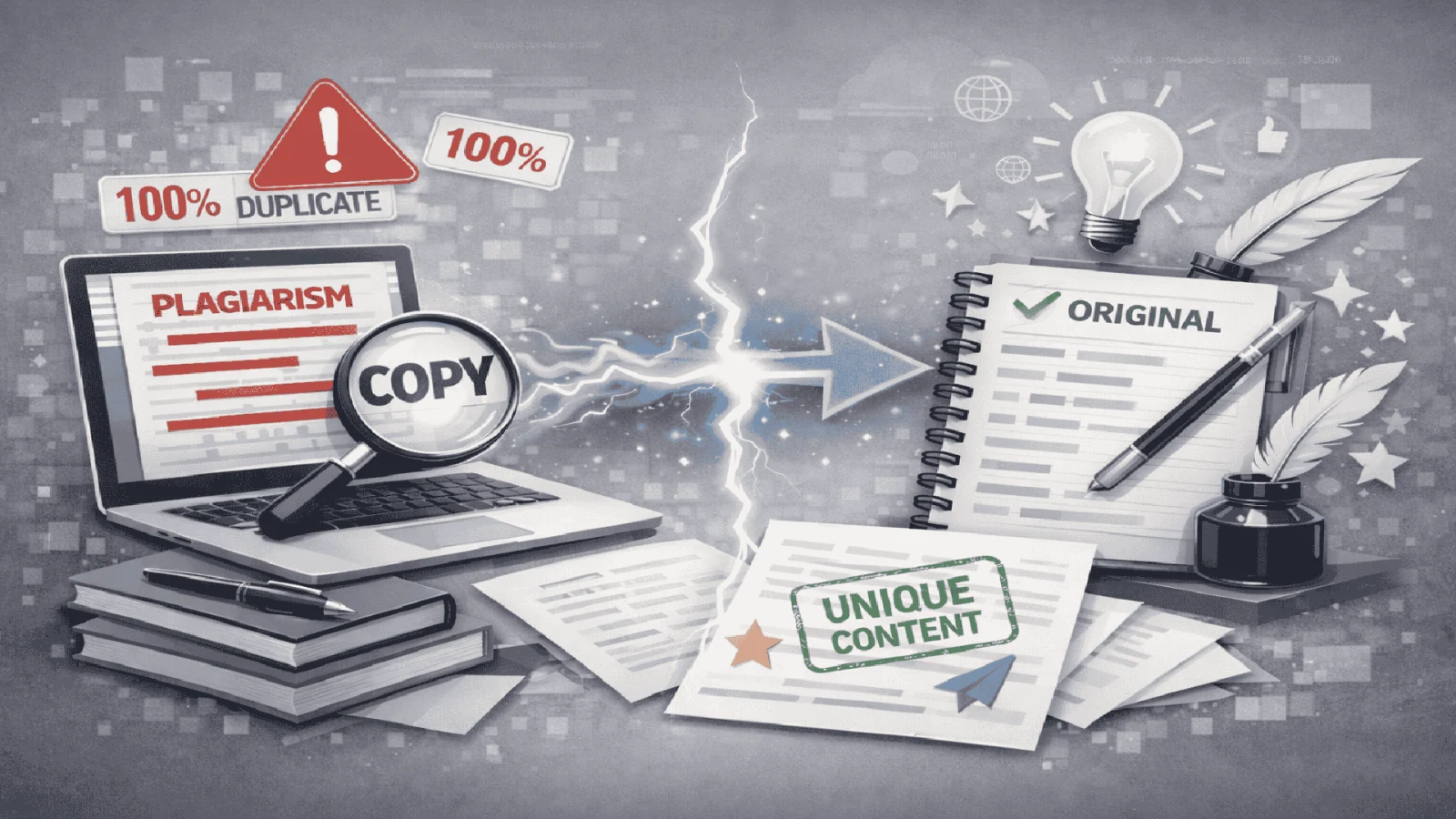
Creating content is very easy today. You can use AI tools to generate articles in seconds. Chatbots allow you to pull ideas from multiple sources and publish content at scale. But AI automation comes with some downsides. The first downside is that AI tools write plagiarized content, because they pull information from existing sources and the wording ends up overlapping the original text. The second downside is that the content is repetitive. It lacks engagement and feels robotic to read. And if you’re publishing it on search engines, they can detect the plagiarism and low-quality and penalize your content with low rankings.
AI content can be plagiarized, but avoiding AI tools altogether is not the solution because content written by humans can be plagiarized too.
The solution instead is to rewrite the AI content to remove plagiarism from it. And an easy way to remove plagiarism is through plagiarism remover tools, which is the focus of this article.
Continue reading to learn how these tools work and how they can help you remove plagiarism from content.
Why Content Quality & Uniqueness Matter
Search engines now prioritize content that's helpful and written for humans first. That means your writing should appeal to users through engagement and originality.
Simply rearranging sentences or swapping a few words won’t be enough.
When your writing lacks originality and engagement, the following things can happen:
- Your SEO performance can drop or stop improving
- Readers can lose trust in your content
- Your ideas can feel repetitive and recycled
- Engagement metrics can decline
You need to make sure your content feels natural and unique to readers, as if a human was behind its editing, and not as if it’s purely AI-generated and unedited.
What Plagiarism Remover Tools Do
A common misconception is that a plagiarism remover just spins content. That used to be true for low-quality tools. But modern tools work differently.
They analyze sentence structure and context and look at relationships between words. Best plagiarism remover tool rewrite the content without altering meaning, by:
- Varying sentences
- Diversifying vocabulary
- Improving structural flow
- Making the tone consistent
These tools help you express ideas differently, which takes more than simple swapping of words, and can enhance your writing in simple ways if you use them correctly.
Improving Readability Without Losing Meaning
Readability is also a big issue with AI content. It feels repetitive and too formal.
You’ve probably seen this before. Sentences follow the same pattern and words repeat too much. The tone also feels neutral and distant.
This is where rewriting tools shine.
They break writing patterns which are predictable and introduce variations which are less predictable.
The content feels more engaging because there’s variety in the wording.
Making Your Content More Unique
Rewriting content manually takes time. Especially when you’re working with long articles or research-heavy material.
You can use a plagiarism remover to transform the existing text into a more original version, instead of rewriting everything from scratch, while keeping the core ideas intact.
This approach works well when:
- You’re repurposing old blog posts
- You’re rewriting research-based content
- You’re improving AI-generated drafts
- You’re avoiding duplication across pages
The goal isn’t to hide copied content. The goal is to present ideas in your own voice.
That’s what makes content truly unique.
Enhancing Tone & Natural Flow
Good content doesn’t just inform. It connects.
If your writing feels robotic, readers disengage quickly. This often happens with AI-generated drafts or overly edited content.
Plagiarism remover tools help by:
- Replacing rigid phrases with natural alternatives
- Adjusting sentence rhythm
- Improving transitions between ideas
Instead of sounding mechanical, your content starts to feel conversational.
You’ll notice smoother transitions. Ideas connect more logically. The overall reading experience improves.
That’s what keeps readers on the page.
Supporting SEO Without Keyword Stuffing
There’s a fine balance between optimization and readability.
If you overuse keywords, your content feels forced. If you ignore them, you lose visibility.
Rewriting tools help you strike that balance.
They naturally distribute keywords across the text. They also introduce semantic variations, which search engines now prefer.
For example, instead of repeating the same phrase, your content might include:
- Synonyms
- Related terms
- Contextual variations
This improves SEO while keeping the content natural.
You don’t have to force keywords into every sentence.
Fixing Structural Issues in Your Writing
Sometimes the problem isn’t the words. It’s the structure.
You might have:
- Sentences that are too long
- Paragraphs that feel disconnected
- Ideas that aren’t clearly developed
A good rewriting process helps reorganize content at a sentence level. It improves clarity without changing your message.
You still control the structure. But the tool helps refine it.
Think of it as editing with assistance, not automation.
When You Should Use a Plagiarism Remover Tool
These tools are useful, but only in the right situations.
You should consider using them when:
- You’ve written a draft that feels repetitive
- You’re working with sourced material
- You want to improve clarity and flow
- You need to reduce similarity scores
However, they shouldn’t replace original thinking.
If your content lacks depth or insight, rewriting won’t fix that. You still need strong ideas.
The tool helps you express them better.
Common Mistakes to Avoid
Misuse of plagiarism removers can hurt your content, even though these tools are made to be helpful. That’s why you should watch out for a few common mistakes, including:
- Over-rewriting everything
If every sentence is heavily altered, the content can lose its natural tone. Keep some original phrasing where it works.
- Ignoring context
Always review the output text. Sometimes, small changes can affect meaning.
- Relying only on tools
Tools assist, so use them for assistance only. They can’t replace your judgment.
- Skipping manual editing
You should always do a final read. This ensures consistency and clarity.
Combining Human Editing with AI Writing
Human writing is slow. But AI writing is plagiarized and robotic, even though it’s fast. And because both sides have their downsides, you don’t have to rely on one alone.
You can instead combine both AI writing and your own editing, to get the best of both.
Start with your draft and then refine it using a tool. After that, edit it manually.
This process gives you:
- Better structure
- Improved readability
- Stronger tone
- More original phrasing
You stay in control of the content. The tool simply speeds up the process.
This is especially useful for content writers managing multiple projects.
Conclusion
Plagiarism remover tools help you refine your writing without writing or editing it from the start. These tools use paraphrasing to improve your content’s uniqueness and make it free of plagiarism.
They also make it more engaging and natural to read so readers engage with it. But plagiarism tools are best used along with your own editing because they’re not always perfect.
You may need to adjust tone or wording at some points.
These tools give you a simple way to prevent plagiarism and publish unique content with minimal effort.