
The screenshot came from a head of content with three words above it: "Is this us?" A prospect had asked ChatGPT to suggest a platform in her category. The answer recommended a competitor, then described her product by quoting a pricing page retired two years ago. By lunch her team had a plan: four new comparison pages. Nobody had checked what the engines were already reading, which is the first job generative engine optimization tools exist to do.
That instinct is familiar, and the evidence says it rarely settles anything. In CMI's research for 2026, 89% of AI-using B2B marketers use it to generate or optimize written content, yet only 39% of those users report better content performance. Output isn't the bottleneck anymore. Sight is: which questions trigger an answer, which pages get cited, and where your brand is absent.
This guide is for in-house content and editorial leads at B2B SaaS companies with roughly 100-1,000 employees and a content team of three to ten writers and editors. You own the SEO content strategy: the blog, the docs, the comparison and integration pages. Someone above you now wants that work to appear in AI answers, and you're weighing AI search optimization tools against the editor you already use.
What Should a B2B SAAS Content Team Use for GEO First?
For a SaaS content team, start with SE Visible by SE Ranking as the measurement layer. It shows the buyer prompts you track, grouped by intent and topic, the stored answer each engine gave, and the sources that answer cited. Writing before you've seen that is replying to a letter you haven't read. The honest catch: it doesn't write or optimize content, so it sits beside the editor your team already uses. The comparison and three jobs below show where each fits.
How Six GEO Tools Compare for a SAAS Content Team
Six options fit a SaaS content team: one measurement platform and five generative engine optimization tools that write, refresh, or research. Here's each one's content job, engines, writing, reporting route, and price as published in October 2026.
| # | Platform | Content job | Engines named | Writes content? | Into reporting | Starting price |
|---|---|---|---|---|---|---|
| 1 | SE Visible by SE Ranking | Measure prompts, answers, sources | ChatGPT, Gemini, AI Mode, AI Overviews | No, measures | Looker Studio, API, CSV/XLSX | Free trial available |
| 2 | Frase | Brief, draft, publish | ChatGPT, Google AI, tiered | Yes, GEO-scored | API on every plan | $39/mo annually |
| 3 | Surfer | Refresh pages, map sources | Five; ChatGPT-only on Standard | Yes, Content Editor | Export, MCP, top-plan API | $82/mo yearly; $99 with editor |
| 4 | Otterly.AI | Prompt research, citation analysis | Four base, three paid add-ons | No; audits, briefs | Looker Studio, API (Standard+) | $25/mo annually |
| 5 | Clearscope | Query discovery, term-based editing | ChatGPT, Gemini, Claude | Yes, AI drafts | Unlimited exporting | $129/mo, monthly |
| 6 | LLMrefs | Prompt volume, cited URLs | Ten, incl. Claude, Grok | No, monitors | CSV, API | $79/mo, limited time |
Job 1: Decide What to Write From the Prompts Buyers Actually Use
Start from prompts, not keyword lists: which buyer questions in your category trigger an answer, which pages it cites, and where your brand never appears. Generative engine optimization tools earn their place by showing what engines say before anyone opens a brief.
Rankings are a proxy. Researchers at Xi'an Jiaotong University and the National University of Singapore found that Google Search and OpenAI's Responses API together recovered only about a quarter of the URLs ChatGPT cited: 28.3% and 26.2%. Read the answer.
SE Visible tags prompts by intent and topic, benchmarks competitors by topic, and stores each engine's unedited answer. Among AI search optimization tools, Clearscope pairs Query Discovery with fan-out awareness, the searches behind an answer. LLMrefs estimates monthly prompt volume, while Otterly.AI brings AI Prompt Research.
Job 2: Refresh the Pages Engines Misquote or Ignore
Refreshing for AI answers means reading what the engine said about you, then fixing the page in your editor. A 2025 study of ChatGPT citations found pages updated within three months averaged 6 citations, against 3.6 for outdated pages.
Say ChatGPT tells a buyer your SSO integration needs a retired plan. SE Visible keeps that answer unedited; period comparison shows whether visibility slipped. In content operations terms, that's a ticket with evidence, not a rewrite.
Three of the five generative engine optimization tools here rewrite pages. Frase shows which of your URLs engines cite, adds a GEO score, and Content Guard drafts fixes for decaying pages. Surfer pairs Content Audit with Content Editor.
With three to ten writers, I'd refresh before writing anew: the URL already has history.
Job 3: Earn the Third-Party Sources Engines Cite
An AI answer about your category draws on other people's pages: review profiles, comparisons, forums, and trade media. Your team's job reaches past the blog: find the URLs each engine cites, then brief PR and partners with that list.
The 2025 ChatGPT study linked review-platform profiles with 3x higher chances of being cited. It's a correlation, but neglected profiles become editorial work.
Google's site reputation policy polices borrowed third-party content, and since August 30, 2026, its manual actions affect results only outside the EEA. Earn mentions; don't rent space.
SE Visible's Sources view handles AI citation tracking: domains and URLs each engine cites, grouped as media, blogs, and forums. Among generative engine optimization tools, the equivalents are Otterly.AI's Link Citations, Surfer's AI Tracker sources and mention gaps, and LLMrefs' cited source URLs.
The 6 Best Generative Engine Optimization Tools for SAAS Content Teams
The measurement platform leads; five generative engine optimization tools follow, ranked for SaaS content teams. Each card names the job it serves, why it fits editorial work, where it falls short, and the published price.
1. SE Visible
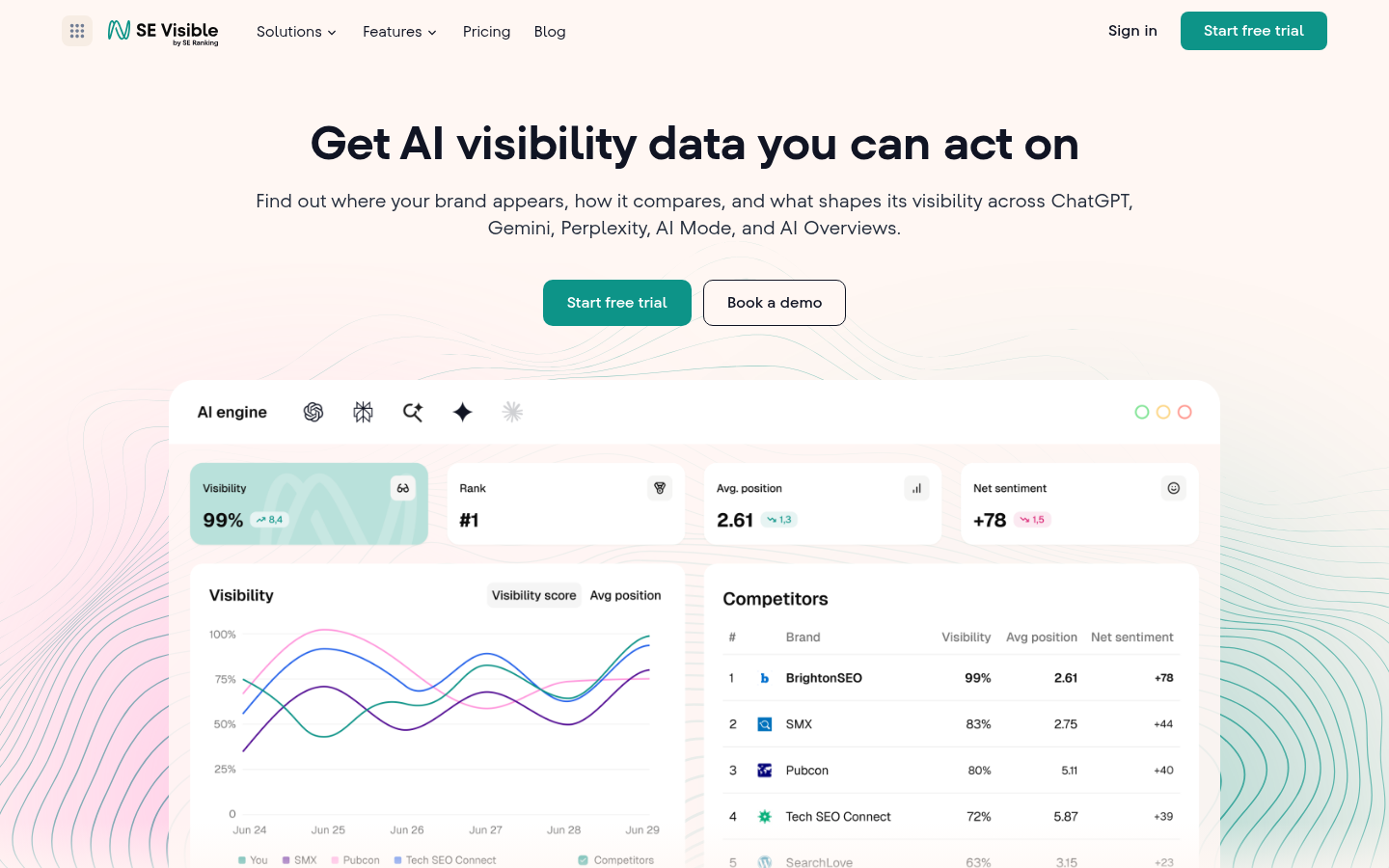
The count of buyer prompts where AI cites a competitor's page instead of yours is where a content brief should start. Think of SE Visible by SE Ranking as the measurement layer: an AI visibility platform that records the answers and citations coming back from ChatGPT, Gemini, Google AI Mode, and Google AI Overviews.
Why it works for SaaS content teams: Before commissioning a brief, the content lead reads each engine's stored answer, its market and date, and the URLs it cited. Prompt research sorts buyer questions by intent and topic, showing where competitors hold ground your pages never reach.
Standout feature: Prompt research and the Sources view double as a planning memo: missing prompts on one side, each engine's cited URLs on the other. Your team writes the brief from that.
Pros:
- Opens a dipping visibility score into the unedited answer
- Daily checks unless you reschedule them
- Sets competitor share of voice beside yours, topic by topic
- API on every plan, plus Looker Studio and exports
Cons:
- Doesn't write, brief, or optimize content, so your editor stays in the stack
- Stays with AI answers; rank tracking and site audits belong to SE Ranking
- Custom access control and Claude support are on the roadmap
- Reports built inside the app are a work in progress
Pricing: Published on the SE Visible site; test it on your own prompts with a free trial.
For the editorial calendar: If you need evidence before commissioning meetings, start here; it opens the planning cycle. See how SE Visible's prompt research maps onto next quarter's calendar. SE Ranking looks after Google rankings, so between them you read both the classic results and the AI answers.
2. Frase
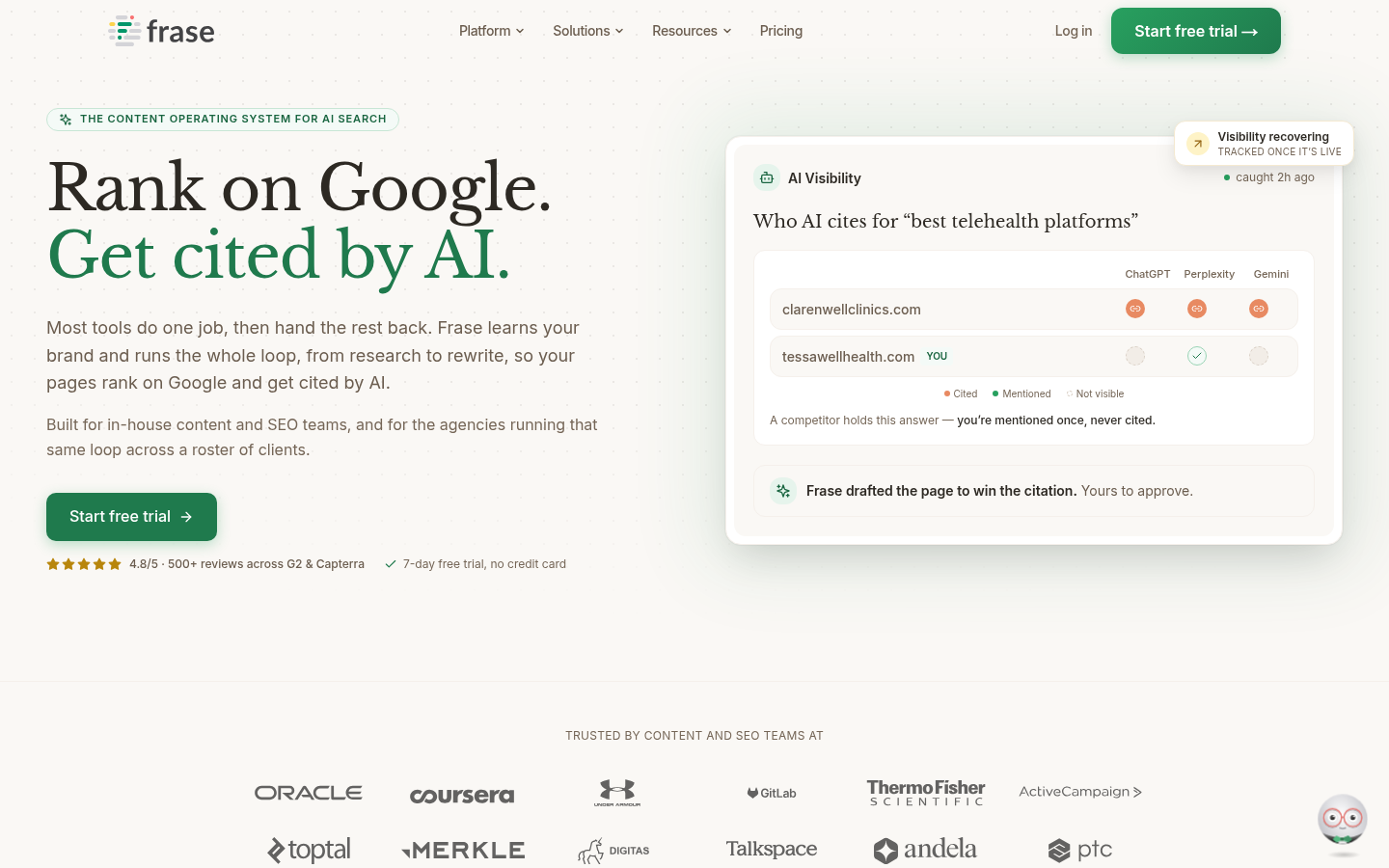
Frase, an SEO writing platform, carries a page from citation signal to brief, draft, and publish in one subscription.
Why it works for SaaS content teams: Frase shows which of your URLs an engine cites and its spot in the citation list, then lets the same writer rework and publish that page.
Standout feature: The editor scores a refresh twice: GEO beside SEO.
Pros:
- Publishes to WordPress, Webflow, Sanity, or Wix
- Flags Google decay via Content Guard and drafts the fix for approval
- Sorts tracked prompts by buying stage
Cons:
- Frase states that AI Visibility monitors and alerts but doesn't fix content automatically
- Claude and Gemini tracking start on the Scale tier
Pricing: $39/month billed yearly ($49 month to month); 7-day free trial.
For the editorial calendar: Frase keeps the shortest path from spotting a cited page to shipping its update. Choose it when one seat carries the loop.
3. Surfer
Surfer pairs its writing environment with an AI Tracker under one login.
Why it works for SaaS content teams: If your writers already draft in Content Editor or Google Docs, their routine barely moves; the tracker adds which sources LLMs pull from.
Standout feature: The tracker's source list reads like an outreach brief: sites engines trust, plus mention gaps where competitors appear and you don't.
Pros:
- Writes and refreshes pages in Content Editor
- Surfaces refresh candidates through Content Audit
- Reports share of voice and brand sentiment
Cons:
- Standard tracks only ChatGPT, weekly; five engines daily need Pro or AI Search Analytics
- Claude isn't among Surfer's supported models
Pricing: $99/month billed yearly with Content Editor; $82/month billed yearly for the tracker alone.
For the editorial calendar: Pick Surfer when your team already writes in its editor and wants generative engine optimization tools from the same vendor. Check the plan grid first: engine coverage depends on it.
4. Otterly.AI
Otterly.AI watches brand mentions and citations in AI answers, then audits single URLs for citation readiness.
Why it works for SaaS content teams: Its GEO URL audits score a page and return a brief naming what to fix. Your writers do the fixing; Otterly.AI audits and recommends, it doesn't write.
Standout feature: AI Prompt Research uncovers the prompts, topics, and intent patterns behind buyer questions.
Pros:
- Tracks ChatGPT, Google AI Overviews, Perplexity, and Copilot daily on every plan
- Maps the domains engines cite through Link Citations
- Sends data to Looker Studio through a connector
Cons:
- Charges extra for Google AI Mode, Gemini, and Claude tracking
- The Looker Studio connector and API start on the Standard plan
Pricing: $25/month billed annually ($29 monthly); a free trial is available.
For the editorial calendar: Otterly.AI is a smoke alarm for your archive: it says which pages to reopen and why, and leaves every sentence to your team.
5. Clearscope
Clearscope began as a term-based editor for writers and has grown query discovery and AI mention tracking around it.
Why it works for SaaS content teams: Unlimited users and projects let writers, editors, and reviewing subject experts share one workspace.
Standout feature: Query Discovery turns a topic or URL into the queries driving traffic and citations; fan-out awareness shows the web searches AI platforms trigger to build an answer.
Pros:
- Flags mention gaps where competitors get recommended instead of you
- Suggests terms while writers draft
- Generates AI drafts
- Tracks queries in ChatGPT and Gemini, with Claude named on its product pages
Cons:
- Business still caps tracked queries at 300
- Essentials caps tracked queries at 50 and drafts at 20 a month
Pricing: $129/month.
For the editorial calendar: Clearscope suits writers who already work from terms and briefs: discovery feeds the calendar, the editor carries the draft.
6. LLMrefs
LLMrefs turns an SEO keyword list into AI prompts and reports which sources the engines cite for each one.
Why it works for SaaS content teams: Most SaaS content teams already own a keyword map; LLMrefs starts there, so nobody hand-writes prompts before the first report.
Standout feature: Monthly AI prompt volume estimates show roughly how often buyers ask a question, beside the full set of source URLs engines cite for it.
Pros:
- Tracks 500 prompts on one plan
- Filters every cited source URL for outreach briefs
- Exports to CSV and includes API access
- Adds team members and projects without limits
Cons:
- Refreshes the dashboard weekly
- Builds prompts from keywords by design
- Doesn't write content
Pricing: $79/month, a single plan currently marked limited time.
For the editorial calendar: Among llm seo tools, it's the one for sizing a question before it earns a page.
Measure First, Then Write: Assembling a Content Team’s GEO Stack
Most SaaS content teams don't need more generative engine optimization tools. They need one measurement layer that stores what each engine answers and cites, the editor they already pay for, and proof upward built on stored answers and cited URLs.
CMI's Robert Rose writes: "AI search retrieval now acts as a universal solvent, decoupling answers from information sources." So check where your unsigned sentences land.
If you don't know what engines cite yet: SE Visible.
If one subscription runs brief to publish: Frase.
If writers draft in Content Editor: Surfer.
If you want a lighter monitoring layer next to the editor: Otterly.AI.
If planning starts from query discovery: Clearscope.
Look first, then write. Give SE Visible a try.
FAQ: GEO Tools for Content Teams
What content works best in AI search?
AI search favors pages settling one question plainly: comparisons, documentation, definitions, and integration guides, kept current. Engines also borrow from review profiles and forums. Before deciding how to optimize content for AI search, let generative engine optimization tools show which formats your category's answers cite.
Is a GEO platform the same as a content optimization tool?
No. A GEO platform measures what each engine answers and which URLs it cites. A content optimizer briefs, scores, and edits pages. Many generative engine optimization tools straddle both. SE Visible, an AI visibility platform, only measures; it doesn't write.
How do you see which of your pages AI engines cite?
Track the prompts buyers ask, store each engine's answer, and read which of your URLs it cites. That's AI citation tracking: several AI search optimization tools above handle it, and SE Visible covers it as a measurement platform. Search Console's generative AI report shows AI Overviews and AI Mode impressions, not ChatGPT citations.