Let's face it – running a pest control business is already a battle against unwanted critters. The last thing you need is to wage war against wasted advertising dollars, too. As a savvy pest control business owner, you know your marketing budget needs to work as hard as you do, strategically reaching prospective customers who are actively trying to evict their six-legged tenants. That's precisely where a Google Ads management company like Cube Creative Design enters the picture (much like you enter homes with your spray gun of justice).
We at Cube Creative Design specialize in pest control digital marketing, turning Google Ads into your virtual technician – one that works 24/7, driving leads to your business. From meticulously selecting and fine-tuning keywords to crafting high-converting ads and landing pages, we ensure your advertising dollars aren't just being sprayed around like an amateur with a fogger. Our team strategically targets relevant traffic and transforms curious searchers into loyal clients who'll call you every time they see something crawling across their kitchen floor. With our expertise managing your campaign, you can focus on what you do best – making homes uninhabitable for pests (but perfectly comfortable for humans).
What Are Google Ads, and Why Should Pest Control Companies Care?
Google Ads (the platform formerly known as Google AdWords – think of it as the "artist formerly known as Prince" of digital marketing) is the equivalent of having your pest control business card appear exactly when someone's frantically searching "OH GOD THERE'S A SPIDER THE SIZE OF MY FACE WHAT DO I DO?!"
When potential customers type in search terms like "pest control near me" or "help my house is being invaded by ants," Google Ads ensures your business appears at the top of their search results – prime real estate for capturing desperate homeowners in their moment of need. For pest control businesses, this means putting your services directly in front of people actively searching for bug-banishing heroes in their vicinity. It's like having a billboard that only appears when someone's actually looking for your services – efficiency at its finest.
Implementing Google Ads can dramatically boost your online visibility, reaching more panicked homeowners than ever before, ultimately driving more leads and turning those "ewws" and "ahhs" into scheduled appointments and revenue.
Why Google Ads Is Your Pest Control Business's New Best Friend
When it comes to marketing your pest control business, Google Ads is like having the perfect bait in your trap – it attracts exactly what you're targeting. By securing placement at the top of search results, your business gains visibility faster than termites in an old wooden house.
Google Ads allows you to create custom-tailored advertisements based on specific demographics and search inquiries – meaning you're not wasting resources advertising termite services to people searching for rodent control. This precise targeting is like having a heat-seeking missile for finding your ideal clients.
But the real beauty? Higher conversion rates. By speaking directly to the specific nightmares keeping your potential customers awake (sometimes literally, in the case of bed bugs), your ads address their immediate concerns. You're not just advertising pest control; you're advertising peace of mind to someone who just found mouse droppings in their pantry. When you target consumers actively seeking solutions to their creepy-crawly problems, you dramatically increase the chances of turning these desperate searchers into grateful clients.
The Secret Weapons in Google Local Service Ads
Google Local Service Ads pack more useful features than your favorite pest control toolkit. Just as you select specific treatments for different pest problems, your business can choose targeted keywords to trigger your ads in relevant searches. No more wasting money appearing in searches for "how to breed exotic beetles" when you're trying to reach "how to get rid of beetles."
The ability to set a daily advertising budget works like a protective barrier, preventing your campaign costs from swarming out of control. Think of Google's quality score as your business reputation in the digital world – the higher your score, the more frequently your ads appear, creating a virtuous cycle of visibility and performance.
Conversion tracking is the equivalent of setting up monitoring stations around a property – it lets you measure exactly how effective your efforts are, showing you precisely how many phone calls, emails, or inquiries your campaign generates. Meanwhile, negative keywords act like repellents, keeping unwanted traffic away and ensuring your advertising budget isn't consumed by irrelevant clicks. These tools combine to create a focused, cost-effective campaign that targets exactly the right customers at exactly the right time.
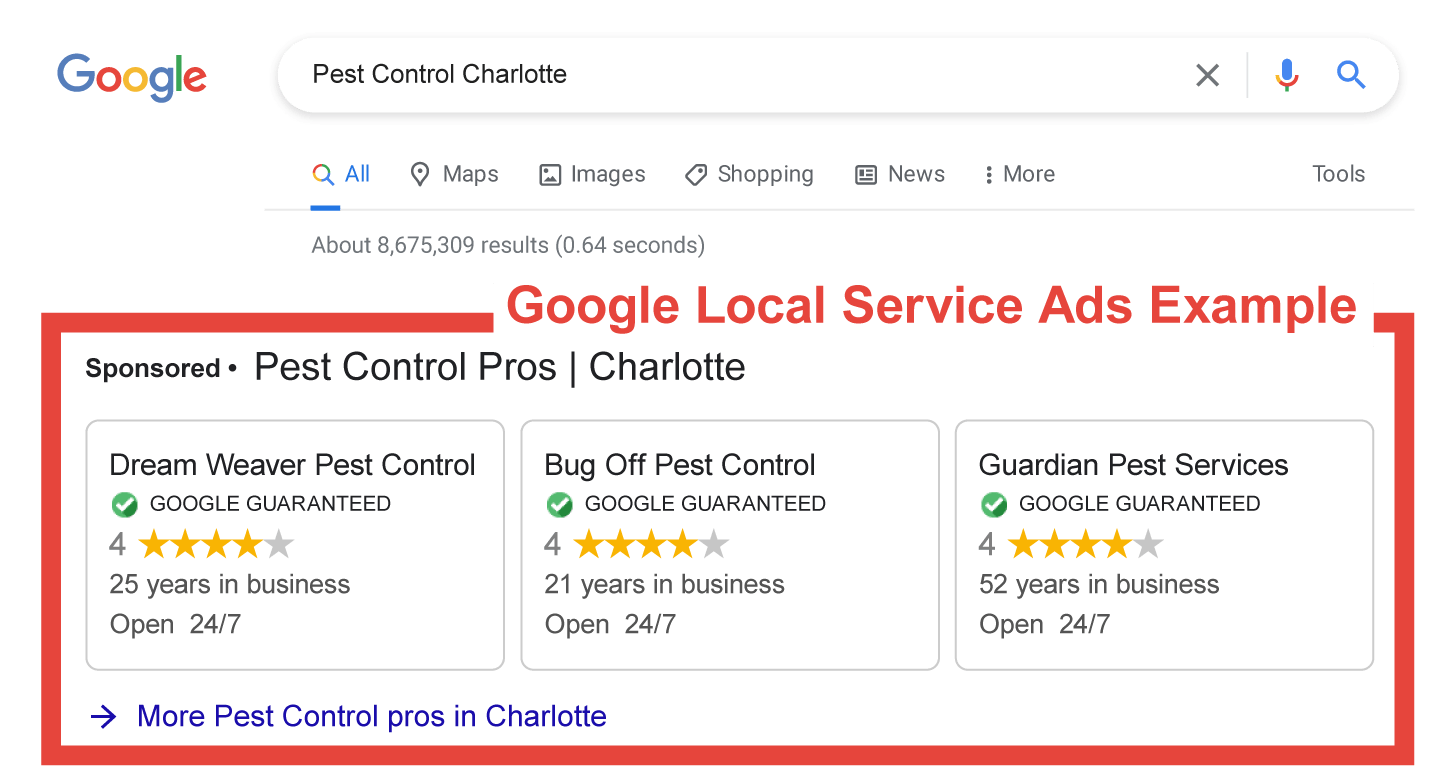
Google Local Service Ads deserve special attention in your pest control marketing arsenal – they're like your specialized equipment for particularly difficult infestations. Unlike standard Google Ads, Local Service Ads appear at the very top of search results with your business name, phone number, reviews, and the coveted "Google Guaranteed" badge – imagine having your truck emblazoned with an official certification that tells homeowners they can trust you before you even arrive.
These ads work differently than traditional Google Ads – you pay per lead rather than per click, much like charging customers for the service call rather than just showing up. This model ensures you're investing in genuine opportunities, not just curious browsers. For pest control companies, this distinction matters when emergency calls are your bread and butter.
What makes these particularly powerful for pest control operators is the Google Guaranteed badge, which acts like an instant trust-builder with potential customers. Google essentially vouches for your business, offering customers a satisfaction guarantee up to $2,000 – like having a referral from the most trusted name in search. For homeowners facing a potential termite infestation or rodent problem, this extra layer of confidence can be the difference between calling you or your competitor.
To qualify, your pest control business must pass Google's screening and verification process, including background checks and license verification – similar to how you perform thorough inspections before treatment. While this requires some initial effort, the payoff is substantial: prime placement, increased trust, and often lower cost per acquisition than traditional search ads.
Why Your Pest Control Business Needs Google Ads Yesterday
If your pest control business isn't using Google Ads yet, you're essentially setting traps without bait. Google Ads pinpoints potential customers with the precision of a wasp, finding that tiny gap in your window screen and directing people who need your services right to your digital doorstep.
The platform's targeting capabilities are like having X-ray vision into your market, allowing you to reach homeowners in the midst of their pest crises. With daily budget controls and conversion tracking, you're not just spraying money around hoping it sticks – you're strategically investing in measurable results.
Unlike traditional advertising methods (which are about as targeted as setting off bug bombs in an empty house), Google Ads delivers improved visibility precisely when and where it matters, generating higher conversion rates. By implementing Google Ads, your pest control business connects with its target audience more effectively than a mosquito finds bare skin on a summer evening, producing the kind of campaign results that don't just look good on paper – they translate to real-world growth and customer acquisition.
How Google Ads Actually Works for Pest Control Services
Google Ads operates like a well-designed pest control system – strategic, targeted, and remarkably effective when properly implemented. This digital advertising platform displays your pest control services across search engine results pages and various websites throughout the internet.
Built on a pay-per-click (PPC) model, it's like only paying for the traps that actually catch something – you're charged only when your ads generate clicks or phone calls. This efficiency means every dollar works harder than your most dedicated technician.
The platform enables your pest control service to zero in on potential clients using specific keywords and location targeting, filtering out irrelevant searches faster than your best exclusion techniques. By setting a budget, analyzing conversion rates, and tracking ad performance through tools like conversion tracking and quality score, Google Ads can expand your customer base more effectively than even the most aggressive door-knocking campaign.
Additionally, keyword tools help identify the most impactful search terms based on volume, ensuring your ads work as effectively as your most powerful pesticides – targeting exactly what you need to eliminate (in this case, wasted ad spend) while maximizing results.
Expert Google Ads Management With Cube Creative Design
Navigating Google Ads without expert help is like trying to eliminate a termite infestation with a flyswatter – technically possible, but why make life harder than it needs to be? With Cube Creative Design, a certified Google Partner, steering your digital advertising campaign becomes as seamless as your most routine pest control service.
Our team of campaign managers unlocks your advertising budget's full potential like expert exterminators finding entry points others miss. We specialize in connecting your pest control business with desperate homeowners dealing with everything from ant invasions to zombie-like, resilient roaches.
Our precision geographical targeting ensures your ads reach potential clients in your service area – not three counties over where you'd never send a technician. Our approach is as customized as your treatment plans, designed specifically around your unique business objectives and budget constraints.
By partnering with Cube Creative Design, you're not just delegating digital advertising tasks; you're gaining a strategic advantage that saves time and resources while enhancing your ROI faster than a colony of termites can damage a foundation. Our seasoned professionals stay current on the latest advertising trends and provide insightful analysis to continuously refine your approach. Choosing us to manage your Google Ads campaign is like upgrading from a handheld sprayer to professional-grade equipment – suddenly, everything works more efficiently, effectively, and profitably.
The Pros and Cons of Google Ads vs. SEO for Pest Control
Unlock the secret to digital advertising success for pest control businesses! Discover the benefits and limitations of Google Ads and SEO for pest control professionals, and learn how to combine them for maximum impact. Let us guide you through the digital jungle and help you attract more customers than ever before!
The Benefits of Google Ads That Make Competitors Nervous
Google Ads is the digital equivalent of a fast-acting pesticide – delivering immediate results when you need them most. Much like how your customers want pests gone yesterday, Google Ads delivers noticeable traffic increases almost as soon as your ads are approved.
With targeting precision that would make a sniper jealous, Google Ads enables your campaign to reach potential customers based on location, demographics, and search terms relevant to your pest control services. Whether they're searching for "rodent control" or "wasp nest removal," your ads appear before their eyes faster than ants find picnic leftovers.
Additionally, Google Ads offers budget flexibility that adapts to seasonal pest patterns – you can increase spending during termite swarming season or scale back during slower periods. This pay-per-click model means you're only investing when prospects actually engage with your ads, making it as efficient as your most systematic treatment protocols.
The Downsides of Google Ads That No One Talks About
Let's be honest – Google Ads can sometimes devour your budget faster than termites through soft wood. Costs can escalate quickly, especially if you're competing with other pest control businesses that have deeper pockets than yours. This challenge becomes particularly acute if you're operating with financial constraints tighter than a properly sealed foundation.
The competition for ad space when targeting popular pest control keywords can be fiercer than territorial wasps, potentially driving up your cost per click to eye-watering levels. Furthermore, Google Ads offers limited long-term benefits – once you stop funding the campaign, your ads disappear from search results faster than roaches when you flip on the lights, resulting in an immediate visibility plummet.
Why SEO Might Be Your Long-Term Pest Control Solution
Search Engine Optimization (SEO) works like a slow-release pest treatment – it takes time to fully deploy but delivers extended protection. This strategic approach enhances your website's visibility in organic search results over the long haul, improving rankings for relevant keywords, particularly local SEO terms that attract customers in your service area.
SEO proves cost-effective in the long run – like preventative pest treatments that save homeowners thousands in potential damage. Instead of continuously paying for ad space, your investment builds lasting digital equity. Additionally, a higher position in organic search results strengthens your brand's credibility, presenting your pest control company as the reliable authority – the difference between being seen as the neighborhood expert versus just another service provider with a spray can.
The SEO Limitations Every Pest Control Company Should Know
SEO isn't without its challenges – it demands significant time and effort, particularly for competitive keywords like "pest control," much like how eliminating an extensive infestation requires more resources than a simple spot treatment. Due to constant algorithm changes (Google makes more updates than you change your truck's oil), your control over ranking improvements is limited.
Perhaps most frustratingly, SEO doesn't deliver immediate results – it's a strategy that demands patience, with substantial improvements potentially taking weeks or months to materialize. For pest control businesses needing an immediate influx of new customers, waiting for SEO to take effect can feel like watching paint dry while billing opportunities scurry past.
How Cube Creative Design Combines Google Ads and SEO for Pest Control Domination
Integrating Google Ads and SEO creates a comprehensive digital strategy that's greater than the sum of its parts – like combining different treatment methods for an absolutely pest-free environment. Using Google Ads for immediate traffic generation while building SEO for long-term results establishes a sustainable digital advertising ecosystem that works year-round.
Seeking guidance from Cube Creative Design, with our expertise spanning both Google Ads and SEO, provides pest control businesses with valuable insights and analytics to continuously refine advertising strategies. We'll help you build the perfect balance – capturing urgent pest control needs through ads while building your reputation as the go-to local expert through organic search results. This integrated approach ensures you're capturing customers at every stage of their pest control journey.
Creating a Multi-Channel Pest Control Marketing Ecosystem
While Google Ads and SEO form the foundation of your digital pest control marketing strategy, true domination comes from creating an integrated multi-channel approach – much like how comprehensive pest management works better than single-treatment solutions.
Your Google Ads campaigns generate valuable intelligence that should inform your other marketing channels. The search queries that trigger your ads reveal exactly how customers describe their pest problems – terminology you should mirror across all your marketing materials. When you discover that customers in your area search for "carpenter ant damage" rather than "wood-destroying insects," that insight should reshape your social media content, email campaigns, and even your technicians' conversation points.
Social media advertising works symbiotically with your Google Ads efforts. While Google captures active searchers with immediate pest problems, platforms like Facebook and Instagram help build awareness among homeowners who haven't yet noticed signs of infestation. Use your highest-converting Google Ads headlines and descriptions as inspiration for social posts that educate homeowners about early warning signs of pest issues – creating demand before they even realize they need your services.
Your email marketing can be dramatically improved with Google Ads insights as well. Segment your customer database based on the pest-specific keywords that generated their initial inquiry, then deliver seasonal prevention tips relevant to their past pest concerns. A customer who found you through termite-related searches might receive spring swarm season warnings, while those who discovered you through rodent-related terms get fall prevention tips as temperatures drop.
Even your offline marketing channels benefit from this integration. The zip codes generating the highest conversion rates in your Google Ads campaigns should influence where you distribute direct mail pieces or place local print advertisements. The keywords driving the most phone calls should inform the headlines on your company vehicles and yard signs.
This ecosystem approach ensures consistent messaging across all customer touchpoints while maximizing the effectiveness of each channel – creating a comprehensive pest control marketing strategy as thorough as your most detailed treatment plans.
Streamline Your Pest Control Digital Marketing with Google Ads Campaigns
Ready to take your business to the next level? A Google Ads campaign can be a game changer, but let's face it, managing and optimizing it can be a real headache. Luckily for you, our streamlined method is here to save the day! We've crafted a foolproof process that guarantees your campaign is set up for success, and we're constantly fine-tuning it to ensure maximum results. Here's a sneak peek at our magic formula.
Maximizing Your Digital Campaigns with Search, Display, and Remarketing Ads
Understanding your target audience is as crucial to advertising success as identifying the correct pest species is to treatment. By analyzing demographics, behaviors, and interests, we design compelling campaigns tailored specifically for each ad format – ensuring your message resonates whether prospects are actively searching for solutions or simply browsing related content.
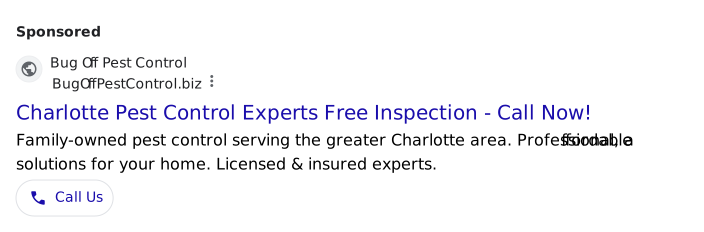
Search Ads require precision and relevancy based on urgent pest queries, while Display Ads leverage visual appeal across websites your potential customers frequently visit. Meanwhile, Remarketing Ads target individuals who previously visited your site but didn't convert – like following up with a customer who noticed pest signs but hasn't scheduled service yet.
Factors such as age, family status, and income further refine our targeting approach, ensuring your message reaches homeowners most likely to require professional pest intervention. Moreover, our geo-targeting capabilities pinpoint specific zip codes or radii within your service area, guaranteeing your ads reach the most relevant audience while optimizing every dollar of your advertising investment.
How to Select Killer Keywords That Attract Quality Pest Control Leads
Choosing the right keywords for your pest control Google Ads campaign is like selecting the proper treatment for an infestation – use the wrong approach, and you'll waste resources with minimal results. These keywords represent what your desperate, itchy customers type into Google when they're frantically searching for solutions to their creepy-crawly problems.
By selecting truly relevant keywords, you'll attract qualified leads rather than curious browsers, improve your ads' quality score (Google's way of rewarding relevance), and maximize your budget by converting clicks into actual service bookings. Start by identifying terms that genuinely represent your pest control specialties and target audience – whether that's "emergency wasp nest removal" or "quarterly pest prevention programs."
Then, leverage Google's keyword planner tool to identify high-potential terms within the pest control industry. The sweet spot? Keywords with substantial search volume but reasonable competition levels, along with specific long-tail variations that indicate high intent (think "how to get rid of bed bugs in apartment" rather than just "bugs").
Setting a Budget That Won't Bug You
Establishing an appropriate advertising budget for your pest control Google Ads campaign is like planning a comprehensive treatment program – it requires strategic thinking and proper resource allocation. Begin by identifying your ideal customer profile and analyzing what your competitors are spending to reach them.
Research which keywords potential customers use when searching for pest control services and evaluate the competitive intensity for these terms – just as you'd assess the severity and extent of an infestation before recommending treatment options. To prevent overspending, establish clear budget parameters aligned with your business's financial realities and expected return on investment.
Implement robust conversion tracking to monitor which aspects of your campaign generate actual service bookings, allowing you to adjust your budget allocation accordingly. A well-managed campaign enhances online visibility like a properly placed bait station strategically positioned to capture maximum attention from your target audience. Effective budget management ensures your ROI remains healthy, maximizing every dollar like a precision application rather than a broadcast spray approach.
How Cube Creative Design Targets Audiences for Valid Leads
At Cube Creative Design, we understand that targeting in Google Ads is like precision pest control – the more accurate your application, the better your results. Our team employs sophisticated targeting techniques that ensure your message reaches homeowners at exactly the right moment in their pest control journey.
We utilize hyper-local zip code targeting to outmaneuver your competition, reaching potential customers in specific neighborhoods where you want to build a presence. Our demographic targeting optimizes campaign effectiveness by focusing on your ideal audience profile – whether that's established homeowners in suburbs or property managers of multi-unit buildings.
Furthermore, we refine your campaigns using interest categories like home improvement or renovation, effectively targeting individuals in the midst of projects who might discover pest issues. Think of it as placing monitoring stations exactly where pests are likely to travel – maximizing the chance of detection and response. With our strategic targeting, your pest control ads connect with motivated prospects at their moment of need, driving qualified leads instead of just accumulating meaningless impressions.
Connecting Google Ads To Conversion Tracking For More Accurate Data
Smart pest control operators know that monitoring is everything – both in treatment programs and marketing efforts. Google Ads conversion tracking provides the digital equivalent of monitoring stations, helping you assess exactly how effectively your campaigns attract genuine customers rather than curious browsers.
By implementing conversion tracking, you can monitor precisely how many website visitors take valuable actions after seeing your ads – whether that's calling your office, submitting a contact form, or scheduling an inspection. This intelligent data collection helps you adjust your campaigns based on actual performance metrics, allowing you to double down on what works and eliminate what doesn't – just like adapting a treatment protocol based on inspection results. With conversion tracking properly implemented, you'll target more potential customers with increasing precision while eliminating wasted ad spend faster than your best treatments eliminate pests.
Implementing proper conversion tracking for your pest control business isn't optional – it's as essential as proper protective equipment on the job. Here's how to set it up for maximum visibility into your campaign's effectiveness:
First, identify the specific customer actions most valuable to your pest control business: phone calls (especially crucial for emergency pest situations), form submissions for inspection requests, online booking completions, and even time spent on treatment description pages. Each becomes a different "trap" in your digital monitoring system.
Setting up phone call tracking is particularly crucial for pest control – most customers with urgent pest problems will call rather than fill out forms. Implement Google's call extension and call conversion tracking to record not just call volume but also call duration, helping distinguish between quality leads and brief inquiries, much like differentiating between serious infestations and minor pest sightings.
For website conversions, install the Google Ads conversion tracking tag on your site – think of it as setting up your digital monitoring system. Create separate conversion actions for different form submissions (residential vs. commercial requests, for example) and assign appropriate values to each based on your average service ticket size.
Most importantly, use this data to inform your bidding strategy and budget allocation. If certain keywords or ad groups generate more phone calls from customers describing emergency situations (your highest-value leads), reallocate budget from lower-performing segments – just as you'd shift your technicians to handle the most pressing infestations first. This closed-loop system ensures that every dollar of your pest control marketing budget works as hard as your most dedicated technician.
Why Quality Score Matters More Than Most Pest Control Companies Realize
Quality Score functions as Google's grading system for your ads, keywords, and landing pages. Think of it as your online reputation score, but it is one that directly impacts your advertising costs and effectiveness. Higher scores indicate better performance, much like how your customer reviews influence potential clients' decisions.
Google calculates Quality Scores based on your historical campaign performance, anticipated click-through rates, and the experience users have on your landing pages after clicking your ads. Maintaining high Quality Scores offers multiple advantages: improved ad rankings and positions, lower costs per click (sometimes dramatically so), increased relevant traffic, and more conversion opportunities.
For pest control companies with limited marketing budgets – which describes most local operators – optimizing Quality Score isn't just helpful; it's essential for campaign success. The difference between a Quality Score of 3 and 8 could mean paying twice as much for the same clicks or appearing half as often in search results. Smart campaign management focuses on continuously improving this metric through relevant ad content, optimized landing pages, and strategic keyword selection.
Let's get technical about Quality Score because understanding the specifics can save your pest control business thousands in wasted ad spend – much like knowing exactly which treatment protocol will eradicate a specific pest most efficiently.
Google evaluates Quality Score on a scale of 1-10, with each point difference having a dramatic impact on what you pay. A Quality Score improvement from 5 to 7 can reduce your cost-per-click by up to 28% – imagine cutting your treatment costs by nearly a third while maintaining effectiveness. For competitive pest control terms like "emergency exterminator" or "termite treatment," this difference can mean paying $4 per click instead of $5.60.
Three specific factors influence your score, each weighted differently:
- Expected Click-Through Rate (most heavily weighted): How likely users are to click your ad when it appears for your chosen keywords. Improve this by crafting compelling ad copy that speaks directly to pest emergencies and specific treatment needs.
- Ad Relevance (moderately weighted): How closely your ad matches the user's search intent. Create separate ad groups for different pest services (rodent control, termite treatment, general pest management) rather than using one generic pest control ad.
- Landing Page Experience (heavily weighted): How relevant and useful your landing page is to someone who clicks your ad. Create dedicated landing pages for specific pest services – your termite ad should link to your termite treatment page, not your general services page, just as you wouldn't use the same treatment for every pest situation.
Google provides component-level Quality Score feedback in the keywords section of your Google Ads account. Look for "below average" ratings in any category and address them immediately – these are the equivalent of red flags in a pest inspection that demand immediate attention. For pest control businesses operating in competitive markets, achieving Quality Scores of 7 or above should be your target, as this is where you'll see significant cost advantages over less-optimized competitors.
How to Use Search Volume And Queries To Exterminate Wasted Ad Spend
Expanding your pest control company's online presence requires strategic use of search volume data and query analysis – similar to how you'd analyze pest activity patterns before developing a treatment plan. Start by selecting appropriate keywords using tools like Google Keyword Planner to identify relevant terms that align with your services, target audience, and service locations.
Focusing on long-tail keywords (like "emergency wasp nest removal near me" rather than just "pest control") drives highly relevant traffic with greater conversion potential. These specific phrases may have lower search volume, but their intent is much clearer – these searchers need immediate help, not just information.
Customizing your ads to match search queries by incorporating targeted keywords in headlines and descriptions enhances your quality score while aligning with user intent. This strategic approach attracts potential customers actively seeking pest control solutions, boosting ROI by ensuring your marketing dollars target genuinely interested prospects rather than casual researchers or DIY enthusiasts.
Mastering search volume analysis requires understanding the seasonal rhythms of pest control searches – much like knowing when different pest populations typically surge. Using tools like Google Trends alongside Keyword Planner reveals crucial seasonal patterns: termite searches spike during spring swarming seasons, rodent-related searches increase as temperatures drop in fall, and general pest searches climb during summer months.
Smart pest control operators build their keyword strategies around these predictable cycles, increasing bids and budgets for termite-related terms in April- May, mosquito terms in summer months, and rodent terms in October- November. This approach mirrors how you might adjust your technician scheduling based on seasonal pest pressures.
Searching query reports requires detective skills similar to thorough pest inspections. Beyond the obvious terms, look for patterns in how customers describe their specific situations. You might discover unexpected terms like "scratching in walls at night" (likely rodents) or "small dirt tubes on the foundation" (termites). These descriptive searches reveal how homeowners perceive pest problems before they know what's causing them – golden opportunities to connect with customers earlier in their pest control journey.
Competitor keyword analysis provides another strategic advantage. Tools like SEMrush or SpyFu can reveal which keywords your successful competitors target and approximately what they're paying per click. This competitive intelligence helps you identify profitable keyword opportunities or gaps in the market – perhaps they're dominating termite terms but neglecting bed bug searches, creating an opening for your business to establish expertise in that niche.
Most importantly, understand the search patterns unique to your specific service area. Urban pest control searches often focus on apartment-specific treatments, while suburban areas generate more preventative and perimeter control queries. Rural areas might show higher volume for wildlife and agricultural pests. These geographical nuances should shape both your keyword selection and ad messaging, ensuring your campaign is as targeted as your most precise spot treatments.
Understanding Cost-Per-Click: The Metric That Makes or Breaks Your Campaign
Monitoring the average cost-per-click (CPC) is essential for pest control businesses using Google Ads – it's the digital equivalent of tracking your cost per lead or service call. This metric represents what you pay each time a prospect clicks your advertisement, directly impacting your campaign's profitability.
By vigilantly tracking CPC, you'll effectively manage your advertising budget while identifying high-performing but potentially expensive keywords. Keeping your CPC reasonable ensures maximum clicks and conversions within your allocated budget, much like how efficient routing maximizes your technicians' productive time between service calls.
Multiple factors influence your average CPC, including keyword competition intensity (terms like "emergency pest control" typically cost more than "quarterly pest inspection") and your quality score. Increased competition drives higher CPCs – particularly during peak pest seasons – while higher quality scores can significantly reduce your costs, rewarding relevant, well-crafted campaigns with more affordable clicks.
Continuous monitoring and optimization are crucial – test different keywords, ad variations, and bidding strategies to identify the most cost-effective approach. The resulting improvements to your ROI might be the difference between a campaign that barely breaks even and one that delivers consistent, profitable growth for your pest control company.
How Zip-Code Targeting Helps You Dominate Your Service Area
To supercharge your pest control Google Ads campaigns, zip code targeting functions like a precision treatment application – focusing your resources exactly where they'll have the maximum impact. By selecting specific zip codes, your ads appear exclusively to potential customers within your designated service areas, eliminating wasted impressions and clicks from locations where you don't dispatch technicians.
Implementing this targeting approach is straightforward: navigate to the "Locations" section in your Google Ads settings and utilize the "Advanced Search" feature to input your preferred zip codes. This strategic focus ensures your advertising budget works efficiently, reaching homeowners and businesses who can actually book your services rather than those outside your operational radius.
The result? Higher conversion rates and lower cost per acquisition – your campaign targets prospects who can realistically become customers, leading to greater ROI and sustainable growth for your pest control business. In competitive markets, this geographical precision might be your most significant advantage over less sophisticated competitors.
The Negative Keywords Strategy That Saves Pest Control Companies Thousands
Negative keywords are the unsung heroes of Google Ads campaigns for pest control businesses with constrained budgets. They function like exclusion techniques in pest management – keeping unwanted elements out while allowing the beneficial ones in. By filtering irrelevant traffic, you preserve your budget and increase conversion rates, focusing resources on genuinely qualified leads.
Identifying effective negative keywords involves compiling search terms irrelevant to your pest control business – phrases related to services you don't offer ("beekeeping supplies"), locations outside your service area, or technical terminology that attracts researchers rather than customers. Common examples include "DIY pest control," "pest control jobs," "pest control equipment," or "pest control courses" – terms used by people looking for information, not services.
In competitive markets, consider using competitors' business names as negative keywords to avoid clicks from people specifically searching for them. This strategic approach ensures your ad spending targets individuals actively seeking your services, maximizing budget efficiency and campaign effectiveness – the difference between a profitable campaign and one that drains resources without adequate return.
A/B Testing: The Scientific Method Applied to Pest Control Marketing
A/B testing functions as the experimental method for optimizing Google Ads campaigns – similar to how you might test different treatment approaches to determine the most effective solution for a persistent pest problem. This systematic process compares two ad versions differing in one variable to determine which performs better in generating clicks, leads, and conversions.
To conduct effective A/B testing, select a specific element to evaluate – perhaps your headline approach or call-to-action phrasing – and create two otherwise identical versions of your ad. Launch both simultaneously for a predetermined period, then compare results, focusing on click-through rates and conversion metrics to identify the superior performer.
For maximum impact, identify your target audience with precision and select relevant keywords that match their search intent. Test one variable at a time to ensure clear, actionable results, and carefully monitor outcomes using conversion tracking and Google Analytics. The insights gained should inform not just your advertising but potentially your overall marketing messaging, helping you develop language that resonates with customers across all channels. Establishing a systematic follow-up protocol ensures you capitalize on the leads generated, turning clicks into service appointments with an efficiency that matches your best technicians.
How Cube Creative Design Optimizes Campaign Data For Better ROI
Cube Creative Design approaches campaign optimization like professional pest inspectors approach property evaluation – with methodical attention to detail and data-driven insights. Our expertise in audience targeting, keyword selection, and budget optimization isn't based on guesswork – it's supported by comprehensive analytics and performance metrics.
We utilize sophisticated tools like Google Analytics to identify your highest-performing ads, optimize ad spend allocation, and ensure precise implementation of negative keywords – eliminating wasteful clicks while maximizing productive ones. Our systematic A/B testing methodology develops increasingly effective ads for your pest control business, refining messaging and offers based on actual customer response rather than assumptions.
With Cube Creative Design managing your Google Ads campaign, you gain the confidence that comes from knowing every aspect of your digital marketing is being continuously optimized for maximum ROI. We don't just run your campaigns; we relentlessly improve them, producing tangible results that translate directly to service bookings and revenue growth for your pest control operation.
Our optimization process follows a systematic schedule – weekly, monthly, and quarterly reviews that examine different aspects of campaign performance, similar to how you might structure regular pest monitoring for commercial clients.
Weekly optimizations focus on critical metrics that demand immediate attention:
- Cost per conversion by ad group: Identifying which pest-specific ad groups are delivering the most cost-effective leads
- Quality Score changes: Addressing any sudden declines that might indicate relevance issues
- Geographic performance variations: Adjusting bids for zip codes showing higher conversion rates
- Search query analysis: Adding new negative keywords to filter out non-converting traffic
Monthly reviews dig deeper into broader performance patterns:
- Device performance: Optimizing for the devices your customers use most (often mobile for emergency pest situations)
- Day and time analysis: Adjusting bid schedules to increase visibility during high-conversion periods
- Demographic insights: Refining audience targeting based on conversion data
- Ad copy performance: Replacing underperforming ad variations with optimized messaging
Quarterly strategic assessments examine:
- Seasonal trend preparation: Adjusting budgets and focus in anticipation of pest-specific seasonal patterns
- Landing page conversion rate optimization: Enhancing page elements based on heat mapping and user behavior
- Competitor position analysis: Adapting strategy based on competitive landscape changes
- ROAS (Return On Ad Spend) assessment: Calculating true return by connecting ad costs to actual service revenue
This methodical approach ensures that every aspect of your campaign receives appropriate attention at the right intervals. We've found this structured optimization process delivers an average 32% improvement in cost-per-acquisition for pest control clients within the first quarter – similar to how systematic property treatments yield significantly better results than sporadic applications.
Our pest control clients particularly value our custom reporting dashboard that translates complex campaign data into actionable insights. Rather than overwhelming you with technical metrics, we focus on business outcomes: cost per new customer acquired, most profitable service types from ad-generated leads, and revenue attributed to specific campaign elements. This practical approach ensures you always understand exactly how your advertising investment translates to business growth.
Use Cube Creative Design to Exterminate Your Marketing Problems
Cube Creative Design specializes in helping pest control businesses transform their Google Ads campaigns from money pits into lead-generating machines. With our expertise in PPC and SEO, we generate high-quality leads for both residential and commercial pest control services. Our comprehensive process includes identifying your target audience, selecting relevant keywords, setting an optimal budget, and creating compelling ads and landing pages.
We utilize advanced strategies such as zip code targeting, negative keyword selection, A/B testing, and data-driven campaign optimization to maximize the effectiveness of your ads. By partnering with Cube Creative Design, you can expand your online presence and connect with potential clients in a targeted and cost-effective manner. Experience the benefits of Google Ads for your pest control business by contacting me today.
Google Ads For Pest Controllers FAQs
Got more questions? Why not explore our range of commonly asked questions. If you still want more answers, book a consultation today!
I'm Curious, What Sets Cube Creative Design's Google Ads for Pest Controller Service Apart From Other Digital Marketing Agencies?
At Cube Creative Design, we know that pest control marketing requires a special touch. Our team is made up of experts who specialize in pest control & HVAC businesses. We create Google Search Ads that use a wide range of keywords, from exact match to phrase match options. With our expertise, we can help you get high-quality leads for your pest control business.
What's the Cost of Cube Creative Design's Google Ads for Pest Controllers Service?
We customize the cost of our pest control services based on your marketing budget, business goals, and monthly budget. Our flexibility allows us to create a plan that fits your financial framework and objectives. We're here to help you achieve your goals within your budget.
What's the Typical Timeframe for Seeing Results With Cube Creative Design's Google Ads for Pest Controllers Service?
The timing and level of competition can affect results, but we usually see an increase in customer calls and pest control leads within the first month of starting your Google Ads and Google Local Services Ads campaigns.
Can You Please Explain to Me How Much I Should Be Actively Participating in the Process?
We take care of everything, from creating Google Search Ads to setting up extensions like Location and Callout. Our priority is transparency, and we keep you updated with data on clicks, impressions, conversion rates, and customer reviews.
Is It Possible to Target Specific Areas With Cube Creative Design's Google Ads for Pest Controllers Service?
To ensure your ads reach your ideal customers in the areas you serve, we utilize Google Maps and Google My Business tools for geo-targeting.
I'm Excited to Learn More About Cube Creative Design's Google Ads for Pest Controllers Service. Can You Walk Me Through How to Get Started?
We're here to help you get started! Just fill out our Contact Form with your contact details or send us an email directly. From there, we'll schedule a consultation to discuss your business and job types, as well as your advertising goals.
I'm Interested in Possibly Creating a Website for My Pest Control Business. Can Cube Creative Design Assist Me With This?
We're happy to let you know that we don't just provide Google Ads services, but we also offer web design to create a stunning website for your business. It includes a contact form to make it easier for customers to reach out to you.
Will I Be Able to Access Data and Analytics for My Campaign?
Yes, we make sure to regularly share campaign performance data with you, including analytics from your Google My Business and Google Business Profile, so that you can stay up-to-date on the progress of your campaign.
Is It Possible to Modify My Campaign Once It Has Been Launched?
We completely understand that business goals may change over time. Don't worry, I’m here to help and work closely with you to adjust and improve your campaign so that it always meets your goals.