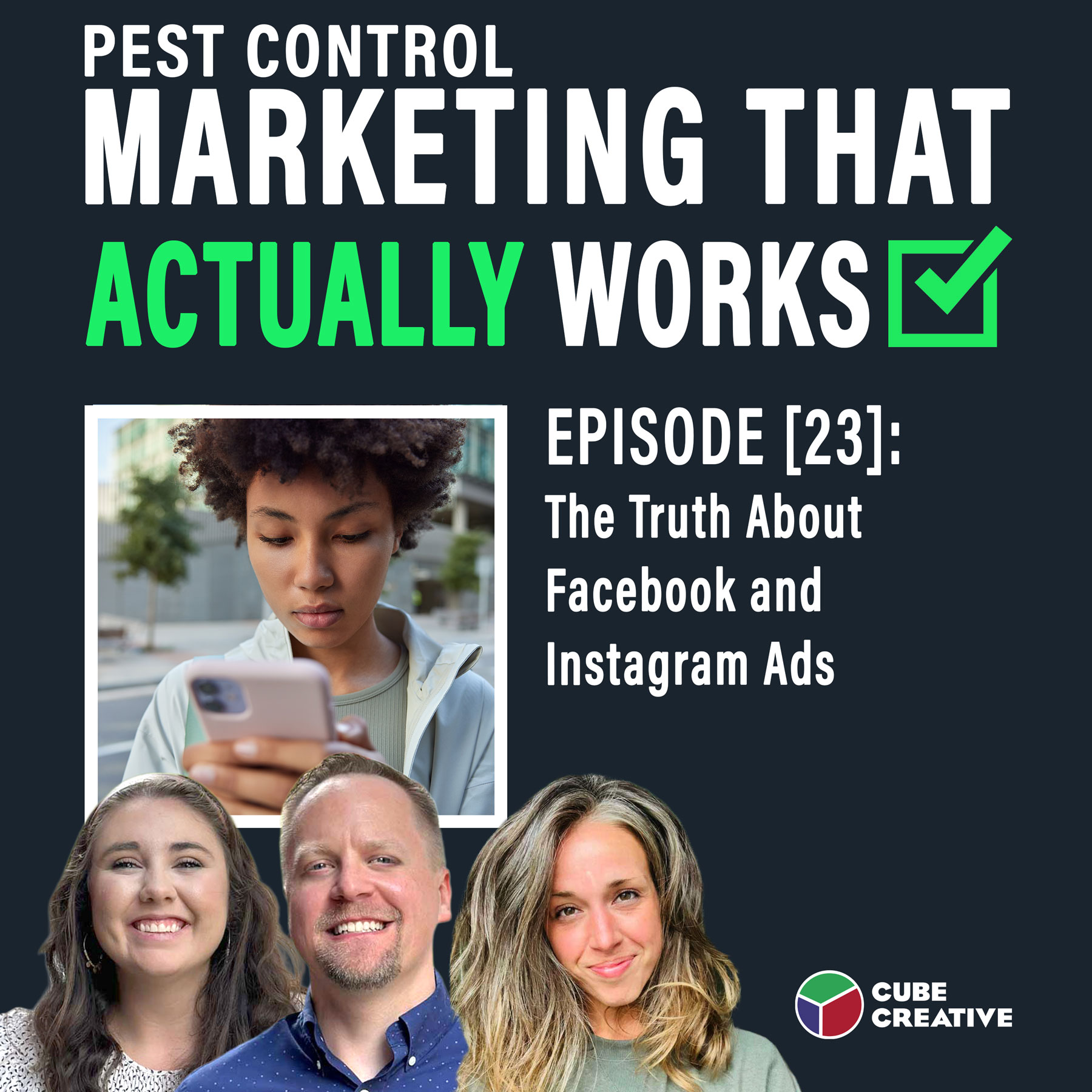
Adam (00:00): Welcome to Pest Control Marketing That Actually Works, the podcast for pest control operators who want real growth, not empty promises. I'm Adam Bennett.
Elisabeth (00:07): And I'm Elisabeth Pallante. We're from Cube Creative Design, and for over 20 years we've helped pest control companies stop wasting money and start growing.
Adam (00:14): Today's episode: The Truth About Facebook and Instagram Ads for Pest Control Companies. We brought in Hannah Kilpatrick for this one because she runs our social ad accounts. Here are your three key takeaways.
Elisabeth (00:25): First, Facebook and Instagram ads don't generate emergency pest calls. They build awareness so you're the name customers already trust when the call is needed. Second, creative matters more than targeting. A boring ad with perfect targeting still fails, and a decent ad with rough targeting will work. Third, stop measuring social ads by cost per click. Measure them by total cost per lead and by what your search traffic does after the campaign runs.
Adam (00:54): Okay, let's dive in. Hannah, I want to start with a question we get probably every other week from a pest control owner. They say something like, I spent $800 on a Facebook ad last month and I got zero leads. Facebook doesn't work for pest control. What do you say when you hear that?
Hannah (01:10): I say they're asking the wrong question. The right question isn't whether Facebook works for pest control. The right question is what job you hired Facebook to do. If you hired it to generate emergency pest calls in 24 hours, it's the wrong tool. Nobody is sitting on Instagram thinking, I'll book a termite inspection while I scroll. The buyer's not in that mindset. But if you hired it to build name recognition in your service area, to keep your company visible to those who don't have a problem today but will in three months, social ads do that better and cheaper than almost anything else.
Elisabeth (01:40): And the connection there matters. When someone finally does have a pest problem, they don't sit down and research six companies. They think of the first name that comes to mind, or they search Google and click the company they already sort of recognize. Social ads put your name in that sort-of-recognize bucket. It's the difference between hunting and farming. Google Ads is hunting. Someone has the problem right now and you intercept them. Facebook and Instagram are farming. You plant the seeds months ahead so when the problem hits, your name is already there.
Adam (02:12): And this trips up a lot of pest control operators because they're used to the hunting model. Google Ads gives you a phone call this week. Social ads give you a phone call in three months from someone who saw your van on the road, then saw your ad on Instagram, and then remembered you when the ants showed up. You can't trace that path easily, so it feels like the ad didn't work. We had a client who shut off their Facebook spend for two months to prove to himself it wasn't working. His Google search traffic for branded terms, meaning people searching his company name directly, dropped 22 percent over those two months. The ads were working. He just couldn't see it because it wasn't in the place he was looking.
Hannah (02:52): That's the most common pattern. Social ads are doing the work, but the proof shows up in your branded search traffic, your direct site visits, and how warm your inbound leads sound on the phone. Not in the ad platform itself.
Let's talk about why most pest control Facebook ads fail. It's almost always the creative, the ad itself. Meta's targeting has gotten worse, and the algorithm has gotten better. What that means in practice is the platform decides who sees your ad more than you do. You can set targeting parameters, but if your creative is boring, the algorithm won't push it. If your creative is interesting, the algorithm finds the right people for you.
Adam (03:28): And by boring, you don't just mean ugly, right? You mean predictable.
Hannah (03:32): Right. The boring pest control ad looks the same every time. A stock photo of a roach or a clean kitchen. Generic copy that says professional pest control, family owned, licensed and insured, call today. A logo in the corner, a phone number. Nobody stops scrolling for that. The algorithm sees the low engagement and stops showing it. You spent $800 on an ad that 600 people glanced at and forgot.
Elisabeth (03:56): Ouch. So what does a good pest control ad look like? Give us a specific shape.
Hannah (04:01): Three shapes work consistently for pest control. The first is what we call the show-don't-sell video. Twenty seconds of a tech doing actual work, pulling a wasp nest out of a soffit, treating a crawl space. No voiceover, no logo bug, just the work. Caption underneath says something like, this is what we found at a home in Asheville this week. That ad gets stopped on. The second is the educational hook. A tech holds up something common, like a brown recluse spider in a jar, and says, if you see this in your basement, here's what you do. Fifteen seconds. The viewer learned something. Now they know the company. The third is the local proof ad. A real customer on camera saying what they had, what we did, what the result was. Not a polished testimonial. A 30-second phone video. Authenticity is the whole point.
Adam (04:47): And the operator listening might be thinking, I'm not going to put my tech on camera, that's a lot of work. What do you say to that?
Hannah (04:53): I say one of your techs has a phone in their pocket right now. They're already pulling wasp nests out of soffits. You're not adding work. You're capturing work that's already happening. The clients who do this best send us 30 seconds of footage every couple of weeks from their phones, and that's the entire content engine.
Elisabeth (05:10): And on the targeting side, what should owners actually do? Because there's this temptation to over-engineer it. Custom audiences, lookalikes, three layers of interest stacked on each other.
Hannah (05:21): Keep it simple. For most pest control companies running local ads, you want a geographic radius, usually 15 to 25 miles around your office. You want an age range of 28 to 65, and that's most of what you need. Let Meta's algorithm do the rest. If you stack too many filters on top, you actually hurt performance because the algorithm has less room to find people.
Adam (05:43): Okay, let's get practical with the numbers because you all know I love working with these numbers. What should a pest control company with say about five trucks spend on social ads in a month?
Hannah (05:52): For a five-truck pest control company in a typical local market, $300 to $600 a month is the right range. That's enough to keep two to three creatives running consistently. Below $300 and the algorithm doesn't have enough to optimize. Above $600 and you start hitting frequency caps where the same people see your ad too often. What I'd push back on is the impulse to spend $1,500 on a single boosted post. That's the worst version of social ads. Big spike, no consistency. The algorithm never learns who responds to you. $400 a month every month for a year beats $4,800 in one quarter.
Elisabeth (06:27): And how many ads should be running at a time? Operators sometimes have one ad they've been running for six months.
Hannah (06:33): You want at least three creatives running at any given time, and you want to refresh them every four to six weeks. Even good ads burn out. The same audience sees them too many times and engagement drops. What we do for clients is keep a running library of short clips, refresh the top three monthly, and rotate them in and out. The technician filming a treatment in February goes into the rotation in March, comes out in May, and goes back in September when fall pests pick up.
Adam (06:57): So Hannah, what's working right now that wasn't working a year ago?
Hannah (07:00): Instagram Reels for local businesses. That's what's working right now. A year ago, Reels for pest control felt like such a stretch. Now it's the highest engagement format we're running for our pest control clients. The reach is two to three times what we get on a regular feed post for the same spend. Stories ads are getting a lot better than they used to be. They're cheap, they're vertical, and the swipe-up is right there. We're seeing $1.50 to $3 per click on well-made Stories ads for pest control, which is way cheaper than Google by a wide margin for top-of-funnel awareness.
Static image ads with stock photography are the opposite. The cost per click has roughly doubled in the last 18 months because engagement is so low. If you're still running a stock photo of a roach with call-us-today overlaid, that's the ad most likely to make an owner conclude Facebook doesn't work. It's the ad that doesn't work. Facebook works.
Adam (07:49): We need to spend a minute on measurement because this is where pest control owners really get frustrated. The Meta ad platform says you got 12 leads. The phone log says you got 4. What's the disconnect?
Elisabeth (08:01): Most pest control companies are measuring the wrong thing. They're looking at cost per click or even cost per form fill inside Meta. But the social ad's job is awareness, so the impact shows up downstream. The three numbers actually worth watching are branded search volume month over month, direct traffic to your website month over month, and lead quality on the phone. Better leads sound warmer because they already know your name.
Hannah (08:24): And the one inside the platform that does matter is video view rate. If your 20-second clip gets a 30 percent plus completion rate, that ad is doing its job whether or not anyone clicks. Brand recall comes from watch time, not clicks.
Adam (08:37): And this connects to something we've talked about a lot on this show. The trust signals AI is now using to recommend businesses include things like brand mentions, branded searches, and direct traffic. Social ads feed all three of those. So even if you can't draw a straight line from a Facebook view to a booked appointment, those impressions are building the underlying trust signals that show up in your search visibility many months later. We're going to do a full episode on those signals coming up in July, but for now, just know that social ads aren't only doing the visible work. They're doing invisible work that pays off in AI recommendations and organic search down the road.
Hannah (09:19): If you take one thing from this episode and try it before next Tuesday, here's what I would pick. Have one of your techs film 20 seconds of something interesting they do this week. A nest removal, a treatment, a finding they didn't expect. No script, just film the work. Send it to whoever runs your ads and have them put $50 behind it as a test. Target a 20-mile radius around your office, no other filters, and let it run for two weeks. What you're testing isn't whether you got leads. You're testing whether your video gets watched. If the completion rate is above 25 percent, you have a winner and you scale it. If it's not, you try another piece of footage. That's the loop.
Adam (09:53): And that $50 is intentional. It's small enough that you'll actually do it instead of overthinking it. Okay, let's recap these three key takeaways.
Elisabeth (10:01): Number one: Facebook and Instagram ads don't generate emergency pest calls. They build awareness so you're the name customers already trust when the call is actually needed. Number two: creative beats targeting. A decent ad with simple targeting works way better than a boring ad with really sophisticated targeting. Number three: measure downstream. Branded searches, direct traffic, and lead quality on the phone are the things to look at and pay attention to, not cost per click inside Meta.
Adam (10:31): And if you need help building social media ads that really move the needle, visit marketingthatactuallyworks.ai to get your free pest control marketing audit. We're going to show you what's working and what's costing you money.
Elisabeth (10:43): And to put a number on where your website stands right now, head to thecubescore.com. It's free, takes about 60 seconds, and grades your site across six categories of trust signals that decide whether AI search recommends your business. You'll see your score out of 600 and where you're losing points.
Adam (11:00): Subscribe to the show on Apple Podcasts or Spotify because you don't want to miss next Tuesday's episode, Local SEO Beyond Google Business Profile.
Elisabeth (11:08): And if you got value today, leave us a five-star review. It helps other pest control operators find the show. And let us know what you'd like to hear about next.
Adam (11:16): Absolutely. Thanks for listening to Pest Control Marketing That Actually Works. We'll see you next Tuesday.