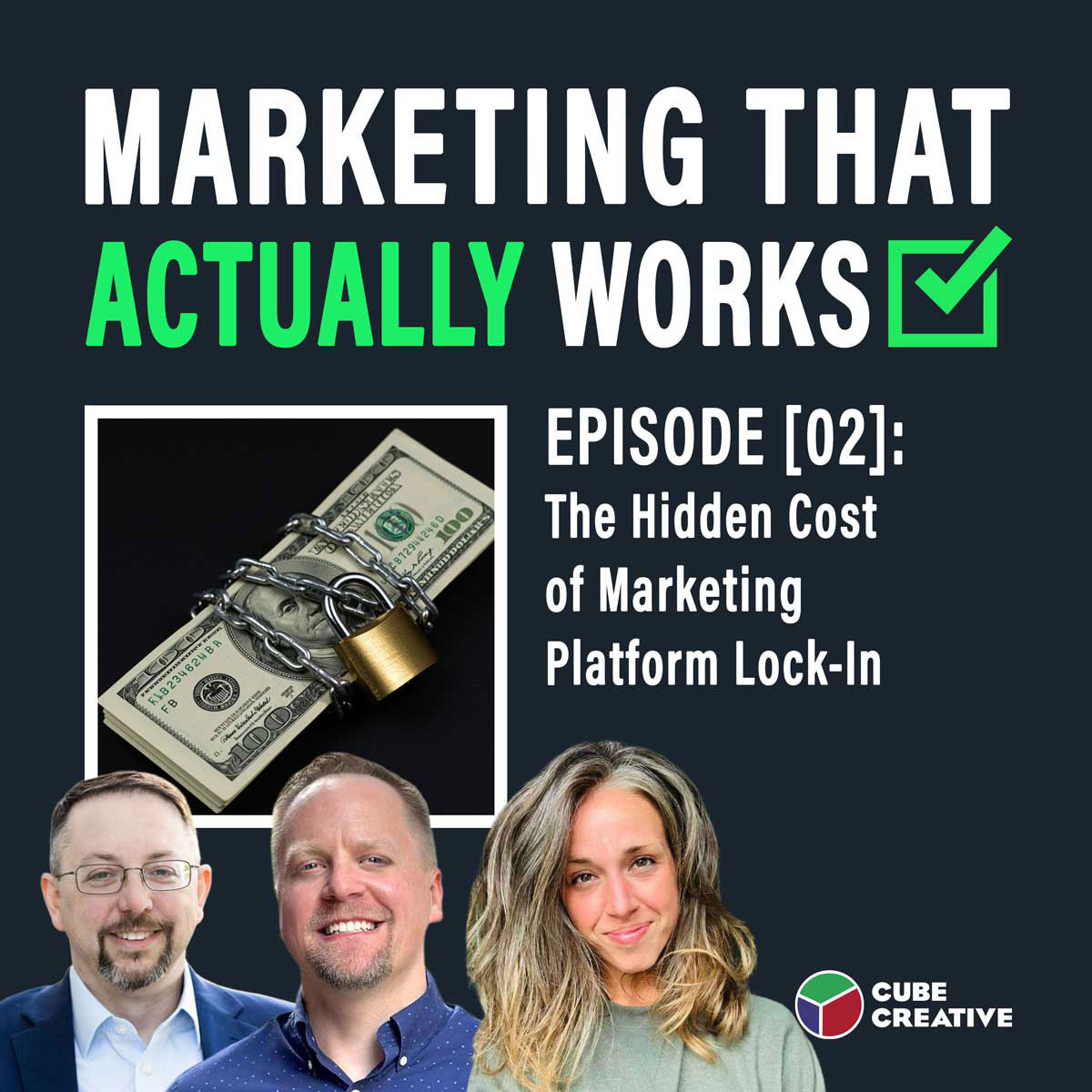
Adam: Welcome to Pest Control Marketing That Actually Works. I'm Adam Bennett.
Elisabeth: And I'm Elisabeth Pallante. We're from Cube Creative Design, and for 20 years, we've helped pest control companies stop wasting money and start growing.
Adam: Today's episode: The Hidden Cost of Marketing Platform Lock-In. Here are your three key takeaways.
Elisabeth:
- What you actually own versus what you think you own with all-in-one platforms
- The true cost—not just monthly fees, but the switching costs that trap you
- How to escape platform lock-in or avoid it entirely from day one
Adam: This might be one of the most important episodes we record all year. We're bringing in Chad Treadway, our Chief Marketing Officer, because he has this conversation with pest control operators constantly. Chad, tell them the story.
The Reality: You Don't Own What You Think You Own
Chad: I get a phone call maybe once a month from a PCO who says, "I'm paying $3,500 a month for this all-in-one platform. Website looks decent, but my leads just aren't coming in. If I do get any leads, they're not converting. The price keeps going up and every time they call, they're wanting to upsell me on something. It's horrible."
So I always ask: "What part of this do you own?" Sometimes they'll look at me like, "What are you talking about? I should own everything." But when you get into the nitty gritty, they don't actually own anything. They don't even have access to their Google Analytics.
Elisabeth: That's when reality hits these clients. They've been paying $3,500 a month—that's $42,000 a year. For three years, that's $126,000. But in the end, they don't actually own anything.
Adam: Not the website, not the content, not the reviews, and not even their own customer email list.
Chad: It's very much like they're leasing a truck. They put the rig on it and everything, and when it's all said and done, they don't own any of it.
Breaking Down What You Actually Own
Elisabeth: Let's break down what's typically in these all-in-one platforms and what you actually own.
The Website
Adam: The website is near and dear to my heart. It's built on their proprietary platform—a platform other designers can't access unless you have a contract with them. You can't export anything. You can't move it to another host. When you leave, it completely disappears.
Chad: A lot of times the content—your blogs, your landing pages—they own the rights to all that. You can't physically take it. So you've paid $42,000 to $126,000 over three years for nothing.
The Reviews
Elisabeth: In addition to that, the reviews—which surprises a lot of people. They host them on their infrastructure, not your Google Business Profile. When you leave, those reviews stay with them. Sometimes they're even generating fake reviews or scraping reviews—copying and pasting from other sites without proper attribution.
The Email List
Adam: The email list is the lifeblood of a business. It's locked into their CRM. You might be able to export a CSV file of names and emails if you're lucky, but all the segmentation, the tagging, the automation workflows—it's all gone.
The Domain Name
Chad: The other kicker: sometimes the domain name is registered through them and they won't release it. You may have your entire business name on your trucks, on your business cards, everywhere. Then you try to leave that vendor and you can't even take any of that with you.
Elisabeth: When you leave, you're not just switching platforms—you're starting completely over. New website, new content, new domain maybe. Your organic search rankings reset to zero.
The Real Numbers: What Platform Lock-In Costs
Chad: Let's talk some real numbers. You're looking at probably $2,500 to $5,000 a month for these top platforms. They bundle a lot of stuff—some you need, some you don't. Let's say you're at $3,500 a month. That's $42,000 a year. Over a typical three-year contract, that's $126,000. You're basically paying a pest control technician salary every year to these people and getting nothing for it.
Adam: Operators we talk to say the price always goes up. You sign up at $2,800 a month. Year two, it's $3,200. Year three, it's $3,500—unless you've signed a multi-year contract. They know you're trapped, so they raise prices at every renewal.
Elisabeth: Compare that to building your own marketing infrastructure:
- Professional website: $5,000 to $10,000 one-time fee
- Monthly SEO and content: $1,500 to $2,500 (depending on scope)
- Google Ads management: $500 to $1,000 plus ad spend
Total: maybe $3,000 to $4,000 a month, but you own everything.
Adam: The obvious costs are bad enough. The hidden costs are what really kill you.
The Hidden Costs of Platform Lock-In
Hidden Cost #1: The Organic Traffic Cliff
Elisabeth: When you leave, there's this giant drop-off. Your website has been live for two to three years. It's ranking for keywords. Google trusts the domain. You're getting organic traffic. But when you switch to a new domain on a new platform, all that trust resets. Your organic traffic drops to near zero overnight.
Chad: I've evaluated a lot of pest control websites and you can see it every time—this hockey stick growth, then a sheer Wile E. Coyote cliff falling off. They're lucky if it takes three to six months to recover.
Let's say you were getting 50 leads a month from organic search and you're down to 10. That's 40 leads a month at maybe $500 each. That's $20,000 lost revenue in a month.
Hidden Cost #2: Content Recreation Costs
Adam: Let's say that company wrote you 100 blog posts over three years—which we find is usually not the case. You can't take those with you because they own the copyright. To create 100 blog posts at market rates—roughly $200 to $500 per post—that's $20,000 to $50,000 just to get back where you were.
Elisabeth: It's so much money. It's awful.
Hidden Cost #3: Review and Reputation Reset
Elisabeth: If your reviews were on their platform instead of your Google Business Profile, you're starting over with zero reviews. It takes months to rebuild social proof. We all know how many times you have to ask to actually get one review. Meanwhile, your competitors have hundreds of reviews while you have none.
Hidden Cost #4: Customer Confusion
Chad: This industry is built on trust and social proof. Your old website goes dark. Your email address changes, your domain maybe changes. Customers who used to Google your old company can't find you. You've lost credibility. Your repeat business suffers. Customers think you went out of business just because you were in a proprietary platform and they held everything hostage.
Adam: You're still there, but your customers have no way to reach you because they may have been using a tracking number that the platform owned.
The Total Switching Cost
Adam: The true cost isn't that $42,000 a year. Switching costs—lost traffic, content recreation, reputation building, customer confusion—could easily be $50,000 to $100,000 in lost revenue.
Chad: Definitely.
Elisabeth: Not to mention the headache. We're talking numbers and data for rebuilding, but most pest control operators we work with are busy. They're managing everything. Having to rebuild while running the normal business—it's very stressful.
Chad: They'll also try to get you in during spring ramp-up or the middle of summer when you're working 12, 14-hour days, six days a week trying to keep up with demand. They hook you then when you don't have time to read the fine print.
How to Escape Platform Lock-In
Adam: What's a plan for getting out of a platform like this?
Step 1: Audit What You Actually Own
Elisabeth: Call them and ask directly:
- Is the domain registered in my name or yours?
- Can I export my website if I leave?
- Who owns the copyright to the content?
- Are our reviews on my Google Business Profile or your platform?
- Can I export my full email list?
Chad: Get all these answers in writing. They probably won't want to put it in writing, but check your contract. Take the time to look at it. What does it actually say about your data portability?
Adam: We're only saying this because we've helped so many operators get out of situations like this. We wish companies would just play fair.
Step 2: Build Your Own Assets Before You Leave
Adam: Don't cancel the platform before you have replacements ready. Run both simultaneously for two to three months so you can start gaining traction on your new assets before you drop the old ones.
Elisabeth: Start building:
- Your new website on your own domain that you own
- New content
- A Google Business Profile properly under your control
- Your email list in a CRM that you own
Chad: Anything like this is going to be expensive—you're paying for both the old platform and your new infrastructure—but it's the only way to avoid a complete traffic cliff. Think of it as a divorce cost. Make sure your new vendor tries to get all that content over to your new website. We've seen situations where you switch vendors and the content doesn't transfer.
Adam: Make sure all that content is at the same URLs or that they set up redirects from old URLs to new ones so Google and search engines can find the new pages.
Step 3: The Cut-Over Plan
Adam: When you're ready to switch:
- Launch the new website
- Set up redirects from old URLs
- Notify all your customers about the new website and possibly new email address
- Transfer your Google Business Profile to the new website
- Immediately push hard on review generation for your new Google Business Profile
We're talking about worst-case scenario here. Most companies don't have to do this, but these are all the steps if it came to that.
Chad: Brace yourself—there's probably three to six months of rough road ahead. You'll have reduced organic traffic. You may want to budget for paid ads—LSA or PPC—just to help maintain traffic volume.
How to Avoid Lock-In From Day One
Elisabeth: If you're not currently trapped and you're choosing a marketing solution, here's how to avoid lock-in from day one. Five ownership questions to ask:
Question 1: Platform
Adam: Is the website built on an open platform like WordPress, Joomla, or Drupal? Or is it proprietary?
WordPress, Joomla, and other open-source platforms mean you can move it anywhere. Proprietary means you're stuck with that company because it's their platform.
Question 2: Domain Name
Elisabeth: Who registers and owns the domain name? The answer must be: it's registered in your name, in your account. Not the agency's name—yours.
Adam: It's okay for the agency to manage it for you, but make sure your information is on it. If you have to transfer it out, you should be the legal recipient.
Chad: Be the custodian.
Question 3: Content Ownership
Adam: Who owns the content on my website? The answer should be: everything created for you is copyrighted to your business, not the agency. You should own everything on it.
Question 4: Reviews
Chad: Where are your reviews hosted? You want them to say Google Business Profile, maybe Nextdoor, or even Facebook potentially. It needs to be on a third-party platform, not their proprietary system.
Adam: The reason we talk about Google Business Profile—like we said in episode one—is that it's the keystone of your digital marketing. It's so important.
Question 5: What Happens When You Stop Paying
Adam: What happens to the website and data if you stop paying? The answer: you keep the website, you keep the data, and you can export everything and move it elsewhere if you like.
Elisabeth: If they cannot answer yes to all these five questions, run. Turn the other way. There's a better option than this company. You're looking at vendor lock-in waiting to happen.
Why This Matters for Your Business
Chad: Here's why it matters from your business perspective. Your marketing infrastructure is an asset—something you own and control. It has value and it appreciates over time.
If you ever sell your pest control business, a website that ranks well and generates leads is worth tens of thousands of dollars more to a buyer than one that doesn't. But platform marketing? Zero value. It disappears when you stop paying.
Recap: Three Key Takeaways
Elisabeth: We've talked about a lot—different questions to ask and everything—but we can distill this down into three main takeaways.
Number one: You probably don't own what you think you own—not the website, the content, the reviews, or your email list. Check on that.
Number two: The true cost isn't just monthly fees. It's the $50,000 to $100,000 switching costs in lost traffic, content recreation, and customer confusion. Not to mention the giant headache from going through all of this.
Number three: Escape by auditing ownership, building owned assets in parallel, and having a cut-over plan. Or if you're not trapped already, avoid it by asking the five ownership questions up front.
Next Steps
Adam: We've created the Platform Lock-In Audit Checklist—every question to ask your current platform. Download it free at marketingthatactuallyworks.ai.
Elisabeth: And if you want us to look at your situation and tell you what you actually own, book a free audit with us.
Adam: Next Tuesday on the podcast: "Building Your 2026 Pest Control Marketing Budget"—real numbers, what to spend, and how to allocate for maximum ROI.
Elisabeth: We'd love for you to subscribe, leave us a five-star review, and tell us what topics you'd like us to discuss.
Adam: Thanks for listening to Pest Control Marketing That Actually Works. We'll see you next Tuesday.