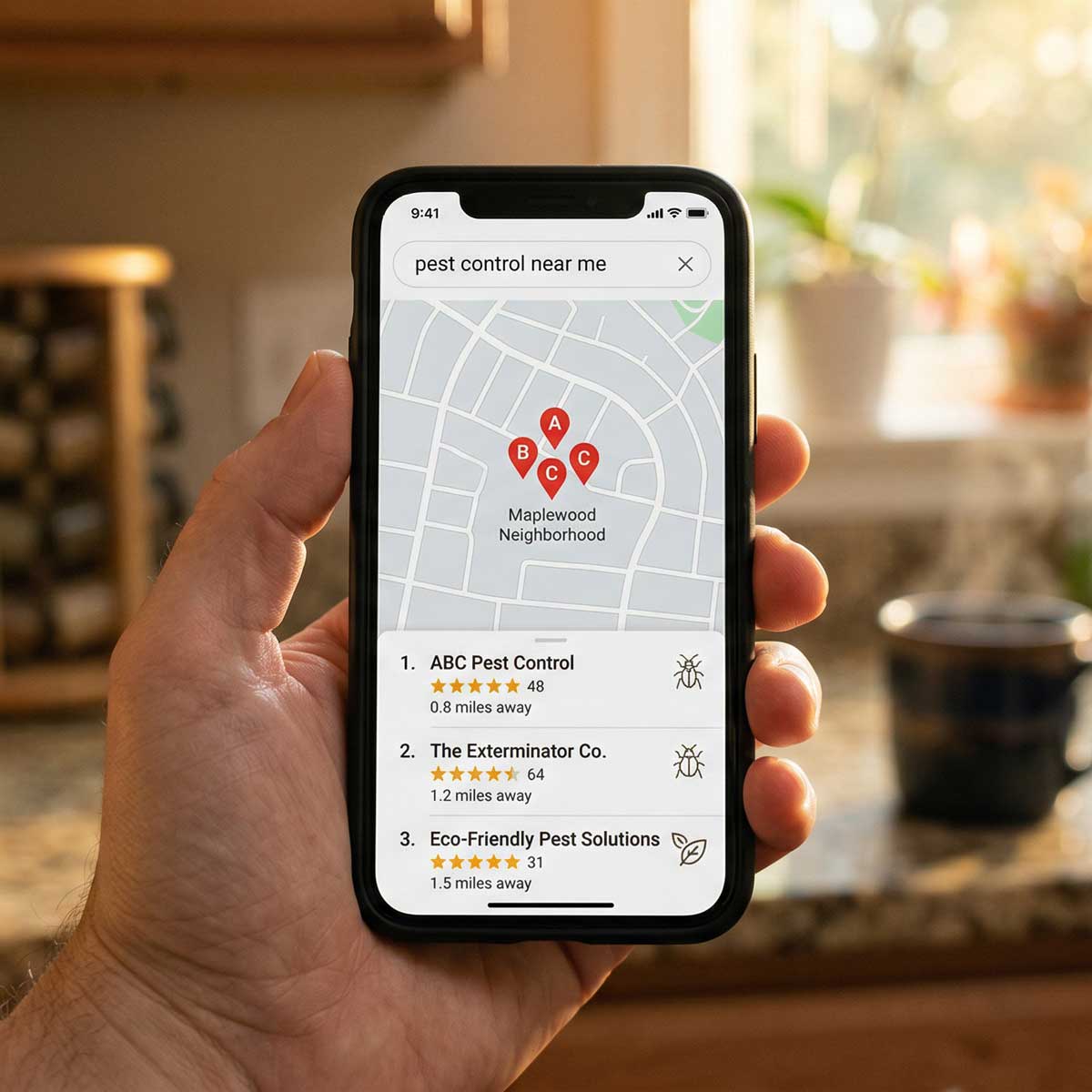
Local SEO is the set of practices that get your pest control business to appear in Google's Map Pack, Local Finder, and organic search results when homeowners and property managers search for service in your area. It is different from traditional SEO because the target is not a global audience. It is the person four miles from your shop who just found rodent droppings in their pantry.
The mechanics that govern local rankings are not the same as the ones that govern a national e-commerce site. Google uses a separate set of signals, a separate set of results (the Map Pack and Local Finder), and a separate understanding of intent. A search for "bed bug treatment" triggers the local algorithm. A search for "how long do bed bugs live" does not.
Why Pest Control Is Built for Local SEO
Pest control is one of the purest examples of a local search use case. The service is physical, the urgency is high, and the customer rarely researches more than three businesses before picking up the phone. Research by BrightLocal indicates 76% of consumers who conduct a "near me" search on their phone visit a related business within 24 hours, and 28% of those visits result in a purchase. In pest control, where the trigger is a live infestation, that ratio skews even higher.
The service-area model is also a perfect fit. Most pest control companies do not operate from a storefront customers ever visit. They dispatch technicians from a central office to jobs within a radius. Google's local algorithm treats service area businesses as first-class citizens, which means a pest control company can rank for a neighboring city without owning real estate there. That is a competitive weapon, but only if the pages are built correctly.
How Local Search Differs from Regular SEO
Regular SEO focuses on keyword relevance, backlinks, content depth, and technical health. Local SEO takes those factors and adds three more: proximity (how close is the business to the searcher), Google Business Profile optimization, and review and citation signals. The algorithms overlap, but the inputs weight differently.
In a Whitespark 2026 Local Search Ranking Factors analysis, Google Business Profile signals accounted for roughly 32% of ranking weight for Map Pack results, with review signals adding another 20%. On-page SEO, the dominant factor in regular search, accounted for only 15%. If you spend your marketing budget on a new website but ignore your GBP, you have optimized for the wrong half of the equation.