
Years ago, taking the background out of a photo used to be pretty frustrating work. You’d sigh before even starting because you knew it would eat up your time. It wasn’t rocket science, but the whole thing felt slow and irritating.
You’d load the picture into your editor, zoom right in, and try to trace the edges carefully. One tiny mistake and you were hitting undo, starting over again. Even on an easy image, ten or fifteen minutes could disappear just like that.
But things have changed a lot.
Now you simply upload the photo and within seconds the background is gone — neat and effortless. The better AI tools today are really impressive at spotting people, objects, and tricky details without any manual work from you.
Of course, not all of them are great. A few leave rough, jagged outlines, some soften the image too much, and others make you create an account before letting you test them.
That’s why it makes more sense to avoid jumping between tools and just use the reliable ones that give you solid results every time.

Time is short when you’re running a home service business, making social media content just one more task you don’t have time for. Between jobs, quotes, and customer calls, creating consistent content for your social media channels will likely slip through the cracks.
This is such a shame because the right content ideas can turn everyday work into powerful social media marketing. There's no need for complicated campaigns or viral trends. With the right approach, simple, practical social media post ideas for small business owners can build trust, visibility, and steady local leads.
Your pest control business doesn't need a Hollywood budget to win with video. What you need is the right format, the right platform, and a clear understanding of what actually drives leads and sales. Video has become the most trusted way customers find service businesses, and if your competitors are already creating videos while you're still relying on static images, you're leaving money on the table.
The data is undeniable:
Wyzowl found that video has helped 93% of marketers increase brand awareness, with 85% reporting that it directly generates leads. For pest control companies specifically, this means more people watching your content, more questions in your inbox, and more service calls booked. But not all videos are created equal. A random TikTok won't cut it any more than a poorly shot smartphone video will. As a pest control marketing partner, we've seen what works and what wastes time. This guide walks you through exactly which video types generate results, where to post them, and how to measure the return on your investment without breaking the bank.

Written By: Chad J. Treadway | April 21, 2026
Chad is a Partner and our Chief Smarketing Officer. He will help you survey your small business needs, educating you on your options before suggesting any solution. Chad is passionate about rural marketing in the United States and North Carolina. He also has several certifications through HubSpot to better assist you with your internet and inbound marketing.
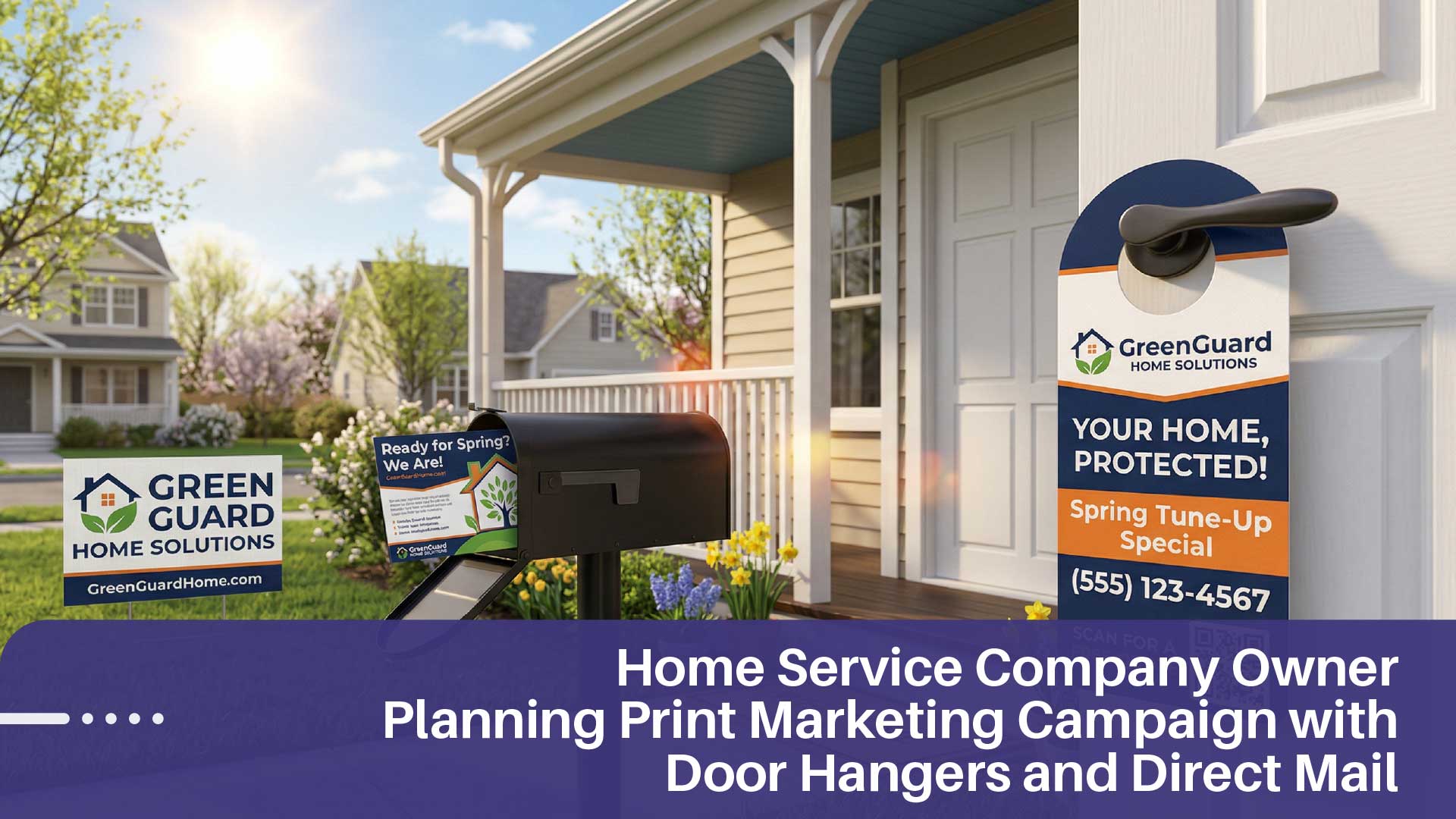
Here's something counterintuitive: in 2024, when everyone talks about digital marketing, print is making a comeback. And for home service companies, it's not nostalgia—it's ROI.
Your market is saturated with digital ads. Homeowners scroll past Google Ads, Facebook campaigns, and sponsored listings every day. But a well-designed door hanger on their doorknob or a personalized mailer in their mailbox? That's different. That's tangible. That's something they notice.
In this post, we'll cover why print marketing works for home service businesses like yours, which specific tactics (door hangers, yard signs, direct mail) deliver the best response rates, and how to integrate print with your digital strategy for 400% better results.
Why Is Print Marketing Effective for Home Service Companies?
Print marketing cuts through digital noise in ways paid ads can't. When you're competing against dozens of service companies online, print gives you a physical presence in a homeowner's world. It sits on their counter. It stays in their car. It isn't lost in an overstuffed inbox.
Data from the ANA Response Rate Report reveals that direct mail achieved a 161% average return on investment, significantly outpacing email (44%), digital display (23%), and paid social media (21%). For home service companies specifically, this matters because your customers (homeowners) are often in decision-making mode only when they need you—a burst pipe, a furnace failure, a roof leak. Direct mail gets your name in front of them right when they're searching for a solution.
Beyond ROI, there's psychology at work. Research compiled by PostcardMania shows that 86% of consumers say they genuinely like receiving direct mail (Lob, 2025), and 70% say mail gives them a better impression of the company than email (MarketReach, 2020). Even more telling, 39% of consumers have tried a business for the first time because of direct mail, according to the Data & Marketing Association.
How Door Hangers Drive Response Rates for Service Companies
Door hangers are the workhorse of print marketing for local service businesses. They're affordable, targeted, and impossible to ignore because they're literally hanging on someone's door. A homeowner can't accidentally delete a door hanger like an email. They either throw it away or keep it, and many keep it for weeks in a drawer or on the fridge.
Typical door hanger response rates for home service companies range from 1-3%, with best-in-class campaigns reaching 3-5% or higher. To put that in perspective, direct mail to house lists (your existing customers or people in your target area) achieves a 9% response rate, while email campaigns often hover around 5% or lower. Door hangers work because they're physical, local, and timely.
Research from ThinkFlyers shows that door hanger effectiveness increases dramatically with personalization. Industry data from Adzze found that personalized door hanger ads can drive up to 135% higher response rates compared with generic versions. That means a campaign pulling a typical 1.8% response could jump above 4% simply by addressing homeowners by name rather than using generic "Dear Neighbor" copy.
The best door hangers for home services include: a clear problem statement ("Is Your AC Running This Summer?"), a specific offer (discount, free inspection), a phone number that's easy to call, and a QR code linking to your website or appointment booking page. Design matters; a professionally printed door hanger works better than something that looks DIY.
Direct Mail Strategy for Service Area Expansion
Direct mail (postcard mailers and multi-page letters) works differently from door hangers. While door hangers hit a neighborhood in a few hours, direct mail reaches carefully selected lists of homeowners over days. This makes it ideal if you're expanding into a new service area or trying to reach homeowners in specific zip codes.
According to PostcardMania, direct mail response rates vary based on audience:
- House lists (existing customers or opted-in prospects): 5-9% response rate
- Cold prospect lists (demographics-matched homeowners): 4-5% response rate
Research from Postalytics confirms that adding a recipient's name to direct mail can increase response rates by up to 135%. Meanwhile, 88% of marketers say personalized direct mail significantly improves response rates (Lob, 2025).
For a growing service company like yours, these data points point to a strategy: start with your house list (past customers, people who called but didn't book). A personalized postcard offering a maintenance special or seasonal discount will pull a 6-9% response. Then expand to targeted purchased lists (age 45+, homeowners in your expansion zip codes) with a different offer to test the market.
Think of it like this: you wouldn't send the same estimate to every homeowner in your service area. You personalize the price, the service offered, and the timeline. Direct mail works the same way. The more you segment your list and customize your message, the better the response.
Yard Signs: Low-Cost Visibility for New Service Areas
Yard signs are often overlooked, but they're one of the most cost-effective ways to build visibility in new neighborhoods. A homeowner places a sign after a successful service (a new roof, a new AC system, a finished landscaping job), and that sign sits in their yard for weeks or months. Every neighbor sees it. Multiple times.
Yard signs work best in combination with other marketing. A homeowner gets a door hanger, you complete the job, they agree to display a sign, and now their neighbors associate your brand with quality work. It's a virtuous cycle that costs very little to maintain because the homeowner is your marketing asset.
The downside: you can't control where signs appear, and response rates are harder to track. But for brand building and increasing your company's visibility in a new area, yard signs are remarkably effective—especially when you ask customers to display them and incentivize them with a small discount or referral bonus.
Combining Print and Digital for 400% Better Results
Here's where print marketing gets really powerful: alone, it works. Combined with digital, it dominates.
Postalytics reports that campaigns combining print and digital marketing are 400% more effective than either channel alone. That means if you send a direct mailer to 1,000 homeowners in your expansion area, adding a digital remarketing campaign (Facebook ads, Google Ads to the same audience will more than quadruple your response.
Here's the practical application for your business: You drop 5,000 door hangers in a neighborhood. You design a Facebook ad targeting homeowners in that same zip code who fit your ideal customer profile. You run the Facebook campaign for 30-45 days, which overlaps with when homeowners find the door hanger. When they Google "plumbing near me" or "HVAC repair," they see your Google Ad. When they're on Facebook, they see your remarketing ad. That repeated exposure creates familiarity, which drives calls.
PostcardMania data shows that 57% of consumers visited the brand's website after receiving direct mail, especially when the mailer includes a URL or QR code. That website visit is your chance to show them your portfolio, read reviews, and book an appointment. If you're not running digital ads during that same window, you're leaving conversions on the table.
Additionally, Postalytics data shows that 82% of businesses increased their direct mail spending in 2024, suggesting that even in an increasingly digital world, savvy companies recognize print's unique role in a complete marketing strategy.
How to Implement a Print Marketing Campaign
Start small and test. Order 500-1,000 door hangers for one neighborhood. Include a trackable phone number or a unique QR code so you can measure response. Track which calls come from the door hanger campaign versus other sources. If the response meets or beats your expectations, expand to more neighborhoods.
For direct mail, consider starting with a postcard to your house list (past customers). A simple message—"We Saved You Money Last Time. Let's Do It Again."—with a seasonal offer, can generate quick wins. Measure the response, calculate your cost per lead, and decide if it justifies expanding to purchased lists.
Yard signs should be a longer-term play. Don't expect immediate ROI. Instead, ask customers to display signs and track how it affects your brand visibility and word-of-mouth referrals over 6-12 months.
For all three tactics, timing matters. Spring is the ideal window—homeowners are thinking about maintenance, repair, and upgrades as the season heats up. Door hangers, mailers, and yard signs placed in March-April hit homeowners right when they're evaluating options. That's why 82% of businesses are increasing direct mail spend—they're capitalizing on seasonal demand.
Should Your Service Company Use Print Marketing?
The data says yes. Print works especially well if you're a growing service company with a specific service area, a local or county-wide reach, and a customer base of homeowners (not commercial clients). If your competitors aren't using door hangers or direct mail, you have an advantage. If they are, you need to match their strategy and combine it with digital to stand out.
The key insight: print isn't meant to replace digital. It's meant to complement it. When a homeowner sees your door hanger, visits your Google Business Profile after searching online, sees your Facebook ad, and finally calls your number, that's three touchpoints in one integrated campaign. That's what 400% more effective means in real terms.
If you're ready to stop guessing and start seeing results, let's talk about building a print and digital strategy that fits your budget and your service area.
Frequently Asked Questions
{{FAQ}}
What's the Average Cost of a Direct Mail Campaign for Home Service Companies?
Direct mail costs depend on volume, design complexity, and list quality. Postcards typically run $0.50-$1.50 per piece all-in (design, printing, postage). A 5,000-piece campaign costs roughly $2,500-$7,500. Door hangers run $0.15-$0.50 per piece, including design and printing (you distribute them yourself), so 1,000 door hangers might cost $150-$500. Start with a small test to validate response rates before committing to larger volumes.
How Do I Measure the ROI of a Print Marketing Campaign?
Assign a unique phone number or QR code to each campaign, so calls and website visits are trackable. Use a simple formula: (Revenue from Campaign - Campaign Cost) / Campaign Cost = ROI %. For example, a $3,000 door hanger campaign that generates 20 jobs at $500 average value = $10,000 revenue minus $3,000 cost = $7,000 profit, or 233% ROI. Track for 60-90 days after distribution to capture delayed responses.
Should I Design My Own Direct Mail or Hire a Professional?
Professional design is worth the investment if you're spending more than $2,000 on a campaign. DIY designs often look cheap, which undercuts your brand positioning. For door hangers and postcards, a designer typically charges $300-$1,000, depending on revision rounds. That's 5-10% of your total campaign cost and significantly improves response rates. Your designer should research competitor materials in your area to position your piece to stand out.
Can I Target a Specific Neighborhood with Door Hangers?
Yes. Door hanger distribution is hyperlocal—you can target specific zip codes, neighborhoods, or even blocks. This makes them ideal for test campaigns or service area expansion. Work with a printing company that offers neighborhood maps or use a marketing service that handles distribution. The cost is low enough to test multiple neighborhoods simultaneously and identify which ones convert best.
When Is the Best Time to Launch a Print Marketing Campaign?
Spring (March-May) is peak season for home service marketing because homeowners are preparing for summer and addressing maintenance issues. Fall (September-October) works well for HVAC and heating companies. Avoid December-January when mailboxes are jammed with holiday promotions. Time your campaign to align with seasonal demand in your trade.
{{endFAQ}}
Written By: Chad J. Treadway | April 21, 2026
Chad is a Partner and our Chief Smarketing Officer. He will help you survey your small business needs, educating you on your options before suggesting any solution. Chad is passionate about rural marketing in the United States and North Carolina. He also has several certifications through HubSpot to better assist you with your internet and inbound marketing.